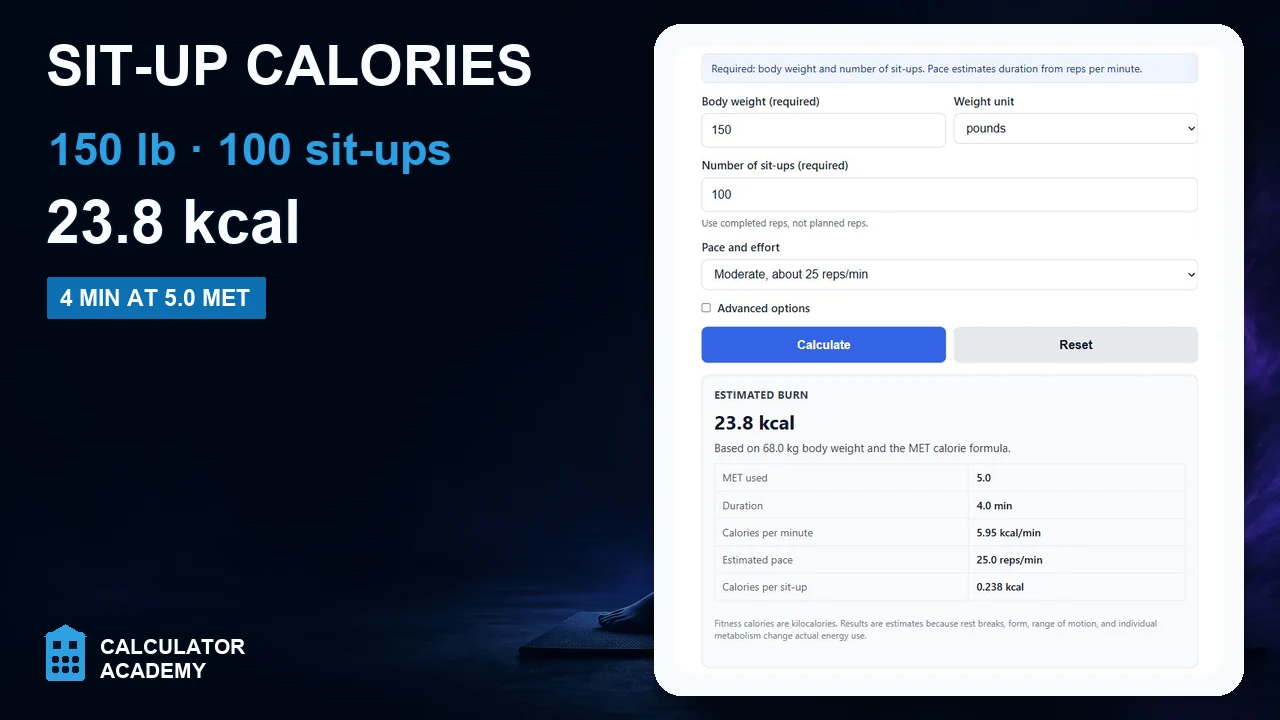
Estimate calories burned from sit-ups using your body weight, number of sit-ups and pace, or duration and intensity, with results in kcal.
Sit-Ups Calories Burned Estimation Formula
The standard method for estimating calories burned during sit-ups relies on the MET (Metabolic Equivalent of Task) system from the Compendium of Physical Activities. The Compendium assigns sit-ups code 02020 under conditioning exercises, with a baseline MET of 2.8 for light effort and up to 8.0 for vigorous effort.
- C = estimated total calories burned (kcal)
- MET = intensity level (metabolic equivalent of task)
- BWkg = body weight in kilograms (divide lbs by 2.2046)
- Min = duration in minutes
The 3.5 in the formula represents oxygen consumption in mL/kg/min at 1 MET (resting metabolic rate). This formula assumes a steady pace without extended rest breaks. Because sit-ups involve frequent starting and stopping, real-world calorie burn can deviate from the estimate by roughly 30-35%.
MET Values for Sit-Up Variations
Not all sit-ups burn the same number of calories. The intensity classification depends on pace, range of motion, and whether added resistance is used.
| Variation | MET | Approx. Pace (reps/min) | kcal/min (150 lb) |
|---|---|---|---|
| Slow crunches / light sit-ups | 2.8 | 10-15 | 3.3 |
| Standard sit-ups, moderate pace | 3.8 | 20-25 | 4.5 |
| Brisk sit-ups, no rest | 5.0 | 25-30 | 5.9 |
| Vigorous / weighted sit-ups | 8.0 | 30-35+ | 9.5 |
| Decline sit-ups (bench) | 5.0-8.0 | 15-25 | 5.9-9.5 |
Decline sit-ups performed on a bench at 30-45 degrees increase gravitational resistance, pushing the MET closer to vigorous levels even at slower rep speeds. Adding a weight plate (10-25 lbs held across the chest) has a similar effect.
Calories Burned by Body Weight (10 Minutes, Moderate Effort)
The following reference table shows estimated calories burned during 10 minutes of moderate-effort sit-ups (MET 5.0) at various body weights.
| Body Weight (lb) | Body Weight (kg) | kcal in 10 min |
|---|---|---|
| 120 | 54.4 | 48 |
| 140 | 63.5 | 56 |
| 160 | 72.6 | 63 |
| 180 | 81.6 | 71 |
| 200 | 90.7 | 79 |
| 220 | 99.8 | 87 |
| 250 | 113.4 | 99 |
Sit-Ups vs Other Core Exercises: Calorie Comparison
Sit-ups are one of several common core exercises. The table below compares estimated calorie burn rates alongside the primary muscles targeted. All values assume a 150 lb (68 kg) person working at moderate effort.
| Exercise | MET | kcal/min | Primary Muscles |
|---|---|---|---|
| Sit-ups | 3.8 | 4.5 | Rectus abdominis, hip flexors (iliopsoas, rectus femoris) |
| Crunches | 2.8 | 3.3 | Rectus abdominis (isolated), external obliques |
| Plank (static hold) | 3.0 | 3.5 | Transverse abdominis, obliques, erector spinae, glutes |
| Bicycle crunches | 4.0 | 4.7 | Rectus abdominis, obliques, hip flexors |
| Leg raises (lying) | 3.5 | 4.1 | Lower rectus abdominis, hip flexors |
| Mountain climbers | 8.0 | 9.5 | Full core, hip flexors, deltoids, quads |
| Burpees | 8.0 | 9.5 | Full body (core, chest, legs, shoulders) |
Sit-ups burn roughly 35% more calories per minute than crunches because they use a larger range of motion and recruit the hip flexors in addition to the abdominals. However, crunches isolate the rectus abdominis more effectively and place less load on the lumbar spine. For pure calorie burn, compound movements like mountain climbers or burpees outpace sit-ups by about 2x.
Muscles Activated During a Sit-Up
A standard sit-up involves two phases of movement. During the initial 30 degrees of trunk flexion (the "crunch" phase), the rectus abdominis and external obliques do most of the work, curling the ribcage toward the pelvis. Once the spine is fully flexed, the hip flexors (primarily the iliopsoas and rectus femoris) take over to pull the torso up to the knees. The transverse abdominis and internal obliques provide stabilization throughout.
EMG studies show that anchoring the feet increases hip flexor activation by approximately 20-30% compared to unanchored sit-ups, which shifts more demand onto the abdominals. Bending the knees reduces rectus femoris involvement but does not eliminate it.
Calories Burned per Sit-Up Rep
A single sit-up burns approximately 0.15 to 0.40 kcal depending on body weight and pace. At a moderate pace (25 reps/min), a 150 lb person completes each rep in about 2.4 seconds and burns roughly 0.18 kcal per rep. At vigorous effort (35 reps/min), each rep takes about 1.7 seconds and burns closer to 0.27 kcal because the higher MET compensates for the shorter duration per rep.
| Number of Sit-Ups | kcal (120 lb) | kcal (150 lb) | kcal (180 lb) | kcal (200 lb) |
|---|---|---|---|---|
| 25 | 3 | 4 | 5 | 6 |
| 50 | 6 | 9 | 10 | 12 |
| 100 | 13 | 18 | 21 | 24 |
| 200 | 26 | 36 | 43 | 47 |
| 500 | 65 | 89 | 107 | 118 |
Based on MET 5.0 at 25 reps/min. Actual values vary with pace and rest intervals.
Example Calculation
A 180 lb person does sit-ups for 10 minutes at moderate effort (MET = 5).
Step 1: Convert weight to kg. 180 / 2.2046 = 81.65 kg.
Step 2: Plug into the formula. C = 5 x 3.5 x 81.65 / 200 x 10.
Step 3: Solve. C = 17.5 x 81.65 / 200 x 10 = 1428.9 / 200 x 10 = 7.14 x 10 = 71.4 kcal.
At 25 reps/min, that 10-minute session is approximately 250 sit-ups for 71 kcal, or about 0.29 kcal per rep.
Accuracy Limitations
MET-based calorie estimates for sit-ups carry a margin of error around 30-35%. Several factors push actual burn higher or lower than the calculated value: rest time between sets, partial range of motion, holding a weight plate, using a decline bench, anchored vs. unanchored feet, and individual metabolic differences (age, muscle mass, fitness level). The MET formula also does not account for the afterburn effect (excess post-exercise oxygen consumption, or EPOC), which adds a small number of additional calories in the hours after the workout.
Sit-Ups and Fat Loss
Spot reduction (losing fat specifically from the abdomen by doing sit-ups) is not supported by research. A 2011 study published in the Journal of Strength and Conditioning Research had participants perform abdominal exercises 5 days per week for 6 weeks and found no reduction in abdominal subcutaneous fat compared to a control group. Sit-ups strengthen the rectus abdominis and hip flexors but do not preferentially mobilize abdominal fat stores. Fat loss requires a sustained caloric deficit, and sit-ups alone burn relatively few calories compared to compound movements or cardiovascular exercise. They are best used as one component within a broader training program.
FAQ
How many sit-ups do I need to burn 100 calories?
For a 150 lb person at moderate pace (MET 5.0, 25 reps/min), burning 100 calories takes approximately 17 minutes or about 425 sit-ups. A 200 lb person reaches 100 kcal faster, around 13 minutes or 325 reps, because higher body weight increases energy expenditure at the same MET level.
Do sit-ups burn belly fat?
Sit-ups strengthen abdominal muscles but do not selectively burn belly fat. Research consistently shows that spot reduction is a myth. Reducing body fat in any specific area requires an overall caloric deficit achieved through a combination of diet, cardiovascular exercise, and resistance training.
Are sit-ups or crunches better for burning calories?
Sit-ups burn roughly 35% more calories per minute than crunches (MET 3.8 vs 2.8 at moderate effort). The larger range of motion and hip flexor recruitment accounts for the difference. Crunches isolate the upper rectus abdominis more effectively and place less compressive force on the lumbar discs. For calorie burn, sit-ups win. For targeted ab strengthening with lower back strain, crunches have an advantage.
What MET value should I use for sit-ups?
The Compendium of Physical Activities lists sit-ups and crunches under code 02020 with a base MET of 2.8 for light effort. For a typical steady-pace workout, MET 3.8-5.0 is appropriate. For high-intensity sets with minimal rest, or weighted/decline sit-ups, MET 8.0 better reflects the actual demand.
Why do heavier people burn more calories doing sit-ups?
Body weight is directly proportional to calorie burn in the MET formula. A heavier person requires more energy to lift their torso against gravity during each rep. A 200 lb person burns about 33% more calories than a 150 lb person doing the same sit-up routine at the same intensity and duration.