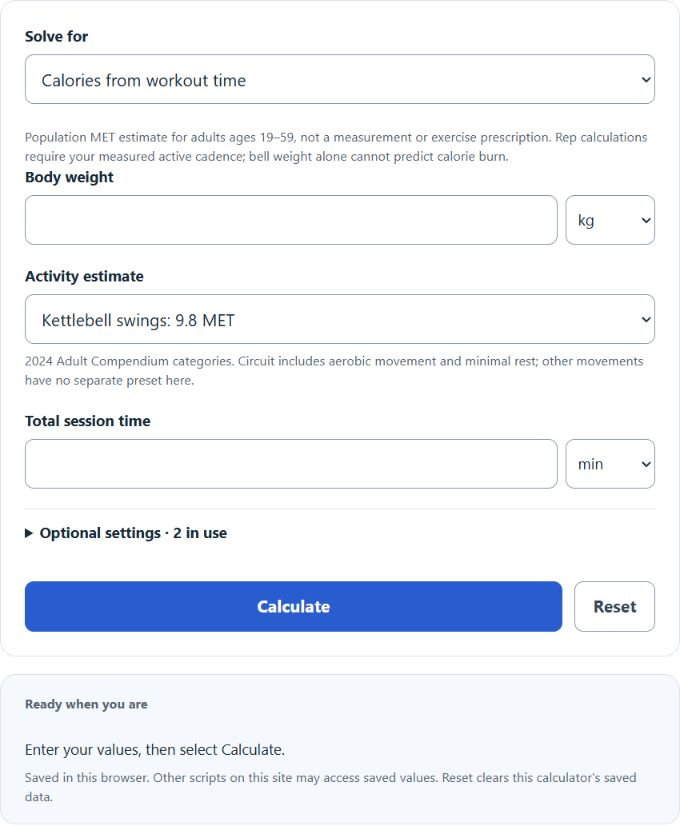
Estimate calories burned in a kettlebell workout or doing kettlebell swings from your body weight and workout minutes or rep count, such as 100 swings.
Kettlebell training combines repeated full-body effort with variable technique, cadence and rest. Population MET estimates cannot establish an individual calorie-per-rep ranking between movements.
Kettlebell Calories Formula
Estimated gross kcal = average MET × 3.5 × body weight (kg) ÷ 200 × session minutes. This oxygen-based approximation assumes 3.5 mL oxygen/kg/min per MET and 5 kcal/L oxygen. The simpler Compendium convention MET × kg × hours gives results about 5% lower; use one convention consistently. These are adult population estimates, not individual measurements.
The 2024 Adult Compendium lists kettlebell swings at 9.8 MET, vigorous circuit training including kettlebells and aerobic movement with minimal rest at 7.5 MET, and vigorous resistance training at 6 MET. Its adult scope is ages 19–59. Choose a matching activity or enter a suitable custom MET; no separate calorie coefficients are assumed for snatches, cleans, presses, squats or get-ups.
If active and rest intervals are modeled separately, average MET = active MET × active share + rest MET × (1 − active share). The default active share is 100%; the optional 1.5 rest MET is a planning assumption. Do not count rest twice when using a whole-session MET. Net energy subtracts one standardized resting MET, which need not equal your actual resting metabolic rate.
How to Calculate Kettlebell Calories
- Select calories from time, calories from reps and measured cadence, minutes for a gross calorie goal, or reps for a gross calorie goal.
- Enter body weight and choose a matching activity estimate. Enter total session time, or actual repetitions and measured active reps per minute. Bell weight alone cannot determine energy expenditure.
- For intervals, enter the actual active share and a defensible rest MET. Optional positive sets and reps per set replace total reps only when both are supplied.
- For a goal, use the result as a mathematical estimate, not a safe exercise prescription. Goal repetitions round up to a whole rep. Optional bell weight adds load × repetitions only; optional weekly and monthly totals repeat the modeled session without predicting fat loss.
Example and Session Benchmarks
A 70 kg adult doing 20 active minutes of kettlebell swings at 9.8 MET has an estimated gross expenditure of 9.8 × 3.5 × 70 ÷ 200 × 20 = 240.1 kcal under this convention. At 20 measured active reps/min, 100 swings take 5 active minutes and correspond to about 60.03 kcal with the same assumptions. These are model examples, not measured burn rates or recommended sessions.
- 70 kg, 20 minutes of 9.8 MET swings with all time active: approximately 240.1 gross kcal.
- 70 kg, 20 minutes of a matching 7.5 MET vigorous kettlebell circuit: approximately 183.75 gross kcal.
- 70 kg, 20 total minutes with 50% active swings at 9.8 MET and 50% rest at an assumed 1.5 MET: approximately 138.43 gross kcal.
Frequently Asked Questions
How many kettlebell swings burn 100 calories?
There is no universal calories-per-swing value. At 70 kg, 9.8 MET, 20 measured active reps/min and no separately counted rests, the model rounds up to 167 swings for a 100 gross-kcal goal. Changing measured cadence, actual intensity or rest changes the estimate.
Do heavier kettlebells automatically increase the result?
No. A heavier bell may change actual effort, technique and cadence, but this MET estimator does not use an unsupported linear bell-weight calorie coefficient. Optional bell weight calculates load × repetitions only.
Which movement burns most per rep?
The calculator does not rank movements with invented multipliers. Use measured duration/cadence and a suitable activity MET. Movement range, work, rest and personal physiology all affect actual expenditure.
Does an easy or hard pace apply a fixed percentage?
No. The former pace multipliers and default RPMs were removed. Select a defensible MET category and enter measured cadence for rep calculations. Results do not promise a fixed accuracy range or a fat-loss outcome.