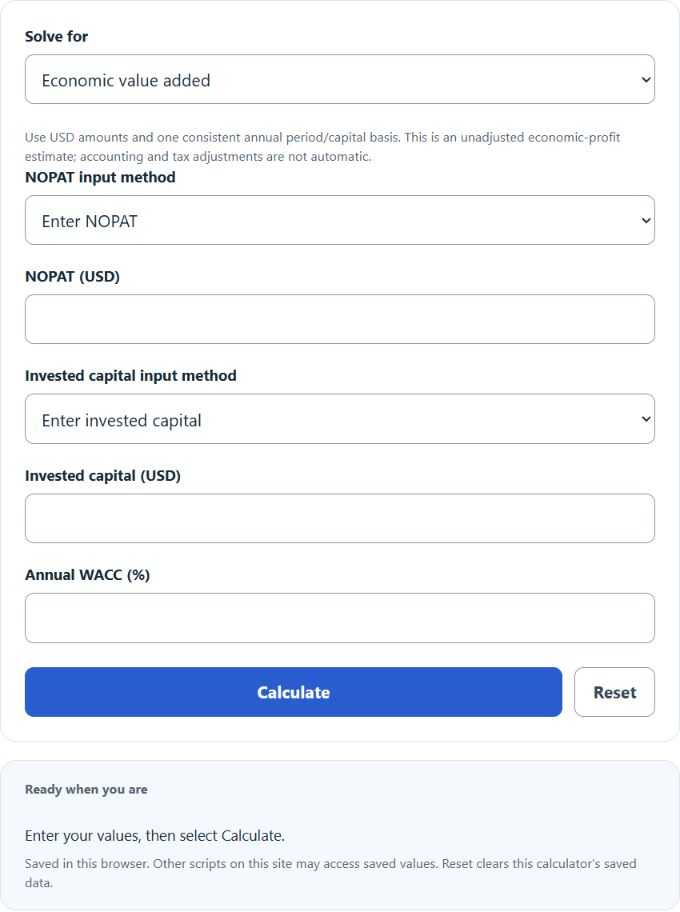
Calculate economic value added (EVA) from NOPAT, invested capital, and WACC, plus the required NOPAT or break-even WACC for any target.
Economic Value Added (EVA) Formula
EVA = NOPAT - (IC * WACC)
- EVA is the economic value added ($)
- NOPAT is the net operating profit after tax ($)
- IC is the invested capital ($)
- WACC is the weighted average cost of capital (%, entered as a percentage and applied as a decimal)
The term IC * WACC is called the capital charge. It is the minimum dollar return that lenders and shareholders require on the capital they provided. EVA is whatever operating profit remains after that charge is paid, which is why it is often called economic profit. If you do not have NOPAT or invested capital directly, the calculator derives them from these supporting formulas:
NOPAT = EBIT * (1 - t)
IC = Adjusted Operating Assets - Non-interest-bearing Operating Liabilities
Here t is the effective tax rate as a decimal. The calculator has three modes. The default mode solves for EVA from NOPAT, invested capital, and WACC, and also reports the capital charge, the return on invested capital (ROIC = NOPAT / IC), and the EVA spread (ROIC - WACC). The second mode solves the formula backwards for the NOPAT required to hit a target EVA, which is useful when setting profit goals for a division. The third mode finds the break-even WACC, the highest cost of capital the company can carry before EVA turns negative. That break-even rate is mathematically equal to ROIC, since EVA is zero exactly when ROIC equals WACC.
EVA Spread Benchmarks and Common Adjustments
The EVA spread (ROIC minus WACC) is the easiest way to compare value creation across companies of different sizes, because it strips out the effect of scale. The table gives illustrative descriptions, not universal valuation thresholds or investment recommendations. Spreads are differences in percentage points.
| EVA spread (ROIC - WACC) | Interpretation |
|---|---|
| Above +5% | Strong value creation, often a sign of a durable competitive advantage |
| +2% to +5% | Solid value creation above the cost of capital |
| 0% to +2% | Marginal value creation, sensitive to small errors in the WACC estimate |
| -2% to 0% | Mild value destruction, capital is nearly but not fully earning its keep |
| Below -2% | Significant value destruction, capital would likely earn more elsewhere |
Analysts who apply EVA rigorously also adjust the raw accounting figures before running the formula. These adjustments, popularized by Stern Stewart, move items that behave like investments out of expenses and into invested capital so the capital charge reflects reality:
| Adjustment | What to do | Why |
|---|---|---|
| R&D expense | Use a consistent after-tax capitalization and amortization adjustment in both NOPAT and invested capital | R&D is an investment in future returns, not a period cost |
| Operating leases | Reconcile lease assets, debt and operating profit to the accounting basis used; avoid double-counting recognized leases | Leases finance assets the same way debt does |
| Non-recurring charges | Remove one-time gains and losses from NOPAT | One-offs distort recurring operating performance |
| Excess cash | Subtract cash beyond operating needs from invested capital | Idle cash is not employed in operations, so it should not incur a capital charge |
| LIFO reserve | Add the LIFO reserve to invested capital | Restates inventory closer to current replacement cost |
Example Problems
Example 1: solving for EVA. A manufacturer reports NOPAT of $500,000 on invested capital of $3,000,000, and its WACC is 9%. The capital charge is 3,000,000 * 0.09 = $270,000. EVA = 500,000 - 270,000 = $230,000. ROIC is 500,000 / 3,000,000 = 16.67%, so the EVA spread is 16.67% - 9% = 7.67%. The company earns well above its cost of capital and is creating value.
Example 2: solving for the break-even WACC. A distributor has EBIT of $950,000 and pays an effective tax rate of 21%, so NOPAT = 950,000 * (1 - 0.21) = $750,500. Its invested capital is $6,500,000. The break-even WACC is 750,500 / 6,500,000 = 11.55%. As long as the company can raise capital for less than 11.55%, its EVA stays positive. If rising interest rates push its WACC past that level, it starts destroying value even though its accounting profit is unchanged.
Economic Value Added FAQs
Is EVA the same as economic profit? Conceptually yes. Both measure profit after subtracting a charge for all capital, including equity. EVA is a registered performance-measure trademark associated with Stern Value Management, which pairs the basic formula with the accounting adjustments shown above. If you run the formula on unadjusted financial statements, the result is usually called economic profit or residual income, and the calculator works for either version.
What should I use for invested capital? The supporting asset-side estimate uses adjusted operating assets minus non-interest-bearing operating liabilities; interest-bearing debt must not be subtracted as an operating liability. A financing-side estimate starts with interest-bearing debt plus equity, with consistent nonoperating-asset and other accounting adjustments. Whichever definition you choose, use it consistently across periods and across the companies you compare, because switching definitions changes the capital charge and makes EVA figures incomparable.
Why can a profitable company have a negative EVA? Net income only subtracts the explicit cost of debt (interest). It treats equity as free, but shareholders expect a return too. A company earning $1 million of NOPAT on $20 million of capital at a 10% WACC faces a $2 million capital charge, so its EVA is -$1 million despite positive earnings. The capital tied up in the business could earn more elsewhere, which is exactly the signal EVA is designed to surface.