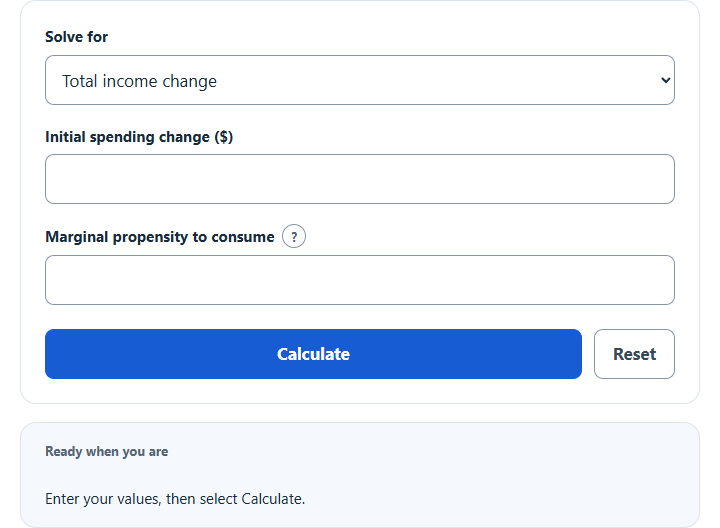
Calculate the spending multiplier from the MPC and the total income change from an initial spending change, or solve for MPC or initial spending.
- All Business Calculators
- Multiplier Effect Calculator
- EPQ (Economic Production Quantity) Calculator
- Economic Equilibrium Calculator
Economics Multiplier Formula
The following formula is used to calculate the economics multiplier effect.
Variables:
- M is the spending multiplier (unitless); total income change equals initial spending change multiplied by M
- MPC is the marginal propensity to consume (0 ≤ MPC < 1)
To calculate the multiplier effect, divide one by the difference between one and the marginal propensity to consume (MPC).
What is the Economics Multiplier?
The economics multiplier refers to the proportional amount of increase, or decrease, in final income that results from an injection, or withdrawal, of spending. The concept is a key component of Keynesian economics and illustrates how the economy can amplify the effects of changes in spending.
How to Calculate the Economics Multiplier?
The following steps outline how to calculate the Economics Multiplier.
- First, determine the initial change in spending.
- Next, determine the marginal propensity to consume (MPC). This decimal must be at least 0 and less than 1.
- Use the formula M = 1 / (1 - MPC) to calculate the multiplier effect.
- Finally, multiply the initial change in spending by the multiplier to find the total impact on the economy.
- After inserting the variables and calculating the result, check your answer with the calculator above.
Example Problem :
Use the following variables as an example problem to test your knowledge.
Initial Change in Spending = $500
Marginal Propensity to Consume (MPC) = 0.8