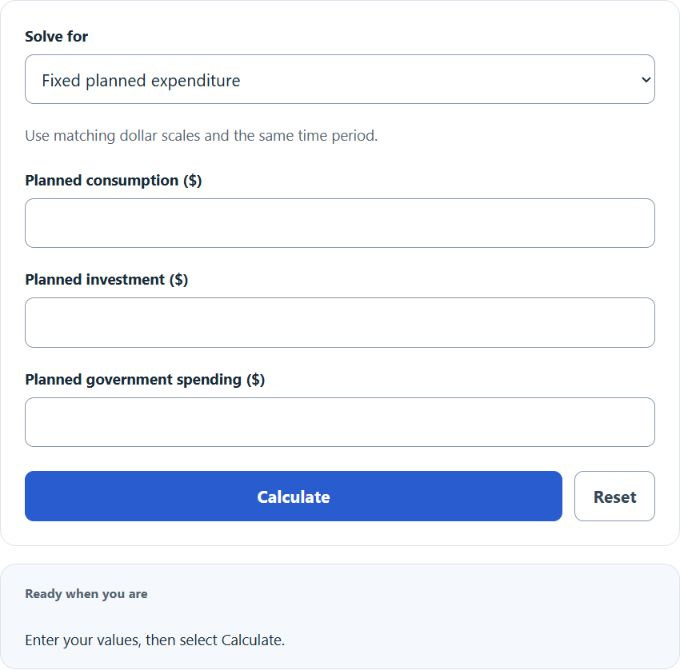
Calculate equilibrium income, output, and spending multipliers from consumption, investment, government spending, MPC, and tax rates.
Related Calculators
- Price Increase Calculator
- Retail Margin Calculator
- Target Profit Calculator
- Total Price Calculator
- All Business Calculators
Economic Equilibrium Formula
The following formula can be used to calculate equilibrium income/output in the simplest Keynesian-cross model where planned spending is treated as fixed (no taxes, no net exports/trade, and consumption is not modeled as a function of income).
- Where Y* is equilibrium aggregate income/output ($)
- C is total (planned) consumption spending ($)
- I is total (planned) investment spending ($)
- G is total (planned) government spending ($)
To calculate equilibrium income in this simplified model, sum consumption, investment, and government spending. In more complete models, consumption depends on income (and taxes), and an open-economy income identity includes net exports (NX); choose the Keynesian cross mode for proportional taxes and constant net exports.
Economic Equilibrium Definition
What is an economic equilibrium?
Economic equilibrium is a situation in which there is no tendency for key economic variables to change. In the Keynesian-cross framework, “equilibrium income/output” occurs when planned aggregate expenditure equals actual output (planned spending equals production), so there is no unplanned inventory buildup or drawdown.
“Market equilibrium” usually refers to a single market (one product/industry) where quantity supplied equals quantity demanded. “Macroeconomic equilibrium” refers to economy-wide conditions (for example, planned total spending equaling total output).
Example Problem
How to calculate economic equilibrium?
The following steps and information are required to calculate the equilibrium income/output of an economy in the simplified closed-economy model (no taxes or trade) where C, I, and G are treated as fixed planned expenditures.
First, determine total consumption. In this example, total consumption is measured to be $100,000.00. We will be using smaller numbers than realistic for this example so that the calculations and number of digits are made simpler.
Next, determine total government spending. For this economy, the government spends $50,000.00.
Next, determine total investment expenditure. This is found to be $30,000.00 for this problem.
Finally, calculate equilibrium income/output using the formula above:
Y* = C + I + G
Y* = $100,000 + $30,000 + $50,000
Y* = $180,000.00