Calculate retail gross margin and markup, reverse-plan a target selling price or cost ceiling, and review quantity profit, overhead break-even, and price sensitivity.
- All Margin Calculators
- Markup to Margin Calculator
- All Business Calculators
- Net Profit Margin Calculator
- Wholesale Price Calculator
- Distributor Margin Calculator
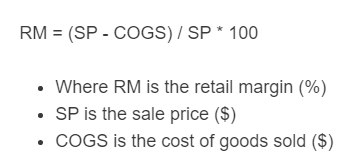
Retail Margin Formula
Retail margin measures the percentage of each sales dollar that remains after covering the cost of goods sold (COGS). It is a gross profit metric, not a net profit metric.
- RM = retail margin percentage
- SP = sale price
- COGS = cost of goods sold
The dollar profit behind the margin is:
Because margin uses sale price as the denominator, it shows how much of revenue is left after direct product cost is covered.
Rearranged Formula
If you know your cost and target margin, the required selling price is:
If you know the sale price and margin, the allowable cost is:
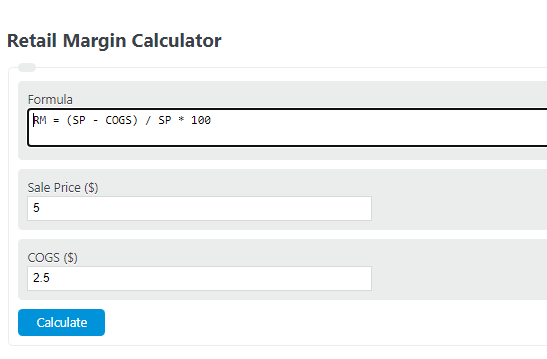
How to Use the Retail Margin Calculator
- Enter the sale price of the item.
- Enter the COGS, including the direct cost to buy or produce the item.
- Calculate to find the retail margin percentage and gross profit.
- If you are pricing forward, use your target margin to solve for the selling price needed to hit that goal.
Example Calculation
If an item sells for $100 and the cost of goods sold is $55, then the gross profit is $45 and the retail margin is:
This means $0.45 of every $1.00 in sales remains after the product cost is covered.
Retail Margin vs. Markup
Retail margin and markup are related, but they are not interchangeable:
- Margin compares profit to sale price.
- Markup compares profit to cost.
To convert between them:
A common mistake is assuming a 50% markup equals a 50% margin. It does not. A 50% markup corresponds to a 33.33% margin.
Quick Pricing Reference
| Target Margin | Required Sale Price Multiple of COGS | Sale Price if COGS = $50 |
|---|---|---|
| 10% | 1.1111x | $55.56 |
| 20% | 1.25x | $62.50 |
| 25% | 1.3333x | $66.67 |
| 30% | 1.4286x | $71.43 |
| 40% | 1.6667x | $83.33 |
| 50% | 2.00x | $100.00 |
| 60% | 2.50x | $125.00 |
Higher target margins require disproportionately larger price increases, especially once you move above 40% to 50% margin.
Discount Impact on Margin
Discounts compress margin quickly because the selling price falls while cost usually stays fixed. If a discount rate of d is applied, the new selling price and margin become:
This is why promotions should be checked against margin before they are launched.
How to Interpret the Result
- Positive margin: the item sells above cost.
- 0% margin: the sale price equals COGS.
- Negative margin: the item is selling below cost.
- Higher margin: more gross profit per dollar of revenue, assuming sales volume stays stable.
What Should Be Included in COGS?
For a realistic margin calculation, COGS should reflect the direct cost of the item being sold. Depending on the business, that may include:
- Purchase or manufacturing cost
- Inbound freight or shipping
- Packaging tied directly to the unit
- Duties or import fees
- Other direct landed costs
Leaving out direct costs makes margin appear stronger than it really is.
Common Mistakes
- Using markup when the goal is to find margin.
- Dividing by cost instead of sale price.
- Ignoring discounts, coupons, or returns when evaluating actual selling price.
- Excluding direct landed costs from COGS.
- Looking only at percentage margin and not at gross profit dollars.
Retail Margin FAQ
- Is retail margin the same as gross margin?
- In retail pricing, retail margin usually refers to gross margin at the item or sales level.
- Can retail margin be negative?
- Yes. A negative margin means the item is being sold for less than its cost.
- Can margin be 100%?
- Only if the item has zero cost. In normal situations, margin is below 100%.
- Should operating expenses be included?
- No. Retail margin only considers sales revenue and direct product cost. Operating expenses are analyzed separately.