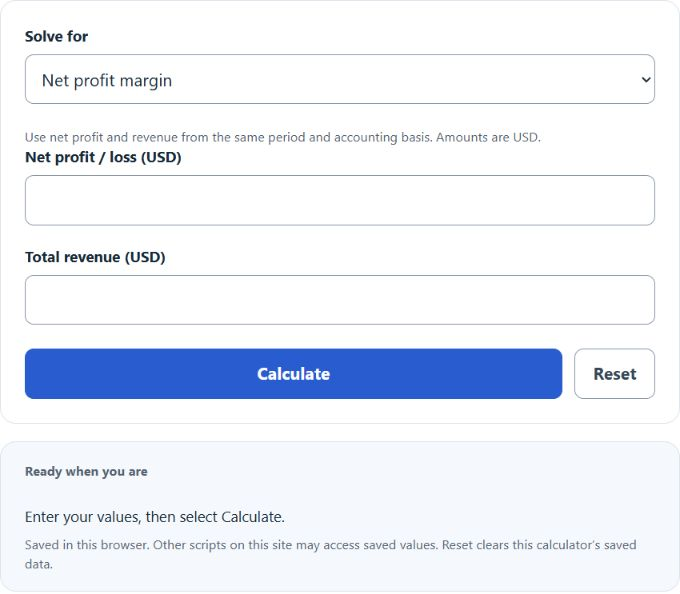
Calculate net profit margin, net profit, or total revenue from any two values and find the missing result in dollars or percent.
- All Business Calculators
- All Profit Calculators
- All Margin Calculators
- Growth Rate Calculator
- Daily Interest Calculator
- Internal Rate of Return Calculator
- Target Profit Calculator
Net Profit Margin Guide
Net profit margin measures how much of each sales dollar remains after all expenses have been paid. It is one of the clearest profitability ratios because it converts profit into a percentage of revenue, making it easier to compare results across different time periods, products, or business units.
Net Profit Margin Formula
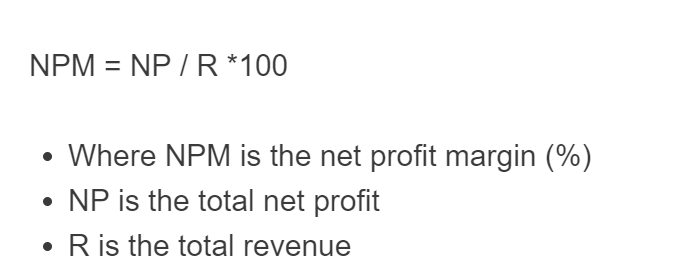
Where:
| Variable | Meaning | Practical Note |
|---|---|---|
| NPM | Net Profit Margin | Expressed as a percentage |
| NP | Net Profit | Revenue minus all business expenses |
| R | Total Revenue | Total sales for the same period |
Useful Rearrangements
If you know any two values, you can solve for the third:
How to Use the Calculator Correctly
- Enter net profit for a specific period such as a month, quarter, or year.
- Enter total revenue for that exact same period.
- Calculate the result to find the percentage of revenue kept as profit.
Important: Revenue and profit must come from the same time frame. If revenue is zero, net profit margin cannot be calculated.
What Counts in Net Profit?
Net profit is the amount left after subtracting all relevant costs from revenue. Depending on the context, this commonly includes:
- Cost of goods sold
- Payroll and labor
- Rent, software, and overhead
- Marketing and administrative costs
- Interest expense
- Taxes
- Other operating and non-operating expenses
How to Interpret the Result
| Margin Result | What It Means | Simple Interpretation |
|---|---|---|
| Negative | The business lost money | Costs were greater than revenue |
| 0% | Break-even | No profit and no loss |
| Positive | The business earned a profit | A portion of each sales dollar was kept |
| Higher positive margin | Stronger profitability | More revenue is being converted into profit |
A 12% net profit margin means the business keeps $0.12 of profit for every $1.00 of revenue. A -5% margin means it loses $0.05 for every $1.00 sold.
Quick Examples
| Net Profit | Revenue | Net Profit Margin | Meaning |
|---|---|---|---|
| $18,000 | $120,000 | 15% | Keeps $0.15 per $1 of revenue |
| $0 | $85,000 | 0% | Break-even period |
| -$3,000 | $60,000 | -5% | Loses $0.05 per $1 of revenue |
Net Profit Margin vs. Other Margin Metrics
| Metric | Focus | Best Use |
|---|---|---|
| Gross Margin | Revenue after direct production costs | Pricing and product profitability |
| Operating Margin | Profit from core operations | Operational efficiency |
| Net Profit Margin | Profit after all expenses | Overall profitability |
Common Mistakes
- Using gross profit instead of net profit
- Mixing monthly revenue with yearly profit
- Dividing profit by cost instead of revenue
- Ignoring taxes, interest, or overhead in net profit
- Trying to calculate margin when revenue is zero
How to Improve Net Profit Margin
- Increase prices where demand supports it
- Reduce direct costs and supplier expenses
- Cut low-value overhead and recurring subscriptions
- Improve labor efficiency and capacity utilization
- Shift sales toward higher-margin products or services
- Reduce returns, waste, and discounting
FAQ
Can net profit margin be negative?
Yes. A negative margin means total expenses exceeded revenue for that period.
Is a higher net profit margin always better?
In general, yes, but the most useful comparison is against the same business over time or against similar businesses in the same industry.
How often should net profit margin be tracked?
Monthly for ongoing management, quarterly for trend review, and annually for long-term performance analysis.