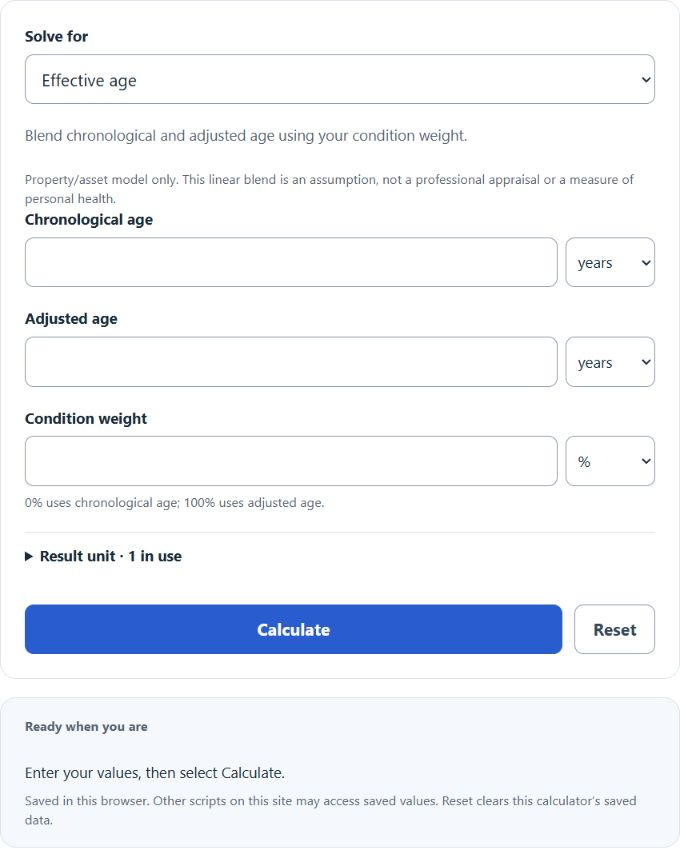
Choose the age or condition weight to solve for, then enter the other three values. This simplified property model supports years, months, days, percent, and decimal weights.
Effective Age Formula
The following simplified formula estimates an effective age by blending a chronological age and an adjusted age estimate using a condition rating.
Note: In professional property appraisal, “effective age” is typically estimated from observed condition/depreciation and remaining economic life; there is not a single universal formula used in all cases. The equation above is a simple linear model.
Variables:
- EA is the effective age
- CA is the chronological age (time since construction/manufacture)
- AA is the adjusted age estimate (an “as-new-equivalent” age based on upgrades/maintenance)
- CR is the condition rating (in percent). In this model, 0% gives EA = CA and 100% gives EA = AA.
To calculate the effective age with this model, subtract the product of (CA − AA) and (CR/100) from the chronological age CA.
What is Effective Age?
Effective age is a measure used to estimate the age of an asset, such as a building or piece of equipment, based on its condition and performance rather than only the time since it was built. This concept is commonly used in property appraisal and asset management to help describe an asset’s apparent age and remaining useful life. Effective age can be lower than chronological age when maintenance or upgrades keep an asset in better-than-typical condition, or higher when condition is poor.
How to Calculate Effective Age?
The following steps outline how to calculate the Effective Age using the simplified model shown above.
- Determine the chronological age (CA) of the asset (time since construction/manufacture).
- Estimate an adjusted age (AA), such as an “as-new-equivalent” age reflecting maintenance/renovations.
- Choose a condition weight (CR) from 0% to 100% (0% gives EA = CA; 100% gives EA = AA). This weight is a model input, not a standardized appraisal rating.
- Calculate the effective age (EA) using the formula EA = CA - (CA - AA) * (CR / 100).
- After inserting the values and calculating the result, check your answer with the calculator above.
Example Problem :
Use the following variables as an example problem to test your knowledge.
Chronological Age (CA) = 20 years
Adjusted Age (AA) = 15 years
Condition Rating (CR) = 80%
Effective Age (EA) = 20 - (20 - 15) × (80/100) = 20 - 4 = 16 years