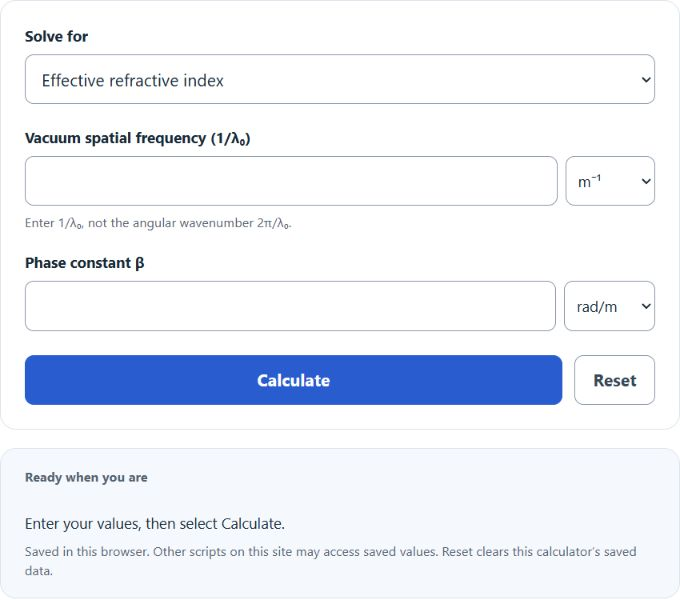
Calculate effective refractive index, wavenumber, or phase constant from the other two values using the wave propagation formulas.
Related Calculators
- Critical Angle Calculator
- Effective Permittivity Calculator
- Transmission Coefficient Calculator
- Angular Frequency Calculator
- All Physics Calculators
Effective Refractive Index Formula
The calculator uses the relationship between effective refractive index, vacuum spatial frequency 1/λ₀, and phase constant. The conventional angular vacuum wavenumber is k₀ = 2π/λ₀; this calculator’s input k means 1/λ₀:
Rearranged to solve each missing value:
- β = phase constant, usually in rad/m
- n_eff = effective refractive index, unitless
- k = wavenumber entered as 1/λ0, usually in m-1
- pi = π, approximately 3.14159
To calculate the effective refractive index, enter the wavenumber and phase constant. To calculate the phase constant, enter the effective refractive index and wavenumber. To calculate the wavenumber, enter the effective refractive index and phase constant. The calculator converts cm-1, mm-1, rad/cm, and rad/mm into base SI units before applying the formula.
Common Unit Conversions for Wavenumber and Phase Constant
| Quantity | Entered unit | Base unit conversion |
|---|---|---|
| Wavenumber | m-1 | 1 m-1 = 1 m-1 |
| Wavenumber | cm-1 | 1 cm-1 = 100 m-1 |
| Wavenumber | mm-1 | 1 mm-1 = 1000 m-1 |
| Phase constant | rad/m | 1 rad/m = 1 rad/m |
| Phase constant | rad/cm | 1 rad/cm = 100 rad/m |
| Phase constant | rad/mm | 1 rad/mm = 1000 rad/m |
Typical Effective Refractive Index Ranges
| Waveguide or medium type | Typical neff range | Notes |
|---|---|---|
| Air or weakly guided field | Near 1.0 | The mode behaves close to propagation in air. |
| Optical fiber mode | About 1.44 to 1.47 | Common for silica-based fibers. |
| Planar dielectric waveguide | Between cladding index and core index | The exact value depends on geometry and mode order. |
| High-index integrated photonics | Often 1.5 to 3.5 | Depends strongly on material, wavelength, and confinement. |
Example Calculations
Example 1: Calculate effective refractive index
Suppose the wavenumber is 1,000,000 m-1 and the phase constant is 9,424,777.9608 rad/m.
The effective refractive index is 1.5.
Example 2: Calculate phase constant
Suppose the effective refractive index is 1.45 and the wavenumber is 645,161.2903 m-1.
The phase constant is 5,877,818.5130 rad/m.
FAQ
What is effective refractive index?
Effective refractive index, written as neff, describes how a guided mode propagates through a waveguide compared with propagation in free space. It is not always the same as the material refractive index because the optical field may be spread across multiple materials, such as a core and cladding.
Why is effective refractive index unitless?
Refractive index is a ratio, so it has no units. In this formula, neff relates the phase constant to the free-space wavenumber. The units are carried by β and k, while neff remains unitless.
What is the difference between wavenumber and phase constant?
In this calculator, the wavenumber is entered as 1/λ0, where λ0 is the free-space wavelength. The phase constant β describes the rate of phase change along the guided path. They are related by the effective refractive index through β = 2πneffk.