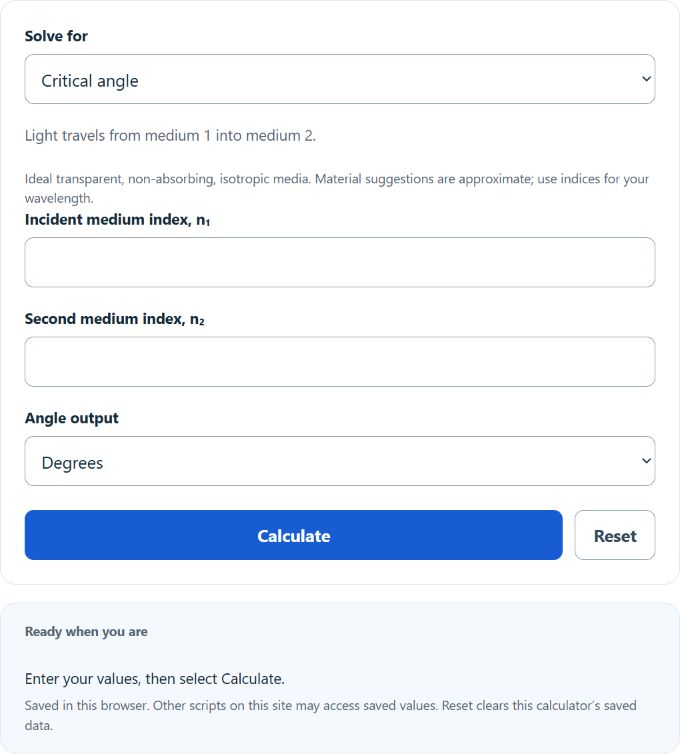
Calculate the critical angle between two refractive indices and check whether a given incident angle causes total internal reflection.
- All Physics Calculators
- Index of Refraction Calculator
- Angle of View Calculator
- Field of View Calculator
- Visual Angle Calculator
- Viewing Angle Calculator
Critical Angle Formula
The critical angle is the incident angle in the higher-index medium at which the refracted ray bends to 90° along the boundary. It comes from Snell’s law with θ₂ set to 90°.
- θc = critical angle, measured from the normal
- n1 = refractive index of the incident (higher-index) medium
- n2 = refractive index of the second (lower-index) medium
A TIR critical angle requires n1 > n2. If n1 ≤ n2, no critical angle exists and total internal reflection cannot occur in that direction. Indices are treated as wavelength-independent here, so for precise work use values matched to your light source. Both media are assumed to be transparent, non-absorbing, and isotropic.
The TIR check mode uses the full Snell’s law to decide what happens at any incident angle:
- θ1 = incident angle from the normal
- θ2 = refracted angle from the normal
If sin(θ2) computes to a value greater than 1, the ray cannot refract and total internal reflection occurs. The two modes work like this:
- Critical angle mode: Enter n1 and n2. The calculator returns θc in degrees or radians.
- TIR check mode: Enter n1, n2, and an incident angle θ1. The calculator compares θ1 to θc and either reports the refracted angle θ2 or flags total internal reflection.
Reference Values
Approximate refractive indices for visible light near 589 nm; actual values depend on composition, temperature, and wavelength:
| Medium | Refractive index n |
|---|---|
| Vacuum | 1.0000 |
| Air | 1.0003 |
| Water | 1.333 |
| Ethanol | 1.361 |
| Fused silica | 1.458 |
| Acrylic (PMMA) | 1.49 |
| Crown glass | 1.52 |
| Polycarbonate | 1.586 |
| Sapphire | 1.77 |
| Diamond | 2.417 |
Critical angles for common boundaries:
| Interface (n1 → n2) | n1 | n2 | θc |
|---|---|---|---|
| Water → Air | 1.333 | 1.0003 | 48.6° |
| Acrylic → Air | 1.49 | 1.0003 | 42.2° |
| Glass → Air | 1.52 | 1.0003 | 41.2° |
| Glass → Water | 1.52 | 1.333 | 61.3° |
| Fiber core → cladding | 1.48 | 1.46 | 80.6° |
| Diamond → Air | 2.417 | 1.0003 | 24.4° |
Worked Examples and FAQ
Example 1: Glass to air. A ray travels in crown glass (n1 = 1.52) and hits a glass-air boundary. The critical angle is θc = arcsin(1.0003 / 1.52) = arcsin(0.6581) ≈ 41.1545°. Any ray hitting the surface at more than 41.1545° from the normal stays inside the glass.
Example 2: Water to air at 50°. Light in water (n1 = 1.333) strikes the surface at θ1 = 50°. The critical angle for water-air is 48.6°. Since 50° > 48.6°, total internal reflection occurs and no light exits into the air.
Example 3: Optical fiber. A step-index fiber has core n1 = 1.48 and cladding n2 = 1.46. The critical angle at the core-cladding boundary is arcsin(1.46 / 1.48) = 80.57°. Light striking the boundary at greater than 80.57° from the normal is trapped inside the core.
Why does the denser medium have to come first? Snell’s law forces sin(θ2) = (n1/n2)·sin(θ1). If n1 < n2, that ratio is below 1 and sin(θ2) can never exceed 1, so refraction always succeeds. Total internal reflection requires n1 > n2.
What happens exactly at the critical angle? The refracted ray skims along the boundary at θ2 = 90°. In practice, any small increase in θ1 sends all the light back into the denser medium.
Does wavelength matter? Yes. Refractive index varies with wavelength (dispersion), so the critical angle for red light differs slightly from blue. For accurate values, use n at your specific wavelength.
Why measure from the normal? Snell’s law is defined that way. An angle of 0° means the ray hits the surface head-on; 90° means it grazes the surface. Convert if your source uses angles from the surface by subtracting from 90°.