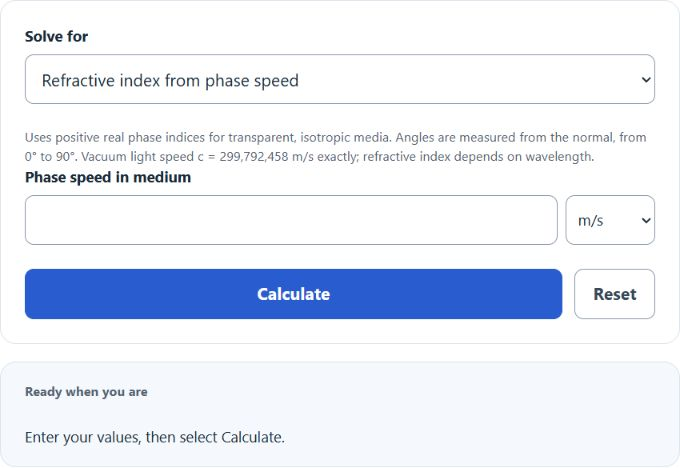
The vacuum speed of light is fixed at 299,792,458 m/s. Choose the refractive index or phase speed to solve, then enter the other value. The index of refraction is calculated with the formula presented below (n = c / v), which is the definition of refractive index in terms of wave speed. This calculator can also use Snell’s Law for positive real indices at an interface: n₁ sin(θ₁) = n₂ sin(θ₂). Measure angles from the normal, from 0° to 90°. Above the critical angle, the transmitted-ray solve reports total internal reflection.
- All Physics Calculators
- Time Dilation Calculator
- Energy to Wavelength Calculator
- Wave Speed Calculator
Index of Refraction Formula
The formula for calculating a refractive index from wave speed is as follows:
- Where n is the index of refraction
- c is the speed of light in a vacuum = 299,792.458 km/s (299,792,458 m/s)
- v is the speed of light in a given medium
To calculate an index of refraction, divide the speed of light in a vacuum by the speed of light in the medium.
Index of Refraction Definition
An index of refraction is the ratio of the speed of light through a vacuum with respect to the speed of light through some other medium, such as water.
How to calculate index of refraction?
How to calculate index of refraction?
- First, determine the speed of light in a vacuum.
The speed of light in a vacuum is known to be 299,792.458 km/s (299,792,458 m/s).
- Next, measure the speed of light in the medium.
For example, the speed of light through water is about 225,000 km/s (for n ≈ 1.33).
- Finally, calculate the index of refraction.
Using the formula above and values from steps 1 and 2, calculate the index of refraction.
FAQ
An index of refraction is the ratio of the speed of light through a vacuum with respect to the speed of light through some other medium, such as water.