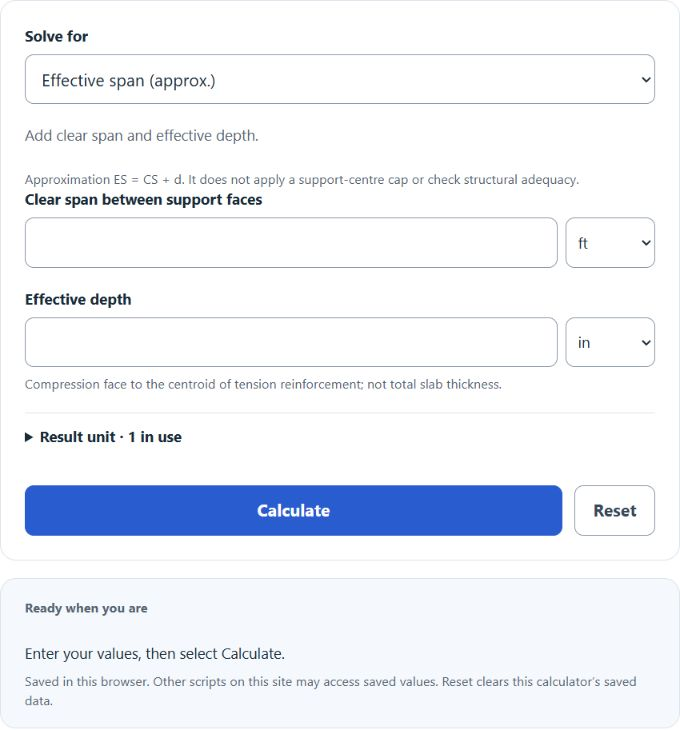
Choose effective span of slab, clear span, or effective depth, then enter the other two values. The calculator evaluates ES = CS + d with compatible length units.
Effective Span of Slab Formula
The calculator uses the approximate slab effective span relationship:
Rearranged forms used when a different value is missing:
- ES = effective span of slab
- CS = clear span between the faces of supports
- d = effective depth from the compression face to the centroid of tension reinforcement, not total slab thickness
Select the value to solve for and enter the other two positive values. The calculator solves the selected value after converting the units so the clear span, effective depth, and effective span are all compatible.
- Calculate effective span: adds the clear span and effective depth.
- Calculate clear span: subtracts the effective depth from the effective span.
- Calculate effective depth: subtracts the clear span from the effective span.
This is an approximate calculation. In reinforced concrete design, some codes define effective span as the lesser of clear span plus effective depth or center-to-center distance between supports. Use the rule required by your design standard when preparing final structural calculations.
Common Length Unit Conversions for Slab Span Calculations
| Unit | Equivalent in feet | Typical use in this calculator |
|---|---|---|
| 1 inch | 0.083333 ft | Small slab depths |
| 1 foot | 1 ft | Clear span and effective span |
| 1 yard | 3 ft | Longer span input |
| 1 centimeter | 0.0328084 ft | Metric depth or span input |
| 1 meter | 3.28084 ft | Metric clear span and effective span |
Effective Depth Design Considerations
| Slab condition | Effective depth selection | Notes |
|---|---|---|
| Light residential slab | Obtain from structural design | Residential use alone does not establish effective depth. Check loads, span, reinforcement, strength and deflection. |
| One-way reinforced slab | Obtain from structural design | Depth depends on span, load, reinforcement, and deflection limits |
| Heavier floor slab | Obtain from structural design | Often controlled by load and serviceability requirements |
Example Calculations
Example 1: Find the effective span
Suppose the clear span is 12 ft and the effective depth is 6 in.
Convert the effective depth to feet:
Apply the formula:
The effective span is 12.5 ft.
Example 2: Find the effective depth
Suppose the effective span is 4.2 m and the clear span is 4.0 m.
The effective depth is 0.2 m, which is also 20 cm.
FAQ
What is the effective span of a slab?
The effective span of a slab is the design span used for structural calculations. For a simple approximate calculation, it is taken as the clear span plus the effective depth of the slab. Depending on the design code, the effective span may also be limited by the center-to-center distance between supports.
What is the difference between clear span and effective span?
Clear span is the open distance between the inside faces of supports. Effective span is the span used in design calculations. In this calculator, effective span is estimated by adding the slab effective depth to the clear span.
Why does unit consistency matter?
The formula only works when the span and depth are in the same length unit. For example, if the clear span is in feet and the effective depth is in inches, the depth must be converted to feet before adding or subtracting it.