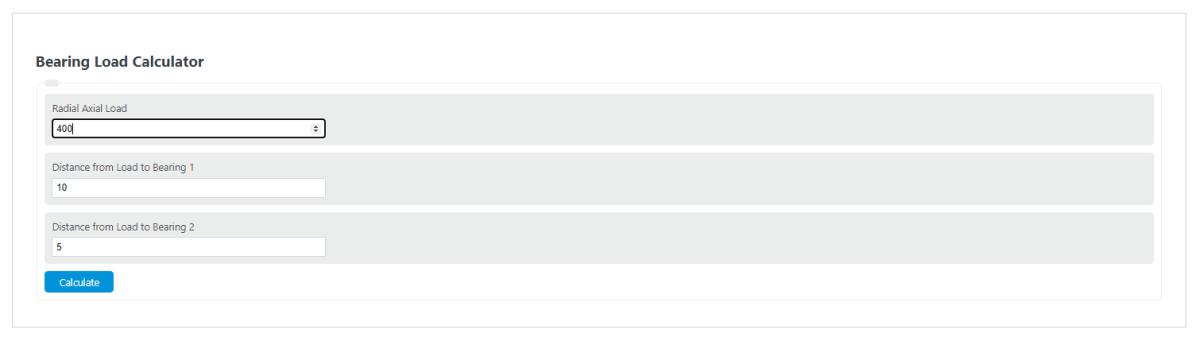
Calculate equivalent dynamic or static bearing load, basic L10 life, required dynamic rating, and static safety factor using catalog load factors and ratings.
- All Automotive Calculators
- Bearing Oil Flow Calculator
- Equivalent Dynamic Load Calculator
- Overhung Load Calculator
- Radial Load Calculator
- Shaft Deflection Calculator
- Press Fit Force Calculator
- Bolt Preload Calculator
- Contact Force Calculator
Bearing Load Formula
The bearing load calculator uses separate formulas for dynamic equivalent load, fatigue life, and static load. Loads are internally converted to newtons before calculation, then converted back to the output unit you select.
Dynamic equivalent bearing load
- P = equivalent dynamic bearing load
- Fr = radial load on the bearing
- Fa = axial load on the bearing
- X = dynamic radial load factor
- Y = dynamic axial load factor
Bearing fatigue life
- L10 = basic rating life in millions of revolutions
- Lna = adjusted rating life in millions of revolutions
- C = basic dynamic load rating
- P = equivalent dynamic bearing load
- p = life exponent, 3 for ball bearings or 10/3 for roller bearings
- a1 = reliability factor
- aISO = lubrication or environment factor
- n = rotational speed in rpm
- t = target life in hours
- Crequired = dynamic load rating needed to meet the target life
Static equivalent bearing load
- P0 = static equivalent bearing load
- C0 = basic static load rating
- X0 = static radial load factor
- Y0 = static axial load factor
- s0 = static safety factor
- s0,target = target static safety factor
- C0,required = static load rating needed for the selected safety factor
The dynamic load function calculates the single equivalent load used for fatigue life checks. The fatigue life function uses a known or estimated equivalent dynamic load to estimate bearing life in revolutions and hours. The static load function checks whether the bearing has enough static capacity for the applied radial and axial loads.
Bearing Factors and Load Rating Reference
The calculator can estimate bearing factors by bearing type, or you can enter custom X, Y, X0, and Y0 values from a bearing catalog.
| Bearing type | Dynamic factor rule used | Estimated X | Estimated Y |
|---|---|---|---|
| Deep groove ball | If Fa/Fr ≤ 0.30, radial dominant. Otherwise combined load. | 1.00 or 0.56 | 0.00 or 1.63 |
| Angular contact ball | If Fa/Fr ≤ 0.68, radial dominant. Otherwise combined load. | 1.00 or 0.44 | 0.00 or 1.17 |
| Cylindrical roller | Estimated combined load factors | 1.00 | 0.50 |
| Spherical roller | If Fa/Fr ≤ 0.25, radial dominant. Otherwise combined load. | 1.00 or 0.67 | 0.00 or 2.00 |
| Tapered roller | If Fa/Fr ≤ 0.35, radial dominant. Otherwise combined load. | 1.00 or 0.40 | 0.00 or 1.60 |
| Thrust bearing | Load based on axial load | 0.00 | 1.00 |
| Input or selection | Value used | How to interpret it |
|---|---|---|
| 90 percent reliability | a1 = 1.00 | Base L10 rating life |
| 95 percent reliability | a1 = 0.62 | Reduces adjusted life for higher reliability |
| 99 percent reliability | a1 = 0.21 | Much shorter adjusted life than the base rating |
| Smooth running static target | s0 = 1.0 | Lower static margin |
| Normal service static target | s0 = 1.5 | Common general-purpose margin |
| Shock or vibration static target | s0 = 2.0 to 3.0 | Use a higher margin when peak loads are likely |
Example Bearing Load Calculations
Example 1: Dynamic equivalent load for a deep groove ball bearing
You have a deep groove ball bearing with a radial load of 2,000 N and an axial load of 800 N.
Because 0.40 is greater than 0.30, the calculator uses the estimated deep groove combined-load factors X = 0.56 and Y = 1.63.
The equivalent dynamic bearing load is 2,424 N.
Example 2: Fatigue life from C and P
You have a ball bearing with C = 25 kN, P = 2.5 kN, speed = 1,200 rpm, reliability factor a1 = 1.00, and lubrication factor = 1.00.
The basic rating life is 1,000 million revolutions.
The adjusted life is about 13,889 hours when a1 and the lubrication factor are both 1.00.
Bearing Load Calculator FAQ
What is equivalent bearing load?
Equivalent bearing load is a single calculated load that represents the combined effect of radial and axial loading. It lets you compare a real loading condition against a bearing load rating. For dynamic checks, the calculator reports P. For static checks, it reports P0.
Should you enter catalog X and Y factors?
Use catalog factors when you have them. The built-in factors are estimates based on bearing type and load ratio. Bearing catalogs may give different factors depending on contact angle, internal geometry, bearing arrangement, and the ratio of axial load to radial load.
Why does bearing life change so much when load changes?
Bearing fatigue life is based on the load ratio raised to a power. For ball bearings, life is proportional to (C/P)3. For roller bearings, life is proportional to (C/P)10/3. Because of that exponent, a small increase in equivalent load can cause a large decrease in calculated life.
Bearing Load Formula
The bearing load calculator uses separate formulas for dynamic equivalent load, fatigue life, and static load. Loads are internally converted to newtons before calculation, then converted back to the output unit you select.
Dynamic equivalent bearing load
- P = equivalent dynamic bearing load
- Fr = radial load on the bearing
- Fa = axial load on the bearing
- X = dynamic radial load factor
- Y = dynamic axial load factor
Bearing fatigue life
- L10 = basic rating life in millions of revolutions
- Lna = adjusted rating life in millions of revolutions
- C = basic dynamic load rating
- P = equivalent dynamic bearing load
- p = life exponent, 3 for ball bearings or 10/3 for roller bearings
- a1 = reliability factor
- aISO = lubrication or environment factor
- n = rotational speed in rpm
- t = target life in hours
- Crequired = dynamic load rating needed to meet the target life
Static equivalent bearing load
- P0 = static equivalent bearing load
- C0 = basic static load rating
- X0 = static radial load factor
- Y0 = static axial load factor
- s0 = static safety factor
- s0,target = target static safety factor
- C0,required = static load rating needed for the selected safety factor
The dynamic load function calculates the single equivalent load used for fatigue life checks. The fatigue life function uses a known or estimated equivalent dynamic load to estimate bearing life in revolutions and hours. The static load function checks whether the bearing has enough static capacity for the applied radial and axial loads.
Bearing Factors and Load Rating Reference
The calculator can estimate bearing factors by bearing type, or you can enter custom X, Y, X0, and Y0 values from a bearing catalog.
| Bearing type | Dynamic factor rule used | Estimated X | Estimated Y |
|---|---|---|---|
| Deep groove ball | If Fa/Fr ≤ 0.30, radial dominant. Otherwise combined load. | 1.00 or 0.56 | 0.00 or 1.63 |
| Angular contact ball | If Fa/Fr ≤ 0.68, radial dominant. Otherwise combined load. | 1.00 or 0.44 | 0.00 or 1.17 |
| Cylindrical roller | Estimated combined load factors | 1.00 | 0.50 |
| Spherical roller | If Fa/Fr ≤ 0.25, radial dominant. Otherwise combined load. | 1.00 or 0.67 | 0.00 or 2.00 |
| Tapered roller | If Fa/Fr ≤ 0.35, radial dominant. Otherwise combined load. | 1.00 or 0.40 | 0.00 or 1.60 |
| Thrust bearing | Load based on axial load | 0.00 | 1.00 |
| Input or selection | Value used | How to interpret it |
|---|---|---|
| 90 percent reliability | a1 = 1.00 | Base L10 rating life |
| 95 percent reliability | a1 = 0.62 | Reduces adjusted life for higher reliability |
| 99 percent reliability | a1 = 0.21 | Much shorter adjusted life than the base rating |
| Smooth running static target | s0 = 1.0 | Lower static margin |
| Normal service static target | s0 = 1.5 | Common general-purpose margin |
| Shock or vibration static target | s0 = 2.0 to 3.0 | Use a higher margin when peak loads are likely |
Example Bearing Load Calculations
Example 1: Dynamic equivalent load for a deep groove ball bearing
You have a deep groove ball bearing with a radial load of 2,000 N and an axial load of 800 N.
Because 0.40 is greater than 0.30, the calculator uses the estimated deep groove combined-load factors X = 0.56 and Y = 1.63.
The equivalent dynamic bearing load is 2,424 N.
Example 2: Fatigue life from C and P
You have a ball bearing with C = 25 kN, P = 2.5 kN, speed = 1,200 rpm, reliability factor a1 = 1.00, and lubrication factor = 1.00.
The basic rating life is 1,000 million revolutions.
The adjusted life is about 13,889 hours when a1 and the lubrication factor are both 1.00.
Bearing Load Calculator FAQ
What is equivalent bearing load?
Equivalent bearing load is a single calculated load that represents the combined effect of radial and axial loading. It lets you compare a real loading condition against a bearing load rating. For dynamic checks, the calculator reports P. For static checks, it reports P0.
Should you enter catalog X and Y factors?
Use catalog factors when you have them. The built-in factors are estimates based on bearing type and load ratio. Bearing catalogs may give different factors depending on contact angle, internal geometry, bearing arrangement, and the ratio of axial load to radial load.
Why does bearing life change so much when load changes?
Bearing fatigue life is based on the load ratio raised to a power. For ball bearings, life is proportional to (C/P)3. For roller bearings, life is proportional to (C/P)10/3. Because of that exponent, a small increase in equivalent load can cause a large decrease in calculated life.