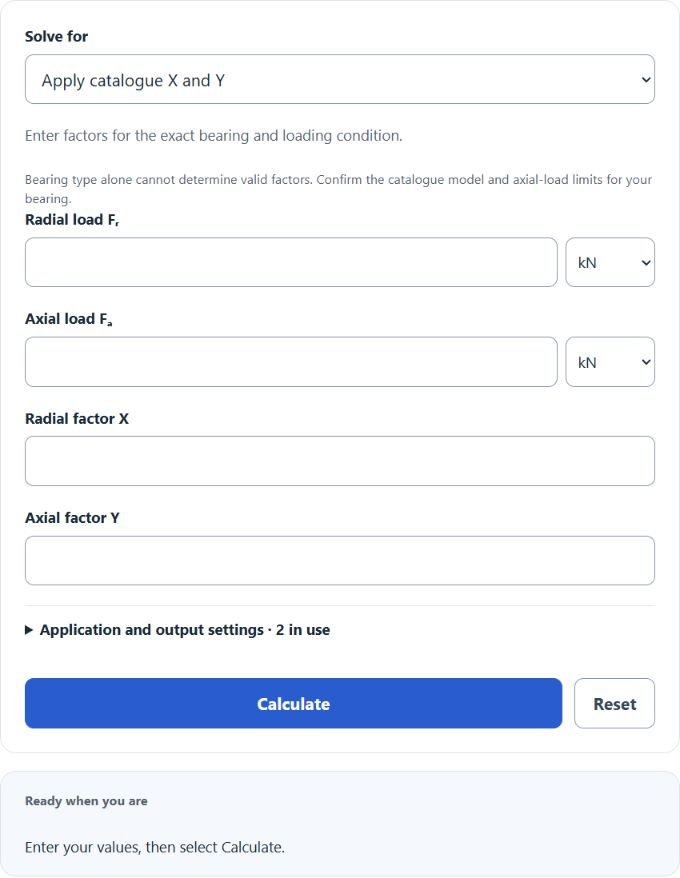
Calculate equivalent dynamic bearing load from radial and axial loads using manufacturer-supplied X and Y factors, or catalogue threshold selection, with an application factor.
- All Automotive Calculators
- Axial Force Calculator
- Bearing Load Calculator
- Bearing Oil Flow Calculator
- Overhung Load Calculator
- Shaft Deflection Calculator
- Contact Force Calculator
Equivalent Dynamic Load Formula
The following equation is used to calculate the Equivalent Dynamic Load.
- Where P is the equivalent dynamic bearing load (use any consistent force unit, e.g., kN)
- X is the radial load factor
- Fr is the radial bearing load (same force unit as P)
- Y is the axial load factor
- Fa is the axial bearing load (same force unit as P)
What is Equivalent Dynamic Load?
Definition:
In rolling-bearing life calculations, the equivalent dynamic bearing load (P) is a hypothetical constant load that would give the same basic rating life (L10) as the actual applied loading. For many radial bearings under combined radial (Fr) and axial (Fa) loading, it is commonly calculated using the catalog/standard factors X and Y: P = X·Fr + Y·Fa. The factors X and Y are not arbitrary constants; they are selected from the bearing manufacturer’s tables (or applicable standards) based on bearing type/design and the load ratio Fa/Fr (and sometimes other conditions).
How to Calculate Equivalent Dynamic Load?
Example Problem:
The following example outlines the steps and information needed to calculate equivalent dynamic load.
First, determine the radial and axial loads. For this example, these are 10 kN and 20 kN respectively.
Next, obtain the radial and axial load factors (X and Y) from the bearing catalog/standard. For this arithmetic example, assume X = 0.35 and Y = 0.65; verify applicable factors in the exact bearing’s catalogue before engineering use.
Finally, calculate the equivalent dynamic load using the formula above:
P = X * Fr + Y * Fa
P = .35*10 + .65 * 20
P = 16.5 kN