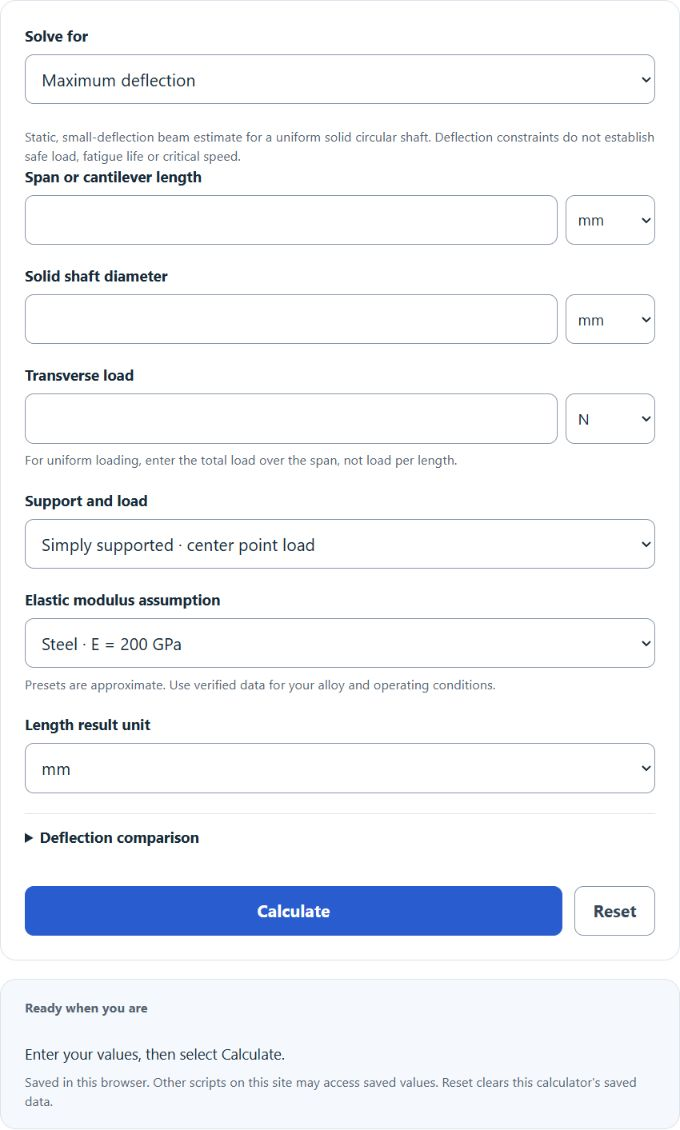
Calculate maximum deflection of a solid circular shaft for three load cases, find diameter or load for a chosen deflection, and review inertia, bending stress, slope, L/δ, and diameter sensitivity.
- All Physics Calculators
- Shaft Torque Calculator
- Bending Stress Calculator
- Plate Deflection Calculator
- Cantilever Load Calculator
- Beam Size Calculator
Shaft Deflection Formula (Cantilever, End Point Load)
This calculator treats a straight, uniform solid circular shaft as an ideal Euler–Bernoulli beam. It supports a simply supported shaft with a center point load, a cantilever with an end point load, and a simply supported shaft with a uniform load over the full span. Maximum deflection is δ = C F L3/(E I), with C = 1/48, 1/3, and 5/384 respectively. For the uniform case, F is the total load over the span, so the load per unit length is w = F/L. These cases follow the standard beam formulas.
The cantilever case is fixed at one end, free at the other, and loaded by a single transverse point force at the free end. Under those conditions, the free-end deflection is:
In this relationship, deflection depends most strongly on length because length is raised to the third power. Small increases in unsupported length can create large increases in shaft movement.
| Variable | Meaning | Typical SI Unit |
|---|---|---|
| D | Deflection at the free end | m |
| F | Applied transverse force | N |
| L | Unsupported shaft length | m |
| E | Modulus of elasticity of the shaft material | Pa |
| I | Area moment of inertia about the bending axis | m4 |
Rearranged Forms
The calculator solves for maximum deflection, solid circular diameter, or load for a chosen deflection. The following are educational rearrangements of the cantilever equation; length, modulus, and inertia are not separate solve modes in this widget:
Applied force from known deflection:
Unsupported length from known deflection:
Required modulus of elasticity:
Required area moment of inertia:
What Shaft Deflection Means
Shaft deflection is the sideways displacement of a shaft under load. In real machines, excessive deflection can lead to bearing misalignment, seal wear, increased vibration, poor gear contact, uneven belt tracking, and reduced service life. Even when a shaft is strong enough to avoid yielding, it may still deflect too much for the system to operate smoothly.
That is why shaft design usually checks both strength and stiffness. This calculator estimates maximum deflection for the selected case and reports idealized bending stress. A load or diameter calculated from a deflection target alone does not establish strength, fatigue life, or safe operating capacity.
How to Use the Calculator
- Choose maximum deflection, diameter for a chosen deflection, or load for a chosen deflection.
- Select the support and load case, then enter the visible required dimensions, force, or deflection target. Uniform load means total force over the full span.
- Select the dimension, force, and deflection units. Choose an approximate material preset or enter a verified custom Young’s modulus in GPa.
- The calculator derives I from the solid circular diameter. An optional L/δ reference is a user-selected comparison, not a safety limit or design standard.
- Calculate and review the result, assumptions, and supporting details.
The widget covers only the three cases listed above. Off-center point loads, multiple or mixed loads, overhangs, additional supports, hollow or noncircular sections, and stepped shafts require a different model.
Why Length Matters So Much
For this loading case, deflection follows these proportional trends:
- If the force doubles, deflection doubles.
- If the modulus of elasticity doubles, deflection is cut in half.
- If the area moment of inertia doubles, deflection is cut in half.
- If the unsupported length doubles, deflection becomes 8 times larger.
This cubic length effect is one of the most important design insights for shafts, beams, brackets, and cantilevered machine members.
Common Area Moment of Inertia Formulas
The area moment of inertia, I, describes section geometry about the bending axis. This widget calculates I for a solid circular shaft from its diameter. The hollow and rectangular formulas below are educational references; those sections are not inputs to this calculator.
Solid circular shaft:
Hollow circular shaft:
Rectangular section:
Here, d is diameter for a solid shaft, D is outer diameter for a hollow shaft, d in the hollow-shaft formula is inner diameter, b is width, and h is the dimension measured in the bending direction.
Material Stiffness and the Role of E
The modulus of elasticity, E, measures how resistant a material is to elastic deformation. A higher value of E means the same shaft geometry will deflect less under the same load. Geometry and material both matter, but in many shaft applications, increasing diameter is often more effective than changing material because I changes rapidly with section size.
For round shafts especially, stiffness is very sensitive to diameter because:
That means a modest increase in diameter can produce a large increase in bending stiffness.
The steel, aluminum, and brass presets assume E = 200, 69, and 100 GPa respectively. They are approximate reference values, not certified properties for every alloy or operating temperature. Use material-specific verified data through the custom E option when needed.
Example
For a cantilever equation example, suppose a shaft has the following properties. Here I is supplied directly; the widget instead calculates I from a solid circular diameter. The example uses custom E = 210 GPa:
- Applied force = 500 N
- Length = 0.5 m
- Modulus of elasticity = 2.1 × 10¹¹ Pa
- Area moment of inertia = 1.5 × 10⁻⁶ m4
Substitute into the formula:
The resulting deflection is:
Which is approximately:
Assumptions Behind This Calculator
- The shaft behaves elastically and returns to shape after load removal.
- Deflection is small relative to shaft length.
- The material is uniform and isotropic.
- The cross-section is constant over the loaded span.
- The load acts perpendicular to the shaft centerline.
- The supports match the selected idealized case: a fully fixed cantilever end, or two simple supports that permit end rotation.
- Shear deformation is neglected, which is typically acceptable for slender shafts.
Practical Design Notes
- Use the distance between supports for the simply supported cases, or the unsupported length from clamp to load for the cantilever case.
- Be careful with unit conversion when switching between Pa, GPa, psi, m, mm, and in.
- For rotating shafts, acceptable deflection is often limited by alignment and vibration requirements, not just by strength.
- Two ideal simple supports are represented by the simply supported cases. Additional bearings, flexible supports, and overhangs need a suitable beam model.
- Loads from several gears, pulleys, or overhung masses need a beam model that represents their positions. Summing those forces alone does not generally preserve the deflection.
When This Calculator Is Most Useful
This calculator is useful for preliminary stiffness estimates of uniform solid circular shafts under a center point load between simple supports, an end point load on a cantilever, or a full-span uniform load between simple supports. It can compare material assumptions, diameters, and spans within those idealized cases. A complete rotating-shaft design also needs appropriate strength, fatigue, alignment, and vibration checks.