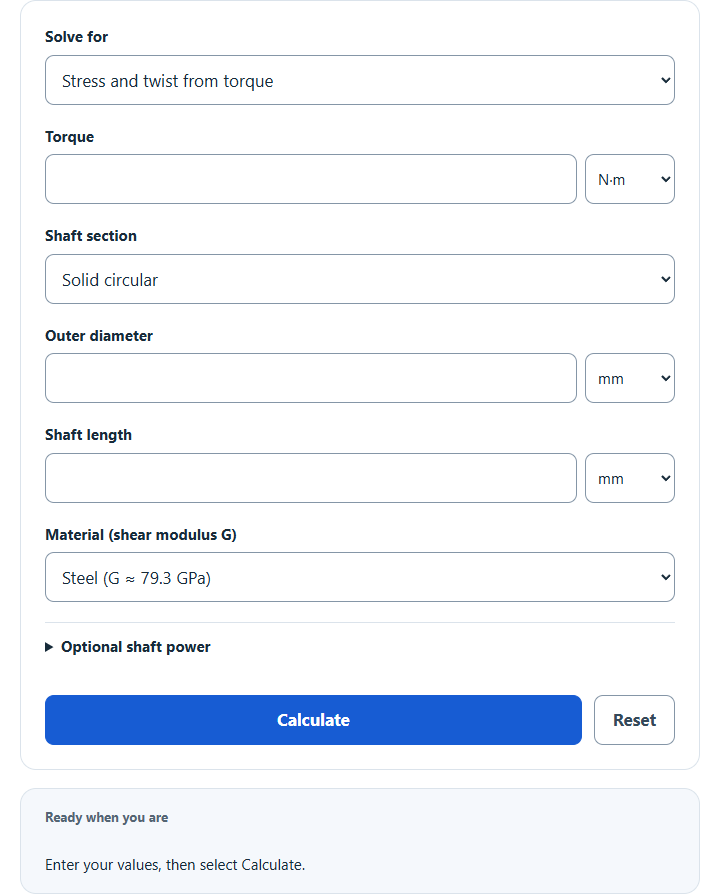
Calculate shaft torque capacity from allowable shear stress, or the shear stress and angle of twist a torque causes in solid or hollow shafts.
- All Physics Calculators
- All Torque Calculators
- Hollow Shaft Diameter Calculator
- RPM to Torque Calculator
- Gear Torque Calculator
- Hydraulic Motor Torque Calculator
- Gearbox Efficiency Calculator
Shaft Torque Formula
The following formula is used to calculate the Shaft Torque.
- Where Tshaft is the Shaft Torque (N-m)
- ss is the shear stress (N/m2)
- J is the polar moment of inertia (m4)
- r is the radius (m)
To calculate shaft torque, multiply the shear stress by the polar moment of inertia, then divide by the radius.
Shaft Diameter from Torque
Choose Shaft diameter from torque to estimate the minimum outside diameter for a uniform circular shaft in pure torsion. Enter a positive torque magnitude and your allowable shear stress. For a hollow shaft, also enter the inner-to-outer diameter ratio, k, between 0 and 1. The result shows the outside diameter in millimeters and inches, the inside diameter, and radial material thickness.
Do = ∛[16|T| / (π τallow (1 − k4))], with Di = kDo. For a solid shaft, k = 0. With torque T in N·m and allowable shear stress τallow in Pa, the diameters are in meters. Radial material thickness is (Do − Di)/2; for a solid shaft this is its radius.
This rearranges the elastic circular-shaft relations τ = Tc/J and J = π(Do4 − Di4)/32, where c = Do/2. See the University of Illinois torsion reference for the equations and assumptions.
For example, a solid shaft transmitting 100 N·m at an allowable shear stress of 50 MPa has a theoretical diameter of approximately 21.677 mm (0.853 in). A hollow shaft with k = 0.5 under the same conditions requires an outside diameter of approximately 22.148 mm and an inside diameter of approximately 11.074 mm.
The entered allowable stress must already include the safety factor appropriate to the application. This calculation does not check bending, fatigue, stress concentrations, keyways, buckling, or limits on twist. Select a practical shaft size only after those checks. Zero torque alone does not establish a useful minimum diameter. The Hollow Shaft Diameter Calculator is useful instead when two geometric dimensions or ratios are already known.
How to Calculate Shaft Torque?
The following example problems outline how to calculate Shaft Torque.
Example Problem #1
- First, determine the shear stress (N/m2). In this example, the shear stress (N/m2) is determined to be 500.
- Next, determine the polar moment of inertia (m4). For this problem, the polar moment of inertia (m4) is measured to be 30.
- Next, determine the radius (m). In this case, the radius (m) is found to be 4.
- Finally, calculate the Shaft Torque using the formula above:
Tshaft = ss * J/r
Inserting the values from above and solving yields:
Tshaft = 500 * 30/4 = 3,750 (N-m)
Example Problem #2
Using the same method as above, determine the variables required by the formula. For this example problem, these are:
shear stress (N/m2) = 750
polar moment of inertia (m4) = 10
radius (m) = 50
Entering these given values into the calculator or the formula above yields:
Tshaft = 750 * 10/50 = 150 (N-m)