Calculate hydraulic motor torque, rpm, and power, or solve required pressure, displacement, and flow with efficiency and unit conversions.
- All Torque Calculators
- Shaft Torque Calculator
- HP to Torque Calculator
- Pressure To Torque Calculator
- All Physics Calculators
Hydraulic Motor Torque Formula
Hydraulic motor torque is the twisting force generated when hydraulic pressure acts through a motor’s displacement. This calculator estimates shaft torque using pressure differential, displacement and mechanical efficiency. Set mechanical efficiency to 100% for ideal theoretical torque. Optional inlet flow enables speed and power estimates using volumetric efficiency.
- T = hydraulic motor torque
- P = pressure differential across the motor
- D = motor displacement per revolution
This relationship is linear, which means torque increases directly as either pressure or displacement increases. If the pressure doubles, torque doubles. If the displacement doubles, torque also doubles.
Variable Definitions
| Input / Output | Description | Common Units | Important Note |
|---|---|---|---|
| Pressure | The effective pressure acting across the motor | psi, bar, kPa, MPa | Use operating pressure difference, not just pump nameplate pressure |
| Displacement | Fluid volume required for one revolution of the motor | in³/rev, cm³/rev, m³/rev | Use motor displacement, not system flow rate |
| Torque | Rotational output force | lb-in, N·m | lb-in can be converted to lb-ft when needed |
How the Calculation Works
A hydraulic motor converts fluid energy into rotational mechanical energy. Pressure provides the force potential, and displacement determines how much fluid is converted into motion during each revolution. The formula divides the work done per revolution by the angular distance of one full turn to obtain torque.
In practical terms:
- Higher pressure produces more torque from the same motor.
- Larger displacement produces more torque at the same pressure.
- For a given flow rate, larger displacement motors generally produce more torque and rotate more slowly.
Rearranged Forms
If you know any two values, the same relationship can be rearranged to solve for the third:
This is useful when sizing a motor for a required torque or estimating the pressure needed to achieve a target output.
Ideal Torque vs. Actual Shaft Torque
The formula above gives theoretical torque. Real hydraulic motors experience losses from friction, internal leakage, fluid shear, and seal drag. Because of that, actual output torque is usually lower than the theoretical value.
Here, ηm is the motor’s mechanical efficiency expressed as a decimal. If efficiency is known, this adjustment gives a better estimate of real shaft torque under load.
How to Use the Calculator Correctly
- Enter the motor pressure differential under operating load.
- Enter the motor displacement per revolution.
- Select the correct units for each field.
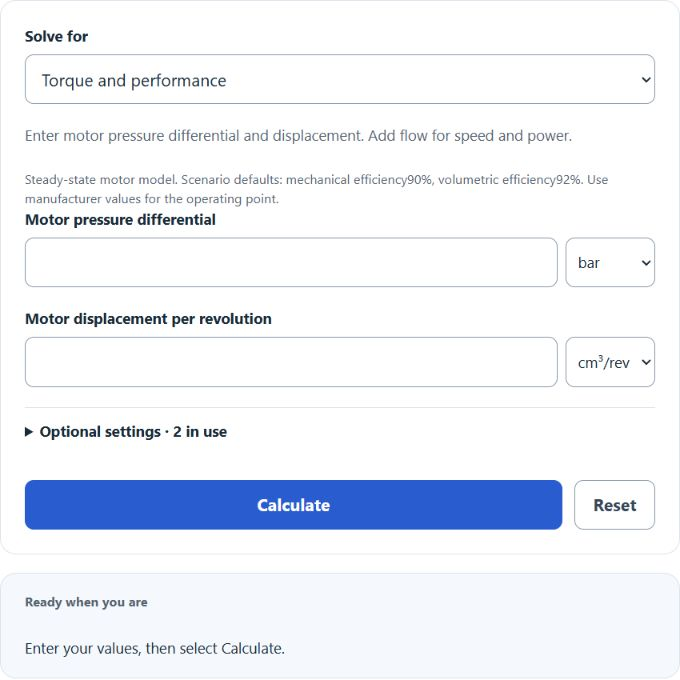
- Choose a solve mode, enter its required values and select Calculate. Scenario efficiency defaults are 90% mechanical and 92% volumetric; replace them with manufacturer values. Primary outputs use N·m, bar, cm³/rev or L/min; alternate units appear in the result.
Be careful not to confuse:
- motor displacement with pump flow,
- system maximum pressure with actual running pressure,
- lb-in with lb-ft.
Torque Unit Conversion
If you need the result in pound-feet instead of pound-inches, convert using:
Example 1
If the pressure is 500 psi and the motor displacement is 0.36 in³/rev, the theoretical torque is:
Example 2
If the pressure is 1250 psi and the displacement is 0.75 in³/rev, the theoretical torque becomes:
Practical Notes
- Use this calculator for preliminary torque checks and system performance estimates; it does not select a safe motor or verify component ratings.
- The result is best treated as a theoretical baseline unless efficiency and operating losses are accounted for.
- Actual output can vary with fluid temperature, viscosity, internal wear, and motor design.
- When comparing motors, displacement and continuous pressure rating should always be evaluated together.