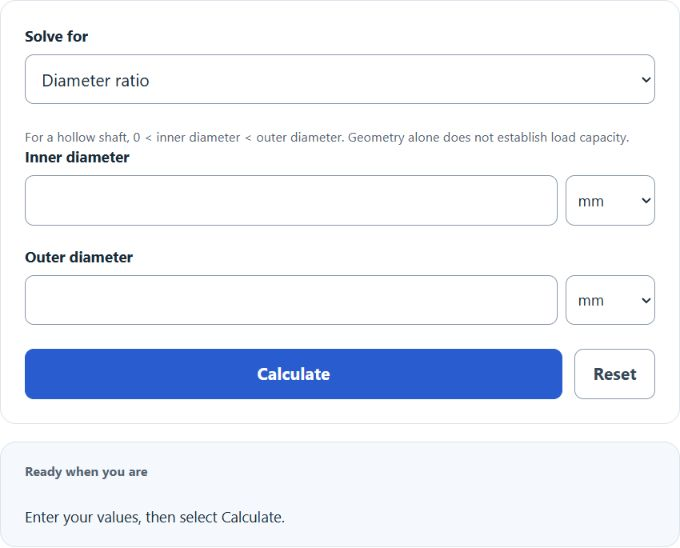
Calculate a hollow shaft’s inner diameter, outer diameter, or diameter ratio from any two known values, using millimeter or inch units.
Related Calculators
- Clamp Load Calculator
- Bronze Weight Calculator
- Coil Weight Calculator
- Live Load Calculator
- All Construction Calculators
Hollow Shaft Diameter and Ratio Guide
Use this calculator when you know any two of the three core values: inner diameter, outer diameter, or diameter ratio. Choose the missing quantity and enter the two known values. Each diameter has its own unit selector; mixed millimeter and inch inputs are converted automatically. The ratio is unitless. ([calculator.academy](https://calculator.academy/hollow-shaft-diameter-calculator/))
Core Formulas
| Find | Relationship | Use Case |
|---|---|---|
| Diameter ratio | HSDR = (ID) / (OD) |
Use when both diameters are known. |
| Inner diameter | ID = HSDR × OD |
Use when the target ratio and outer diameter are known. |
| Outer diameter | OD = (ID) / (HSDR) |
Use when the bore size and ratio are known. |
| Wall thickness | t = (OD - ID) / (2) |
Useful for checking how much material remains in the shaft wall. |
The primary relationship above matches the calculator’s hollow shaft diameter ratio equation, and the other forms are direct algebraic rearrangements of that same ratio. ([calculator.academy](https://calculator.academy/hollow-shaft-diameter-calculator/))
Variable Reference
| Symbol | Meaning | Typical Unit |
|---|---|---|
| HSDR | Hollow shaft diameter ratio | Unitless |
| ID | Inner diameter | mm, in, or any consistent length unit |
| OD | Outer diameter | mm, in, or any consistent length unit |
| t | Wall thickness | Same unit as the diameters |
Input Checks
| Check | Why It Matters |
|---|---|
| Inner diameter must be smaller than outer diameter. | Otherwise the geometry is not physically possible. |
| For a true hollow shaft, the ratio should be greater than zero and less than one. | Values near one indicate a thin wall; values near zero indicate a very thick wall. |
| Select the correct unit for each diameter. | Select the unit matching each input; the calculator converts millimeters and inches automatically. |
| Convert percentages to decimals before entry. | For example, 75% should be entered as 0.75. |
How to Interpret the Ratio
| Ratio Range | Wall Condition | General Meaning |
|---|---|---|
| Below 0.50 | Thicker wall | More material in the section and a smaller internal opening. |
| 0.50 to 0.80 | Moderate wall | An intermediate bore-to-outer-diameter ratio; suitability depends on material, loads, and engineering checks. |
| Above 0.80 | Thin wall | Larger internal passage and lower weight, but less wall material. |
Example Results
| Known Values | Solve For | Result |
|---|---|---|
| Inner diameter = 30 mm, outer diameter = 40 mm | Diameter ratio | 0.75 |
| Diameter ratio = 0.60, outer diameter = 50 mm | Inner diameter | 30 mm |
| Inner diameter = 24 mm, diameter ratio = 0.80 | Outer diameter | 30 mm |
Helpful Notes
- The ratio only describes the size of the hole relative to the outside diameter; it does not give the absolute shaft size by itself.
- Once inner and outer diameter are known, wall thickness is usually the next value checked for fit, strength, and manufacturability.
- If you are comparing multiple designs, the ratio is a quick way to see which option has the larger bore or thicker wall.