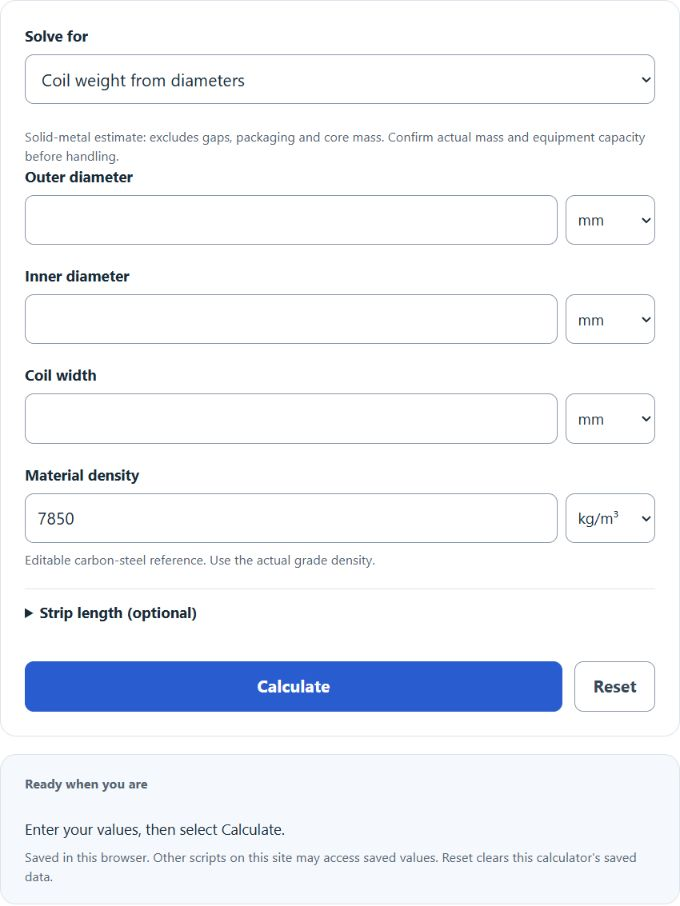
Calculate metal coil weight or outer diameter from OD, ID, width, density, and units, with specific coil weight and optional strip-length estimation.
- All Construction Calculators
- Coil Length Calculator
- Coil Diameter Calculator
- Coil Surface Area Calculator
- Outside Diameter of a Roll Calculator
- Paper Roll Weight Calculator
Coil Weight Formula
Use diameter mode for a tightly wound coil, or strip mode when length and thickness are known. All formulas below use meters, kg/m³ and kilograms. In diameter mode, mass = π/4 × (OD² − ID²) × width × density; outer diameter = √(ID² + 4 × mass ÷ (π × width × density)). The flat-strip relationship is:
Rearranged formulas for the other fields:
- CW = coil weight, in kilograms before output conversion
- W = coil width, in meters before output conversion
- L = coil length, in meters before output conversion
- T = coil thickness, in meters before output conversion
- rho = material density, in kg/m³ before output conversion
Select the quantity and measurement method in Solve for, then enter the displayed inputs. Diameter modes find coil weight or outside diameter; strip modes find weight or strip length. Optional thickness adds a length estimate in diameter modes. The rearranged formulas above also show the underlying relationships. Estimates exclude winding gaps, packaging and core mass; verify actual handling loads separately.
Common Coil Material Densities
Use a density that matches the actual material grade when possible. The values below are typical reference values for common coil materials.
| Material | Density kg/m³ | Density lb/ft³ |
|---|---|---|
| Carbon steel | 7,850 | 490 |
| Stainless steel | 7,900 to 8,000 | 493 to 499 |
| Aluminum | 2,700 | 169 |
| Copper | 8,960 | 559 |
| Brass | 8,400 to 8,700 | 524 to 543 |
Weight Unit Conversions Used for Coil Results
| Unit | Equivalent in kg | Equivalent from 1 kg |
|---|---|---|
| Kilogram | 1 | 1 kg |
| Pound | 0.453592 | 2.20462 lb |
| Short ton | 907.185 | 0.00110231 short tons |
| Metric ton | 1,000 | 0.001 metric tons |
Example Calculations
Example 1: Calculate coil weight
You have a steel coil with a width of 1.2 m, length of 500 m, thickness of 0.8 mm, and density of 7,850 kg/m³.
Convert thickness to meters:
Apply the coil weight formula:
The coil weight is 3,768 kg, or 3.768 metric tons.
Example 2: Calculate coil length
You have an aluminum coil weighing 2,000 kg. The width is 1 m, the thickness is 1.5 mm, and the density is 2,700 kg/m³.
Convert thickness to meters:
Use the length formula:
The coil length is about 493.83 m.
FAQ
Does this calculate weight from coil outside diameter and inside diameter?
Yes. Select Coil weight from diameters and enter outside diameter, inside diameter, width and density. The annular-volume estimate assumes tightly wound solid material. You can also use flat-strip dimensions or solve outside diameter from a known mass.
Why does thickness need to be entered carefully?
In strip-weight mode, mass is proportional to thickness at fixed width, length and density. In diameter modes, mass comes from annular volume; optional thickness changes the estimated strip length, not that mass. Select the correct thickness unit and use a measured value when possible.
What density should you use for steel coil?
For general carbon steel, 7,850 kg/m³ is commonly used. Stainless steel is often slightly higher, usually around 7,900 to 8,000 kg/m³ depending on grade. If the material specification gives an exact density, use that value for the most accurate result.