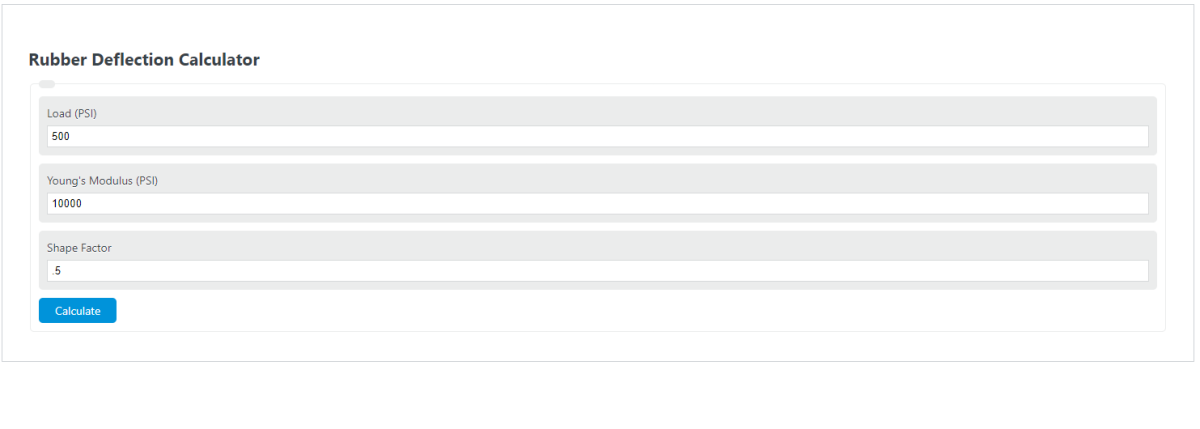
Calculate rubber pad compression, strain, stiffness, load, and Young’s modulus for rectangular or circular pads using shape-factor geometry in SI or US units.
- All Construction Calculators
- Rubber Sheet Weight Calculator
- Spiral Torsion Spring Calculator
- Spring Constant Calculator
- Compressive Stress Calculator
- Applied Force Calculator
Rubber Deflection Formula
The following equation is used to calculate rubber deflection (compressive strain) for a rubber pad using a simple shape-factor stiffness approximation.
- Where D is the rubber compressive strain (dimensionless; often reported as % by multiplying by 100). Axial deflection (length) = D × thickness.
- Y is the Young’s modulus (PSI)
- f is the shape factor
- The shape factor is calculated by dividing the compressed (loaded) area by the area that is able to bulge (free area)
- L is the compressive stress (PSI)
To calculate rubber deflection (strain), divide the stress by the product of Young’s modulus times (1 plus 2 times the shape factor squared).
What is Rubber Deflection?
Definition:
Rubber deflection is the deformation of a rubber component under an applied load. It may be expressed as a displacement (for example, inches or millimeters of compression) or as strain (dimensionless, often reported as a percent).
When a rubber part is loaded in tension or compression, the applied stress causes strain (a change in length divided by the original length). In simple linear approximations, stress and strain are related by an elastic modulus, but real rubber is often non-linear and its stiffness depends on strain level, temperature, and formulation.
For rubber pads in compression, geometry matters because rubber tends to bulge sideways. The shape factor (loaded area divided by free-to-bulge area) is a common way to account for how constrained the bulging is: higher shape factor generally means higher apparent compressive stiffness and therefore less deflection for the same stress.
Rubber can have relatively high tensile strength and still stretch significantly because tensile strength describes failure resistance, while stiffness/deflection is governed primarily by elastic modulus.
How to Calculate Rubber Deflection
To calculate rubber deflection, take the shape factor raised to the power of 2, multiply by 2, then add 1.
Next, multiply the result from above by the Young’s modulus of the rubber.
Finally, divide the compressive stress acting on the rubber (in PSI) by the result from above. (Multiply the resulting strain by 100 to express it as a percent.)