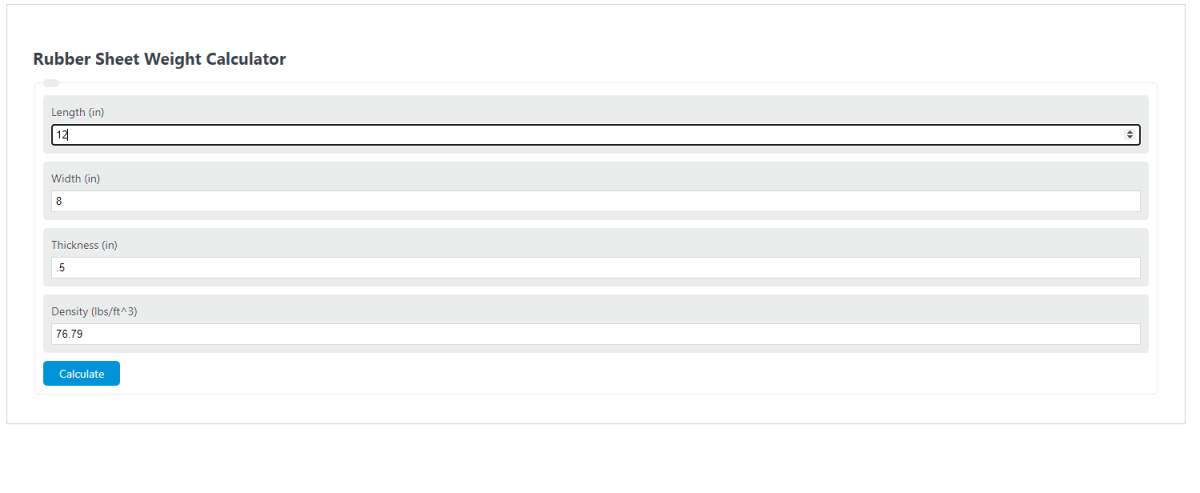
Calculate rubber sheet weight, density, length, width, or thickness from any four values with inch, foot, cm, meter, lb, or kg units.
- All Construction Calculators
- Delrin Weight Calculator
- OSB Weight Calculator
- Plywood Weight Calculator
- Rubber Deflection Calculator
- Plastic Weight Calculator
- PVC Weight Calculator
- Polycarbonate Weight Calculator
- Vinyl Banner Weight Calculator
How to Calculate Rubber Sheet Weight
Rubber sheet weight is determined by volume and material density. For a rectangular sheet, that means the total weight changes directly with length, width, thickness, and the density of the rubber compound. This calculator is useful for estimating material needs, shipping weight, handling loads, machine capacities, rack loading, and finished part mass before ordering or cutting stock.
Core Formula
In any unit system, weight is volume multiplied by density.
If length, width, and thickness are entered in inches and density is in lb/ft^3, convert each dimension to feet before multiplying:
The same imperial relationship can be written as a shortcut:
If you work entirely in metric units, use a consistent system such as meters and kilograms per cubic meter:
| Variable | Meaning | Typical Units |
|---|---|---|
| RSW | Rubber sheet weight | lb or kg |
| L | Sheet length | in, ft, cm, m |
| W | Sheet width | in, ft, cm, m |
| T | Sheet thickness | in, ft, cm, m |
| D | Rubber density | lb/ft^3, kg/m^3, g/cm^3 |
| V | Sheet volume | ft^3, m^3, cm^3 |
How to Use the Calculator
- Enter the length, width, and thickness of the sheet.
- Enter the density of the rubber material.
- Select the correct units for each field.
- The calculator can solve for the missing value when any four of the five variables are known.
The most important rule is unit consistency. A density in lb/ft3 must be paired with dimensions converted to feet, while a density in kg/m3 should be paired with dimensions in meters.
Solving for a Missing Value
If the total weight is known, the same formula can be rearranged to solve for density or one of the dimensions. The expressions below assume L, W, and T are in inches, D is in lb/ft3, and RSW is in pounds.
| Unknown | Formula |
|---|---|
| Density | D = (1728RSW) / (LWT) |
| Thickness | T = (1728RSW) / (LWD) |
| Length | L = (1728RSW) / (WTD) |
| Width | W = (1728RSW) / (LTD) |
Example
For a sheet that is 12 in long, 8 in wide, 0.5 in thick, with a density of 76.79 lb/ft3:
If you want the same result in kilograms:
If Your Material Data Uses Specific Gravity
Many rubber datasheets list specific gravity instead of density. You can convert it before using the calculator.
This is especially helpful when comparing compounds such as neoprene, EPDM, nitrile, silicone, natural rubber, and sponge or foam grades, which can have very different densities even when the sheet dimensions are identical.
Why Rubber Sheet Weight Matters
- Purchasing: estimate how much material a project or production run will require.
- Shipping: forecast carton, pallet, or roll weights before freight booking.
- Fabrication: verify whether a press, cutter, table, or support fixture can safely handle the sheet.
- Design: compare compounds when weight is a performance constraint.
- Inventory: estimate stock on hand from sheet count and dimensions.
Accuracy Tips
- Use the actual density from the manufacturer whenever possible rather than a generic rubber value.
- Measure true thickness instead of relying only on nominal thickness, especially for tighter tolerances.
- For reinforced, backed, laminated, or adhesive-coated materials, use the composite density or a known sample weight.
- If the part is cut from a sheet, calculate from the final net dimensions instead of the original blank size.
- All four inputs are linear: doubling length, width, thickness, or density doubles the final weight.
Cut Parts, Pads, and Gaskets
If the rubber is not a full rectangle, it is often better to calculate from the part’s actual area first, then multiply by thickness and density using a consistent unit system.
In that form, A is the finished area of the part. This approach is useful for die-cut pads, custom gaskets, strips, and irregular shapes where the full sheet dimensions would overstate the real weight.
Common Questions
Why do two sheets with the same size sometimes weigh differently?
Because the compound density can change with rubber type, filler content, reinforcement, or whether the material is solid, sponge, or foam.
Does hardness tell you the weight?
Not directly. Hardness and density may be related in some compounds, but they are not the same property, so weight should still be calculated from volume and density.
Can this be used for rubber rolls?
Yes. If you know the total sheet length in the roll, the width, thickness, and density, the same volume-based method applies.