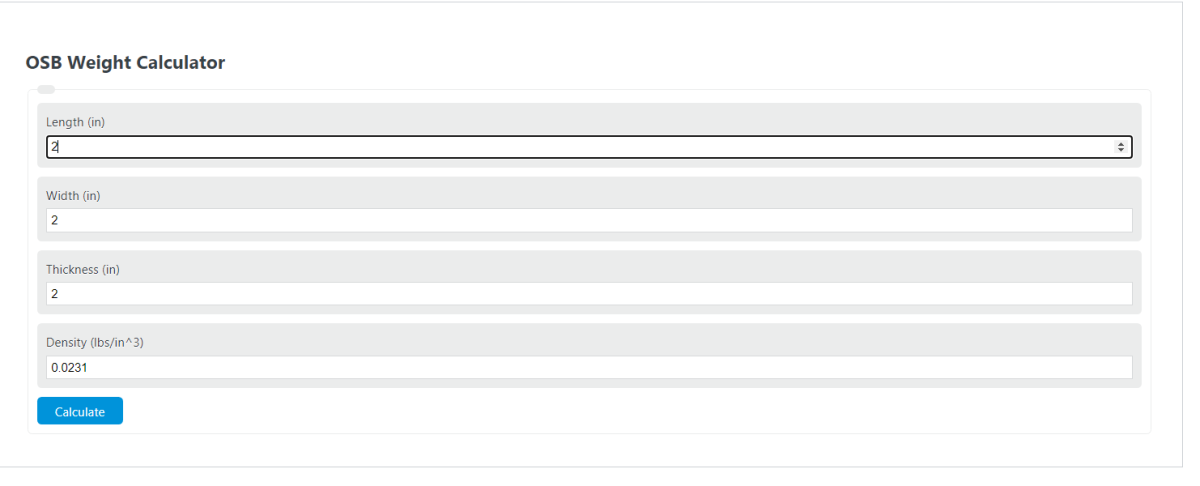
Estimate OSB panel and order weight or load-limit sheet count from dimensions, count, and clearly labeled approximate density presets or a custom product density.
- Plywood Weight Calculator
- Medium Density Fiberboard (MDF) Weight Calculator
- Door Weight Calculator
- All Construction Calculators
OSB Weight Formula
OSB weight is calculated from the panel volume and the panel density. In the most direct form, multiply length, width, thickness, and density using a consistent unit system.
- OSBW = OSB weight
- L = panel length
- W = panel width
- T = panel thickness
- D = panel density
If you use inches for the dimensions and lb/in3 for density, the result is in pounds. If you use meters for the dimensions and kg/m3 for density, the result is in kilograms.
Fast Area-Based Shortcut
For sheet goods, it is often quicker to calculate weight from panel area and thickness. This is especially useful for standard 4 ft x 8 ft, 4 ft x 10 ft, and cut-down sheets.
When area is entered in square feet, thickness is entered in inches, and density is the calculator's default value of 0.0231 lb/in3, the estimate simplifies to:
This shortcut is convenient for quick field estimates because the constant already accounts for the square-foot to square-inch conversion.
Common 4 ft x 8 ft OSB Sheet Weights
The table below uses a density of 0.0231 lb/in3. Actual sheet weights can vary by manufacturer, grade, resin content, and moisture level.
| Thickness | Approx. Weight (lb) | Approx. Weight (kg) | Approx. Weight per ft2 (lb) |
|---|---|---|---|
| 7/16 in | 46.6 | 21.1 | 1.46 |
| 15/32 in | 49.9 | 22.6 | 1.56 |
| 1/2 in | 53.2 | 24.1 | 1.66 |
| 19/32 in | 63.2 | 28.7 | 1.98 |
| 5/8 in | 66.5 | 30.2 | 2.08 |
| 23/32 in | 76.5 | 34.7 | 2.39 |
| 3/4 in | 79.8 | 36.2 | 2.49 |
| 1-1/8 in | 119.8 | 54.3 | 3.74 |
Scaling Weight for Other Sheet Sizes
If thickness and density stay the same, OSB weight changes in direct proportion to area. Once you know the weight of one reference sheet, you can scale it to any other size.
| Sheet Size | Area (ft2) | Multiplier vs. 4 x 8 |
|---|---|---|
| 2 x 4 | 8 | 0.25 |
| 2 x 8 | 16 | 0.50 |
| 3 x 8 | 24 | 0.75 |
| 4 x 8 | 32 | 1.00 |
| 4 x 9 | 36 | 1.125 |
| 4 x 10 | 40 | 1.25 |
| 4 x 12 | 48 | 1.50 |
Example Calculation
For a 4 ft x 8 ft sheet with a thickness of 7/16 in and a density of 0.0231 lb/in3, first convert the panel dimensions to inches:
The sheet weighs about 46.6 lb, which is approximately 21.1 kg.
Using the Calculator Efficiently
- Enter the panel length, width, and thickness.
- Use the sheet's actual density if the manufacturer provides it; otherwise use the default estimate.
- For partial sheets, enter the cut dimensions rather than the original full-sheet dimensions.
- If you are mixing unit systems manually, convert them before calculating so the density matches the dimension units.
- Round up when planning lifting, shipping, racking, or dead-load allowances.
Solving for a Missing Value
Because the calculator can work from any four known values, it can also be used to estimate density or thickness when the other measurements are known.
This is useful when you have a measured panel weight from a supplier and want to back-calculate the density for more accurate estimates on future sheets.
What Changes OSB Weight?
- Density variation: Different mills and product lines can produce noticeably different weights.
- Moisture content: Wetter panels weigh more than dry panels.
- Actual thickness: Small thickness differences create a direct change in weight.
- Coatings or overlays: Specialty finishes add mass.
- Trimmed dimensions: Cut panels weigh less in exact proportion to the removed area.
When This Calculation Is Most Useful
- Estimating roof, wall, or subfloor dead load
- Planning how many sheets can be moved safely by hand
- Comparing OSB with plywood, MDF, or other sheet goods
- Calculating shipping weight for pallets or deliveries
- Checking trailer, truck, shelf, or rack loading
Tip: If precision matters for engineering, transport, or inventory control, use the manufacturer-listed panel weight or density instead of a generic average.