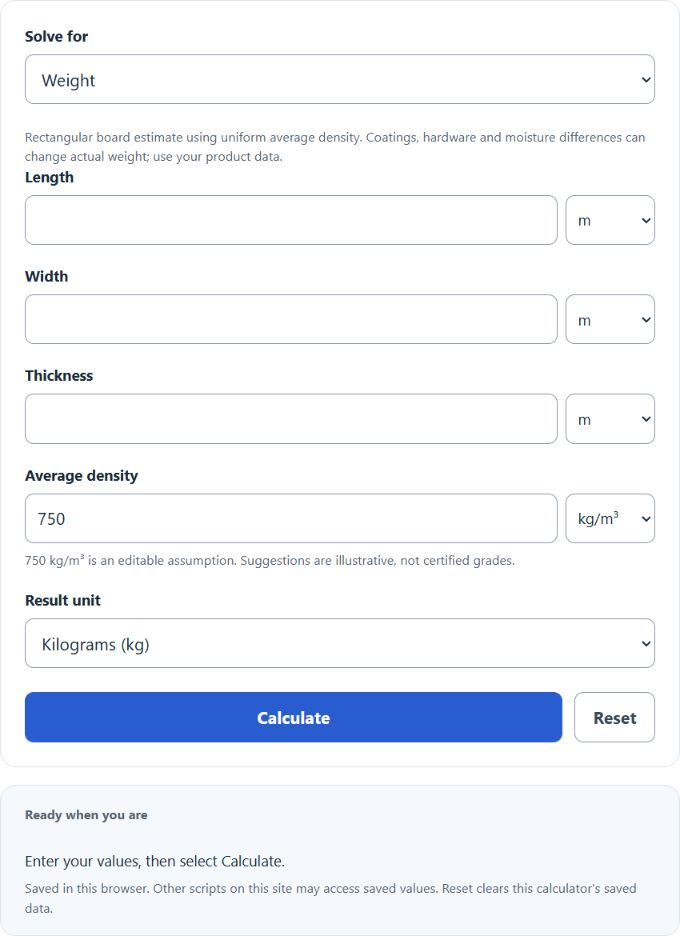
Calculate MDF board weight from length, width, thickness, and density, or solve for any missing dimension, density, or weight in common units.
- All Construction Calculators
- Door Weight Calculator
- Plywood Weight Calculator
- Plywood Load Capacity Calculator
- OSB Weight Calculator
- Wainscoting Calculator
- Balsa Wood Weight Calculator
MDF Weight Formula
The weight of any piece of MDF is calculated by multiplying its volume by the material’s density:
Here m is mass (commonly called board weight), L is length, B is width, T is thickness, and ρ is average density. With dimensions in meters and density in kg/m³, the answer is kilograms. For dimensions in inches and density in lb/in³, the answer is pounds. An illustrative density of 700 kg/m³ equals 0.70 g/cm³ or about 0.0253 lb/in³; use the density for your specific product.
4×8 MDF Sheet Weight by Thickness
The table below uses an exact 4 ft × 8 ft sheet (1219.2 mm × 2438.4 mm), the listed exact inch thicknesses, and an illustrative average density of 750 kg/m³. A 1220 mm × 2440 mm sheet is a close metric size, not an exact conversion. Actual product dimensions and density can differ.
| Thickness (in) | Exact Thickness (mm) | Approx. Weight (lb) | Approx. Weight (kg) |
|---|---|---|---|
| 1/8 | 3.175 | 15.6 | 7.1 |
| 1/4 | 6.35 | 31.2 | 14.2 |
| 3/8 | 9.525 | 46.8 | 21.2 |
| 1/2 | 12.7 | 62.4 | 28.3 |
| 5/8 | 15.875 | 78.0 | 35.4 |
| 3/4 | 19.05 | 93.6 | 42.5 |
| 1 | 25.4 | 124.9 | 56.6 |
| 1-1/2 | 38.1 | 187.3 | 85.0 |
These values use a density assumption, not a certified grade. Lightweight, moisture-resistant and fire-rated products can have different densities; a grade name alone does not establish a fixed percentage weight change.
MDF Density by Grade and Type
MDF density varies by product, thickness and manufacturing process. Face layers can be denser than the core, so use the average board density for weight calculations. The ranges below are illustrative product ranges, not certification limits or a way to identify a grade.
| MDF Type | Density Range (kg/m³) | Density Range (lb/ft³) | Typical Use |
|---|---|---|---|
| Ultralight / Lightweight | 500 – 650 | 31 – 41 | Furniture panels, shelving where weight matters |
| Standard | 680 – 800 | 42 – 50 | Cabinetry, trim, general millwork |
| Moisture Resistant (MR) | 720 – 850 | 45 – 53 | Kitchens, bathrooms, humid environments |
| Fire Rated (FR) | 720 – 780 | 45 – 49 | Commercial interiors, code-required assemblies |
| High Density Fiberboard (HDF) | 800 – 1,000 | 50 – 62 | Laminate flooring cores, door skins |
The calculator defaults to an editable 750 kg/m³ (0.75 g/cm³) assumption. Its 600, 750, 800 and 900 kg/m³ suggestions are illustrative values, not guaranteed densities for lightweight, standard, moisture-resistant or high-density products. Check the manufacturer’s data sheet for the product and thickness you are using.
MDF vs Plywood vs Particleboard: Weight Comparison
MDF is often heavier than softwood plywood of the same dimensions, but it is not consistently heavier than every plywood or particleboard product. Density ranges overlap, and actual weight depends on the specific product and thickness. The density ranges below are illustrative; the sheet weights are calculated from those ranges for an exact 3/4-inch, 4 ft × 8 ft sheet, whose volume is 2 ft³.
| Material | Typical Density (lb/ft³) | 3/4″ 4×8 Sheet (lbs) | Screw Holding (face) | Moisture Resistance |
|---|---|---|---|---|
| MDF | 44 – 50 | 88 – 100 | Moderate | Low (swells quickly) |
| Softwood Plywood | 29 – 36 | 58 – 72 | High | Moderate |
| Hardwood Plywood | 36 – 45 | 72 – 90 | High | Moderate |
| Particleboard | 28 – 44 | 56 – 88 | Low | Very Low |
| OSB | 36 – 44 | 72 – 88 | Moderate | Moderate |
An exact 3/4-inch, 4 ft × 8 ft sheet at 750 kg/m³ weighs about 93.6 lb (42.5 kg). Large sheets can be awkward to handle; use the product’s handling guidance and suitable assistance or equipment. Cumulative material weight also matters for transportation and floor-loading plans.
What Affects MDF Weight
Moisture content can change MDF mass and dimensions, so a stored or damp board may differ from a nominal dry-product estimate. The change depends on exposure and the product; a fixed percentage increase is not reliable for every board. Saturation can cause swelling and permanent damage, including in products intended for humid interior conditions.
Wood fiber, adhesive, wax, moisture and additives contribute to MDF mass. Their proportions vary by product; a single fixed recipe does not describe every MDF board. Moisture-resistant and fire-rated formulations can also differ, so use published product density rather than inferring weight from resin or grade names.
Average density can vary with thickness as well as the face-to-core density profile. For example, West Fraser’s EcoGold specification lists 897 kg/m³ for its 2.5 mm product and 745 kg/m³ for its 15–19 mm products. Those are product-specific averages, not universal density values for all thin or thick MDF.
Formaldehyde Emission Classes
MDF adhesive systems and formaldehyde emissions vary by product. Emission classifications and legal limits use specified test methods and conditions; they do not establish density or weight, and values from different methods should not be treated as directly interchangeable.
| Standard or Category | Limit or Meaning | Notes |
|---|---|---|
| E1 classification | 0.124 mg/m³ or less under the relevant chamber classification | E1 alone does not establish compliance with the current EU market restriction |
| EU REACH, from 6 August 2026 | 0.062 mg/m³ for furniture and wood-based articles | Specified Appendix 14 test conditions and exemptions apply |
| US TSCA Title VI: MDF | 0.11 ppm | Applies to covered MDF; specified test and certification requirements apply |
| US TSCA Title VI: thin MDF | 0.13 ppm | Thin MDF is 8 mm thick or less |
| NAF | No-added-formaldehyde resin category | Does not mean zero emissions; conditional testing/certification provisions apply |
| ULEF | Ultra-low-emitting-formaldehyde resin category | Distinct from NAF; does not mean no added formaldehyde |
NAF and ULEF are distinct regulatory resin categories. NAF concerns resins formulated without added formaldehyde, while ULEF concerns qualifying low-emitting formaldehyde-containing systems. Conditional testing or certification exemptions do not make either category a zero-emission claim or remove all compliance obligations. Check the applicable jurisdiction, test method and product documentation.
Common MDF Applications by Thickness
Choosing the right MDF thickness depends on the structural and aesthetic requirements of the project. Inch and metric sizes below are nearby nominal product sizes, not exact conversions. Thinner sheets are used for backer panels and drawer bottoms where weight should be minimized. Mid-range thicknesses (1/2″ to 3/4″) are the workhorses for cabinetry, shelving, and architectural millwork. Thicker boards (1″ and above) are used for heavy-duty applications like router table tops or speaker enclosures where mass actually improves performance by dampening vibration.
| Thickness | Common Applications |
|---|---|
| 1/8″ (3 mm) | Drawer bottoms, cabinet backs, templates |
| 1/4″ (6 mm) | Backer panels, wainscoting, craft projects |
| 1/2″ (12 mm) | Shelving, interior door panels, jigs |
| 3/4″ (18 mm) | Cabinet boxes, countertop substrates, furniture |
| 1″ (25 mm) | Heavy shelving, workbench tops, speaker cabinets |
| 1-1/2″ (38 mm) | Router tables, machine bases, acoustic panels |
MDF is often chosen for speaker enclosures because it offers a uniform panel structure and can be machined into sealed cabinets. Resonance and sound performance depend on the full enclosure design, including thickness, bracing and damping; MDF is not inherently free of resonance.