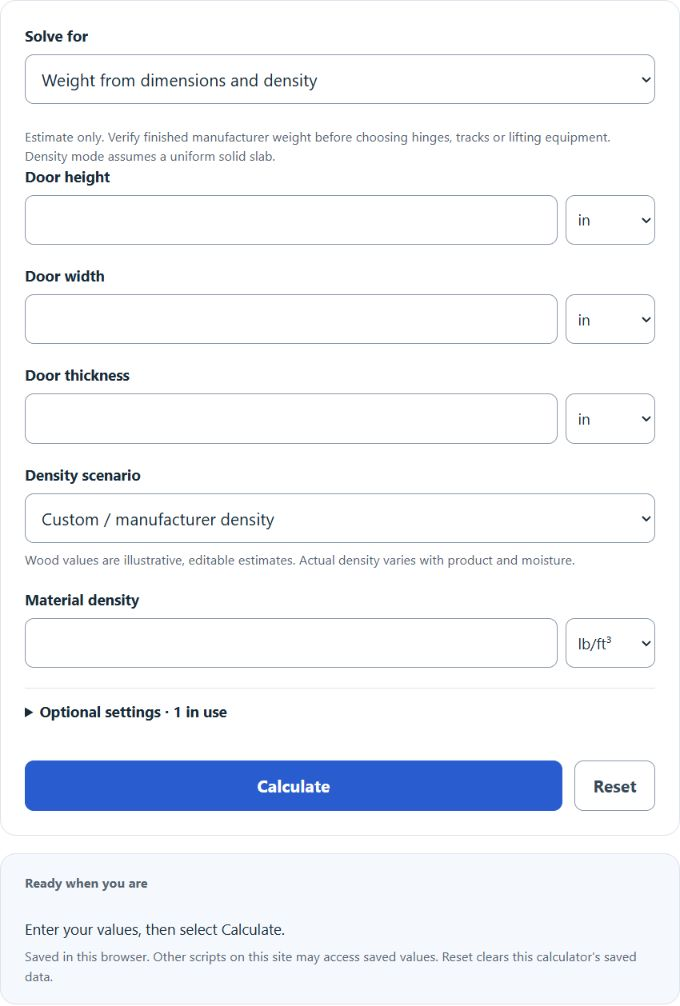
Calculate door weight from dimensions and material density, or use weight per area for hollow and core doors, with cutouts, hardware, quantity, and lb/kg conversions.
- All Construction Calculators
- Door Header Size Calculator
- Hinge Weight Calculator
- MDF Weight Calculator
- Plywood Weight Calculator
- OSB Weight Calculator
- Weight Per Square Foot Calculator
Door Weight Formula
The following formula is used to calculate the weight of a door.
- Where DW is the door weight (lbs)
- L is the length of the door (inches)
- W is the width of the door (inches)
- T is the thickness of the door (inches)
- D is the density of the door material (lbs/ft^3)
- 48 lbs/ft^3 as an illustrative MDF assumption
- 70 lbs/ft^3 as an illustrative HDF assumption; use the product specification
To calculate the weight of a door, simply calculate the volume with the length, width, and thickness, then multiply by the density of the material.
What is a door weight?
Door weight here means estimated mass in lb or kg. Use net volume times density for a uniform slab, or net area times a manufacturer mass-per-area rating for other constructions, then add hardware not already included.
What is the average weight of a door?
Door weight depends on dimensions and construction. The 100-pound value below is one solid-slab example, not a universal average.
How to calculate the weight of a door?
Example Problem:
The following example outlines how to calculate the weight of a door.
First, determine the length. In this example, the door is measured to be 80″ tall.
Next, determine the width. This is measured to be 30″ wide.
Next, determine the thickness. The thickness is 1.5 inches.
Next, determine the density. For this example, a medium-density fiberboard will be used which has a density of 48 lbs/ft^3.
Finally, calculate the door weight using the formula above:
DW = L/12*W/12*T/12 * D
DW = 80/12*30/12*1.5/12 * 48
DW = 100 lbs