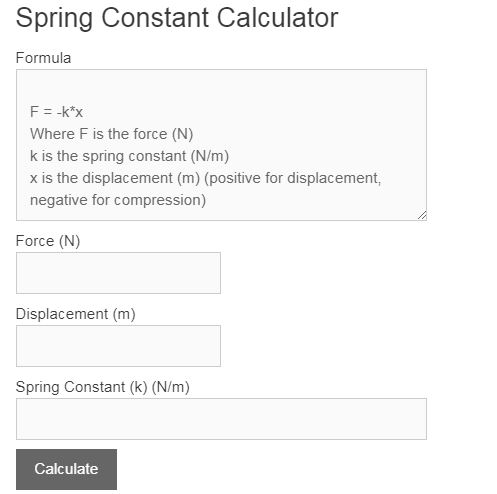
Calculate spring constant, force, or displacement from any two values using N, lbf, meters, cm, mm, inches, feet, yards, N/m, or lbf/in.
Related Calculators
- Load Force Calculator
- Wave Period Calculator
- Pendulum Velocity Calculator
- Velocity to Work Calculator
- All Physics Calculators
Hooke’s Law Formula
The spring constant calculator uses Hooke’s Law to relate force, displacement, and spring stiffness for a linear spring. In the elastic region, the restoring force is proportional to how far the spring is stretched or compressed from equilibrium.
- F = restoring force exerted by the spring
- k = spring constant, also called spring rate or stiffness
- x = displacement from the equilibrium position
The negative sign shows direction: the spring force acts opposite the displacement. If you only need the size of the force or stiffness, use the magnitude form.
Rearranged Forms
This calculator can solve for any one of the three variables when the other two are known.
What the Spring Constant Means
The spring constant measures how stiff a spring is. A larger value of k means more force is required to produce the same displacement. A smaller value means the spring is easier to stretch or compress.
On a force-versus-displacement graph, the slope in the linear region is the spring constant.
| Symbol | Description | Common Units |
|---|---|---|
| F | Spring force | N, lbf |
| k | Spring constant / spring rate | N/m, lbf/in |
| x | Extension or compression from equilibrium | m, cm, mm, in, ft, yd |
How to Use the Spring Constant Calculator
- Enter any two known values: force, displacement, or spring constant.
- Select the correct units for each input.
- Use a consistent sign convention if you want signed results:
- extension often treated as positive
- compression often treated as negative
- Click calculate to solve for the missing value.
If you are only interested in stiffness magnitude, enter positive values and interpret the answer as the size of the force or spring rate.
Examples
Finding the Spring Constant
If a spring requires 12 N of force to stretch 0.03 m, the stiffness is:
This means every additional meter of displacement would require 400 N of force, as long as the spring remains in its linear elastic range.
Finding the Force
If a spring has a spring constant of 250 N/m and is stretched 0.08 m, the magnitude of the restoring force is:
Finding the Displacement
If a spring has a stiffness of 500 N/m and experiences a 40 N force, the displacement magnitude is:
Important Notes for Accurate Results
- Hooke’s Law is linear. It only applies while the spring remains in its elastic range.
- Do not mix units. Convert displacement and force to compatible units before interpreting results manually.
- The negative sign is directional. It does not mean the spring constant itself is negative.
- A larger spring constant means a stiffer spring. Doubling k doubles the force needed for the same displacement.
- Zero displacement means zero spring force. At equilibrium, the spring is not exerting a restoring force due to deflection.
Related Spring Relationships
Spring problems often involve energy as well as force. The elastic potential energy stored in a spring is:
For a vertical spring holding a mass at rest, the spring force balances the weight:
If multiple springs are combined, the equivalent stiffness depends on how they are arranged.
Parallel springs:
Series springs:
FAQ
What are the units of spring constant?
In SI units, spring constant is usually expressed in newtons per meter (N/m). In U.S. customary units, it is often expressed in pounds-force per inch (lbf/in).
Is the spring constant always positive?
For an ordinary passive spring, yes. The negative sign belongs to the force direction in Hooke’s Law, not to the stiffness value itself.
Does the spring constant depend on mass?
No. The spring constant is a property of the spring itself and depends on its material and geometry. The attached mass affects motion, but not the spring’s inherent stiffness.
Can the spring constant change?
It can if the spring is damaged, heated significantly, pushed beyond its elastic limit, or operating in a non-linear range. For ideal calculations, it is treated as constant.
What does a high spring constant mean?
A high spring constant means the spring is stiff and resists deformation. It takes more force to produce the same extension or compression than it would for a softer spring.