Calculate wavelength, frequency, period, and photon energy for light and sound waves, or convert between period and frequency values.
Wave Period Formula
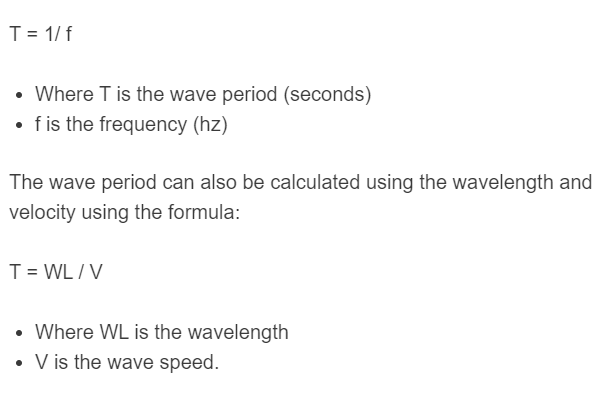
The following is the wave period formula:
- Where T is the wave period (seconds)
- f is the frequency (Hz)
To calculate a wave period, simply take the inverse of the frequency. If the frequency is in Hz, this provides the period in seconds.
The wave period can also be calculated using the wavelength and wave speed using the formula:
- Where λ is the wavelength (meters)
- v is the wave speed (m/s)
Wave Period Definition
A wave period is defined as the time it takes for one full cycle of a wave to pass a fixed point (equivalently, the time for the wave to travel one wavelength). A wave period should not be confused with wavelength or frequency. Wavelength is the distance of one cycle along the direction of propagation, and frequency is the inverse (reciprocal) of the period.
How to calculate a wave period?
- First, determine the information available to you. You should be provided either the frequency or both the wavelength and the wave speed.
- Next, determine the formula you should use. For this example, we will say that frequency was provided and it is equal to 50 Hz.
- Finally, calculate the wave period using the formula above. Using the formula we find the wave period to be 1/(50 Hz) = 0.020 seconds.
FAQ
Wave period and wavelength are related, but not the same. The wave period can be calculated using the wavelength and the wave speed (T = λ/v).
Wave period and frequency are reciprocals of each other: T = 1/f and f = 1/T.
Many waves are periodic (repeating) when produced by a periodic source and can be modeled as sinusoidal (for example, many sound and electromagnetic waves). Water surface waves can also be periodic (regular wave trains), but they can be non-periodic as well (irregular wind-driven or breaking waves).
The period changes when the frequency changes (since T = 1/f), such as when the source frequency changes or due to Doppler shift. When a wave enters a different medium, the wave speed and wavelength typically change, but the frequency (and therefore the period) usually remains the same across the boundary.