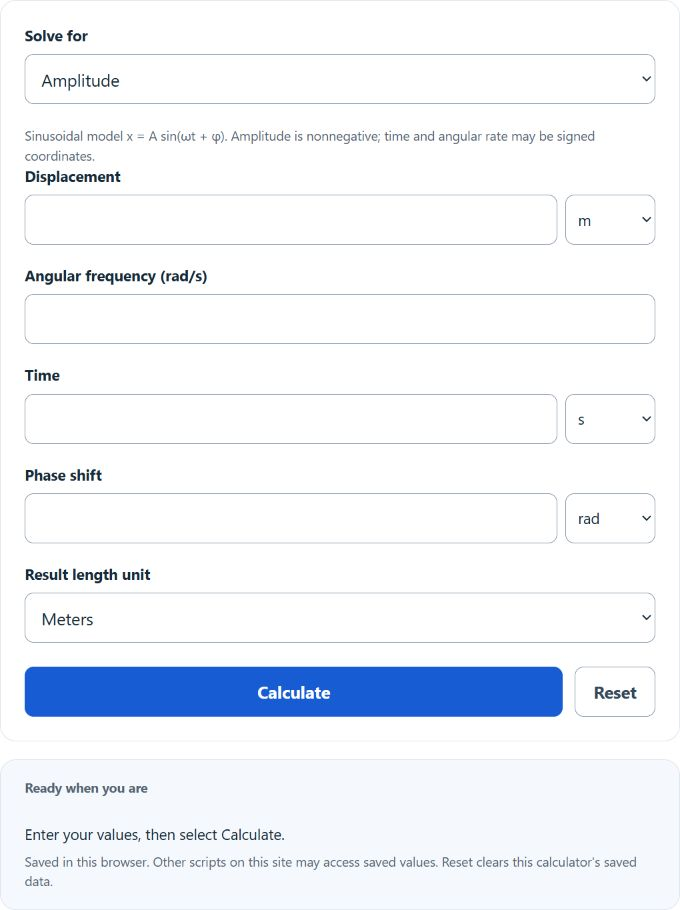
Calculate wave displacement, angular frequency, time, phase shift or amplitude from x = A sin(ωt + φ) by choosing a solve mode and entering the known values.
Related Calculators
- Received Power Calculator
- High Pass Filter Calculator
- EMF Distance Calculator
- Epicenter Distance Calculator
- All Physics Calculators
Wave Amplitude Formula
The calculator uses the sinusoidal wave displacement equation. Choose the value to solve for, then enter the known values. Inverse modes also offer a sine branch and integer cycle index.
Rearranged forms used by the calculator:
- x = displacement at a specific time
- A = wave amplitude, the maximum displacement from equilibrium
- ω = angular frequency in radians per second
- t = time
- φ = phase shift
The displacement function calculates the wave position from amplitude, angular frequency, time, and phase shift.
The amplitude function divides displacement by the sine term and requires a nonnegative answer. Opposite signs do not fit the fixed phase; a zero or numerically near-zero sine term cannot reliably determine amplitude.
The displayed inverse formulas above show the default principal branch with cycle index 0. More generally, set θ = asin(x/A) + 2πk or θ = π − asin(x/A) + 2πk, then use ω = (θ − φ)/t, t = (θ − φ)/ω or φ = θ − ωt. Here k is any integer; the calculator supports k from −1,000,000 to 1,000,000 and bounds phase magnitude for numerical reliability. Signed time and angular-rate coordinates are allowed.
Unit Conversions and Wave Value Checks
| Quantity | Allowed units | Base unit used in calculation |
|---|---|---|
| Displacement | m, cm, mm, km, ft, in | meter |
| Amplitude | m, cm, mm, km, ft, in | meter |
| Angular frequency | rad/s | rad/s |
| Time | s, min, h | second |
| Phase shift | rad, deg | radian |
| Check | Meaning |
|---|---|
| |x| ≤ |A| | Displacement cannot be larger than amplitude in this sinusoidal model. |
| A ≥ 0 | Amplitude is treated as a magnitude, so it is non-negative. |
| sin(ωt + φ) ≠ 0 when solving for A | If the sine term is zero, amplitude cannot be found from x divided by that term. |
Examples
Example 1: Calculate displacement
Given amplitude A = 2 m, angular frequency ω = 3 rad/s, time t = 0.5 s, and phase shift φ = 0.2 rad:
The displacement is about 1.9833 m.
Example 2: Calculate amplitude
Given displacement x = 0.5 m, angular frequency ω = 4 rad/s, time t = 0.2 s, and phase shift φ = 0.1 rad:
The amplitude is about 0.6383 m.
FAQ
What is wave amplitude?
Wave amplitude is the maximum displacement from the equilibrium position. If a wave moves 3 cm above and 3 cm below the center line, its amplitude is 3 cm.
Why can the calculator reject a displacement value?
For the equation x = A sin(ωt + φ), the sine value must stay between -1 and 1. That means displacement cannot have a greater magnitude than amplitude. If |x| is greater than |A|, the inputs do not fit this wave model.
Why can time, angular frequency, or phase shift have multiple solutions?
Sine has two inverse branches, θ = asin(x/A) + 2πk and θ = π − asin(x/A) + 2πk. Choose a branch and cycle index to select a solution. The default uses the principal branch with k = 0; zero amplitude or a zero inverse denominator may leave the requested value undetermined.