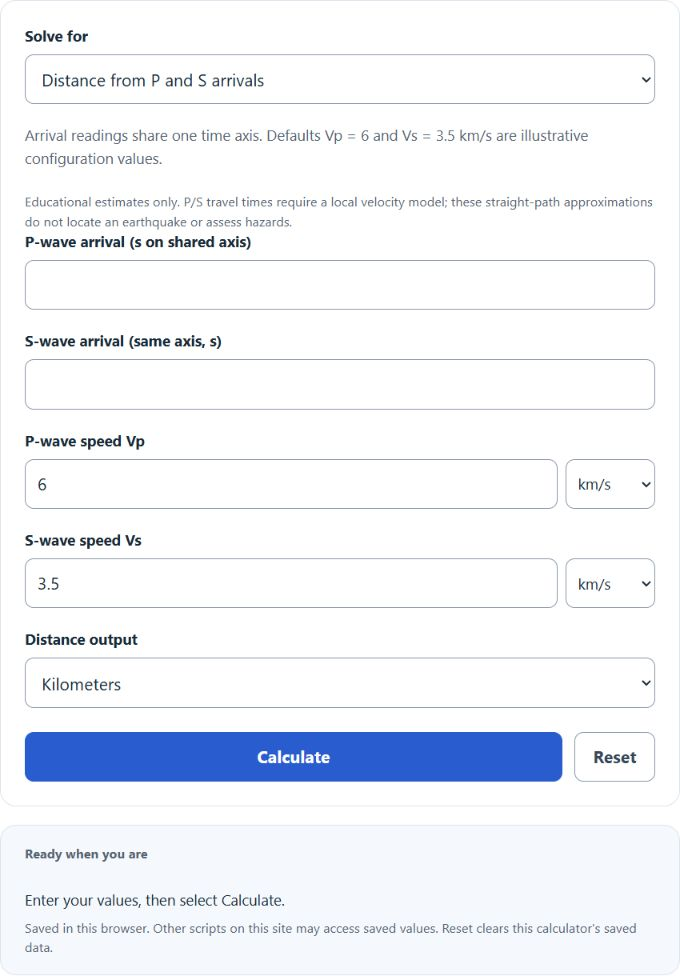
Estimate source-path distance from P- and S-wave arrivals or their time gap, or calculate epicentral surface distance and a geometric source chord from coordinates and depth. The wave model approximates epicentral distance only when focal depth is negligible.
- All Physics Calculators
- All Distance Calculators
- Light Speed Distance Calculator
- Average Distance Calculator
- Milliradian Distance Calculator
Epicenter Distance Formula
The common-path, constant-speed wave model uses P speed Vp and S speed Vs, with Vp greater than Vs. Real travel times depend on the regional Earth model.
- d is the estimated common source-path distance (km); it is a shallow-event epicentral approximation
- S is the arrival time of first shear wave (s)
- P is the arrival time of first compressional wave (s)
Subtract P arrival from S arrival on one shared time axis, then divide the gap by (1/Vs − 1/Vp). The illustrative defaults Vp = 6 km/s and Vs = 3.5 km/s give a factor of 8.4 km/s; that factor is not universal. Coordinate mode returns great-circle surface distance on a sphere of radius 6,371.0088 km. Optional focal depth supplies a geometric source chord, while the retained square-root surface/depth result is only a local flat approximation.
How to Calculate Epicenter Distance?
The following example problems outline how to calculate Epicenter Distance.
Example Problem #1:
- First, determine the arrival time of the first shear wave (s).
- The arrival time of the first shear wave (s) is given as 24.
- Next, determine the arrival time of the first compressional wave (s).
- The arrival time of the first compressional wave (s) is provided as 12.
- Finally, calculate the Epicenter Distance using the equation above:
With Vp = 6 km/s and Vs = 3.5 km/s, d = (S−P) × 8.4.
The values given above are inserted into the equation below and the solution is calculated:
d = (24−12) × 8.4 = 100.8 km in the illustrative constant-speed model.
FAQ
What are shear waves and compressional waves?
Shear waves (S-waves) and compressional waves (P-waves) are types of seismic waves generated by earthquakes. P-waves are the first to arrive at a seismic station because they travel the fastest. They compress and expand the ground in the direction they are traveling. S-waves arrive after P-waves and move the ground up and down or side to side, perpendicular to the direction of wave travel.
Why is it important to calculate the epicenter distance?
Seismologists estimate source location and origin time from multiple stations with an Earth velocity model and uncertainty analysis. One arrival gap gives a distance estimate, not an exact epicenter or a hazard assessment. The epicenter is the surface point above the hypocenter.
Can the epicenter distance formula be used for any type of seismic event?
The displayed P/S equation assumes constant wave speeds along a common path. It is an educational approximation; real events require appropriate travel-time curves or velocity models. Coordinate distances describe geometry and do not model seismic rays, shaking, or safety.