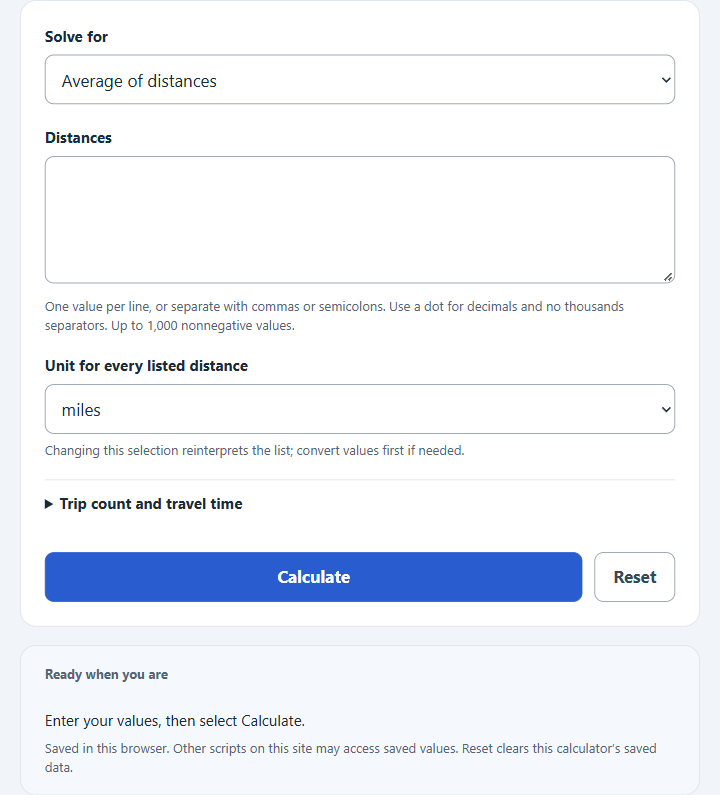
Calculate average distance from multiple trips, solve speed-distance-time values, or estimate great-circle distance between cities or coordinates.
- All Math and Numbers Calculators
- All Distance Calculators
- Fractional Distance Calculator
- Diagonal Distance Calculator
Average Distance Formula
Choose a task: average listed distances, solve distance, speed or time, or calculate a great-circle distance between coordinates. Optional trip counts divide the listed total by that count; optional travel speeds estimate time. Coordinate multipliers are assumed scenarios, not validated road-route predictions.
Trip distance:
- d = distance traveled
- v = average speed
- t = elapsed time
Average of distances:
- d_i = each individual distance
- n = number of distance values
Units must match before you multiply or add. The calculator converts speed, time, and distance internally to SI units (m/s, seconds, meters) and converts the answer back to your chosen unit. The trip formula assumes speed is constant over the interval; if speed varies, use the mean speed for the period.
Reference Tables
Quick conversions between common speed and distance units, plus illustrative speed assumptions you can enter for a trip. Actual speeds vary.
| From | To | Multiply by |
|---|---|---|
| mph | km/h | 1.60934 |
| mph | m/s | 0.44704 |
| km/h | m/s | 0.27778 |
| miles | km | 1.60934 |
| ft | m | 0.3048 |
| Activity | Illustrative speed assumption |
|---|---|
| Walking | 3 mph (4.8 km/h) |
| Running | 6 to 8 mph (9.7 to 12.9 km/h) |
| Cycling (road) | 14 to 18 mph (22.5 to 29 km/h) |
| City driving | 25 to 35 mph (40 to 56 km/h) |
| Highway driving | 60 to 70 mph (97 to 113 km/h) |
| Commercial flight | 500 to 575 mph (805 to 925 km/h) |
Worked Examples
Example 1 — Trip distance. You drove for 2.5 hours at an average of 60 mph.
d = 60 × 2.5 = 150 miles.
Example 2 — Mixed units. A runner averages 4 m/s for 30 minutes (1800 seconds).
d = 4 × 1800 = 7200 m, or 7.2 km.
Example 3 — Average of distances. Four daily commutes: 12.4, 11.8, 13.1, and 12.7 miles.
d_avg = (12.4 + 11.8 + 13.1 + 12.7) / 4 = 50.0 / 4 = 12.5 miles.
FAQ
What if my speed wasn’t constant? Use the time-weighted average speed for the interval. If you have segment speeds and segment times, multiply each pair, add the products, and that is your total distance directly.
Can I average distances in different units? Convert them all to one unit first. The calculator’s average mode treats every entry as the unit selected in the dropdown.
Why does my answer differ slightly from a map app? Map apps use road or path geometry. Trip calculations use distance = time-weighted average speed × elapsed time. Coordinate calculations use a spherical great-circle approximation, which does not follow roads; multiplying it by an assumed factor does not provide an actual route.