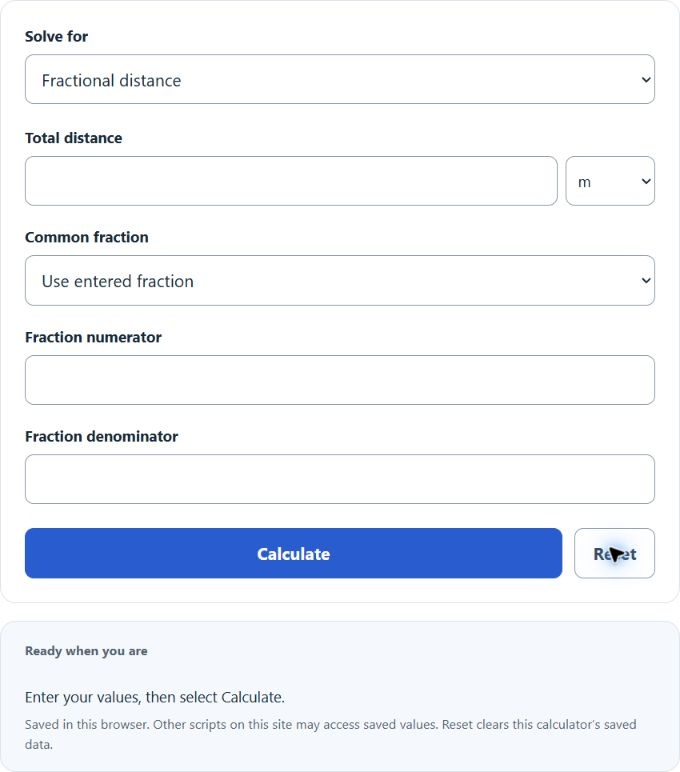
Calculate fractional distance from total distance and a fraction, or find distance completed and remaining using a completed fraction.
- All Math and Numbers Calculators
- All Distance Calculators
- Diagonal Distance Calculator
- Genetic Linkage Distance
- Fraction To Decimal Calculator
Fractional Distance Formula
The following formula is used to calculate the Fractional Distance.
- Where Df is the Fractional Distance
- TD is the total distance
- F is the fraction of the distance
To calculate the fractional distance, multiply the total distance by the fraction.
How to Calculate Fractional Distance?
The following example problems outline how to calculate Fractional Distance.
Example Problem #1:
- First, determine the total distance.
- The total distance is given as 167.
- Next, determine the fraction of the distance.
- The fraction of the distance is provided as 3/5.
- Finally, calculate the Fractional Distance using the equation above:
Df = TD * F
The values given above are inserted into the equation below and the solution is calculated:
Df = 167 * 3/5 = 100.2
FAQ
What is the significance of calculating fractional distances?
Calculating fractional distances can be particularly useful in various fields such as physics, engineering, and geography. It allows for the determination of a part of a total distance, which can be critical for planning, construction, and navigation purposes.
Can the fractional distance formula be applied to any type of distance measurement?
Yes, the fractional distance formula is versatile and can be applied to any type of distance measurement, whether it’s in miles, kilometers, meters, or any other unit of distance. The fraction is dimensionless. The calculated portion uses the total-distance unit; when comparing two distances, convert them to the same unit.
Are there any limitations to using the fractional distance calculator?
While the fractional distance calculator is a powerful tool for quickly determining a portion of a distance, it requires accurate input values to be effective. Additionally, it does not account for variations in terrain or obstacles that might affect the actual distance traveled. For more complex scenarios, additional calculations or methods may be necessary.