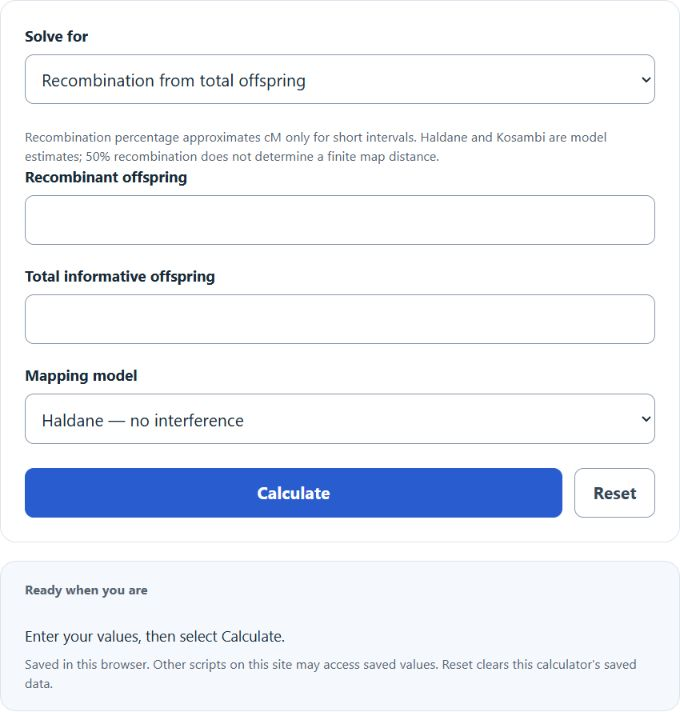
Calculate recombination fraction from offspring counts and convert between recombination fraction and cM using Haldane or Kosambi maps.
- All Biology Calculators
- Recombination Frequency Calculator
- HWE Calculator
- Phenotypic Ratio Calculator
- Fixation Index Calculator
- Transformation Efficiency Calculator
Genetic Distance Formula
The following formulas calculate observed recombination fraction (r) and percentage. Recombination percentage approximates map distance in cM only over short intervals; it is not a general distance conversion.
- Where r is the observed recombination fraction (unitless); standard two-locus population models range from 0 to 0.5
- RF(%) is the observed recombination percentage; a finite sample can exceed the population-model expectation of 50%
- RG is the total number of recombinant gametes (or recombinant offspring scored)
- G is the total number of gametes (or total offspring scored)
To calculate the recombination fraction, divide the number of recombinant gametes by the total number of gametes. To express it as a percentage, multiply by 100. For standard two-locus population models, r approaches a maximum of 0.5 (50%). A sample above 50% requires checking sampling variation, parental phase and scoring; it does not imply a map distance above 50 cM. Also, using recombination percentage as “distance” (≈ cM) is only a good approximation for small distances because multiple crossovers can cause recombination to underestimate map distance; mapping functions (e.g., Haldane or Kosambi) are used to convert between r and map distance (cM).
For 0 ≤ r < 0.5, Haldane gives d = −50 ln(1 − 2r) cM and assumes independent crossovers without interference. Kosambi gives d = 25 ln((1 + 2r)/(1 − 2r)) cM under a particular interference model. Their inverses are r = (1 − exp(−d/50))/2 and r = 0.5 tanh(d/50), respectively. Genetic map distance may exceed 50 cM; at exactly 50% recombination no finite distance is determined by either model. Independent assortment can arise from separate chromosomes or far-apart loci on one chromosome.
How to Calculate Genetic Distance?
The following example problems outline how to calculate Genetic Distance.
Example Problem #1:
- First, determine the total number of recombinant gametes.
- The total number of recombinant gametes is given as 90.
- Next, determine the total number of gametes.
- The total number of gametes is provided as 250.
- Finally, calculate the Genetic Distance using the equation above:
r = RG / G
The values given above are inserted into the equation below and the solution is calculated:
r = 90 / 250 = 0.36 (36%)
Example Problem #2:
For this problem, the variables needed are provided below:
total number of recombinant gametes = 7
total number of gametes = 51
This example problem is a test of your knowledge on the subject. Use the calculator above to check your answer.
r = RG / G = ?