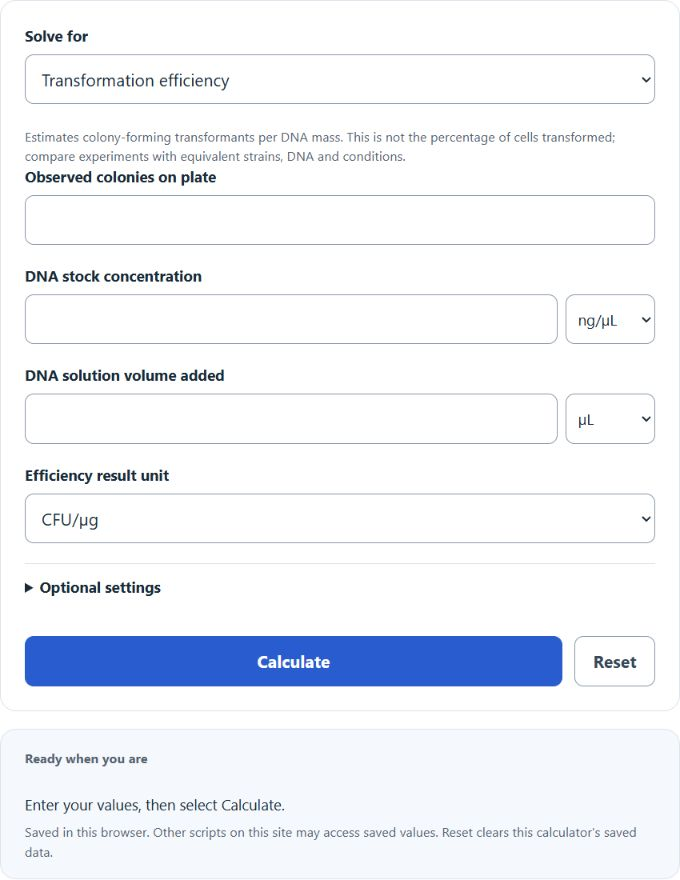
Select transformation efficiency, expected plate colonies, DNA concentration, or DNA volume to solve for, with optional plating and dilution correction.
- All Biology Calculators
- Bacterial Concentration Calculator
- Efficiency Calculator
- CFU/mL Calculator
- Cell Density Calculator
- Concentration from Absorbance Calculator
Transformation Efficiency Formula
Transformation efficiency describes how many successful transformants are produced per amount of DNA used in a bacterial transformation. In practice, it is usually reported as colony-forming units (CFU) or transformants per nanogram or per microgram of DNA, with optional correction for the plated fraction and any dilution.
When DNA is entered as concentration and volume, the DNA mass is:
If you plated only part of the recovered transformation, or you plated a diluted sample, use this correction factor:
To convert a result from transformants/ng to transformants/µg:
Variable Meanings
- TE = transformation efficiency
- N = number of colonies counted on the plate
- m = total DNA mass used in the transformation
- C = DNA concentration
- V = DNA volume added to the transformation mix
- F = correction factor for partial plating and dilution
- Vr = total recovery volume after transformation
- Vp = volume plated
- D = dilution factor of the plated sample
How to Calculate Transformation Efficiency
- Select the value to solve for. Enter observed colonies as a whole count; a calculated expected count can be fractional.
- Determine the DNA concentration and the volume of DNA added.
- Calculate total DNA mass from concentration × volume, making sure the units match.
- For volume correction, enter both undiluted recovery volume and the volume plated after dilution, or leave both blank for a ratio of 1. Enter reciprocal dilution (10 for 1:10), or leave it blank for undiluted. The effective plated fraction cannot exceed the recovery sample.
- Divide the corrected transformant count by the DNA mass.
If the entire recovered transformation was plated without dilution, the correction factor is effectively 1, so the calculation becomes simply the colony count divided by DNA mass.
Rearranged Forms
The explicit solve modes use these equivalent forms. Zero-efficiency and zero-count inverse cases can have no positive or no unique solution:
Example Calculation
Assume you count 250 colonies, use DNA at 10 ng/µL, add 1 µL of DNA, recover the cells in 1000 µL, and plate 100 µL of an undiluted sample.
This means the transformation produced the equivalent of 250 transformants for every nanogram of DNA used, or 250,000 transformants per microgram.
How to Interpret the Result
- Higher efficiency means the competent cells and protocol produced more transformants from the same DNA input.
- Lower efficiency can result from poor cell competency, degraded DNA, large plasmid size, ineffective recovery, strong selection pressure, plating error, or incorrect dilution correction.
- Best comparisons are made only when strain, plasmid, antibiotic, transformation method, and recovery conditions are similar.
Input Guidance
| Input | What to Enter |
|---|---|
| Colonies | The count from a readable selective plate. Avoid plates that are overgrown or confluent. |
| DNA Concentration | The concentration of the DNA stock used for transformation, using the correct unit selected in the calculator. |
| DNA Volume | Only the volume of DNA solution added to the transformation, not the total reaction volume. |
| Total Recovery Volume | The full post-recovery liquid volume before any plating step. |
| Volume Plated | The actual amount spread onto the plate. |
| Dilution Factor | Use 1 for undiluted plating, 10 for a 1:10 dilution, 100 for a 1:100 dilution, and so on. |
Common Unit Notes
- 1 µg = 1000 ng
- 1 mL = 1000 µL
- If concentration is entered in µg/µL, convert carefully before comparing results with values reported in transformants/ng.
- If your output is desired in transformants/µg, multiply the transformants/ng value by 1000.
Common Mistakes
- Forgetting to account for plating only a fraction of the recovered cells.
- Ignoring dilution when the plated sample was not taken directly from the recovery tube.
- Mixing ng and µg units.
- Using colony counts from plates that are too crowded to count accurately.
- Entering the total transformation volume instead of the DNA volume.
Why Transformation Efficiency Matters
Transformation efficiency is a practical way to judge the quality of competent cells and the effectiveness of a transformation workflow. It helps compare protocols, troubleshoot low colony counts, estimate expected clone yield, and decide whether a transformation should be repeated before moving on to downstream screening or sequencing.