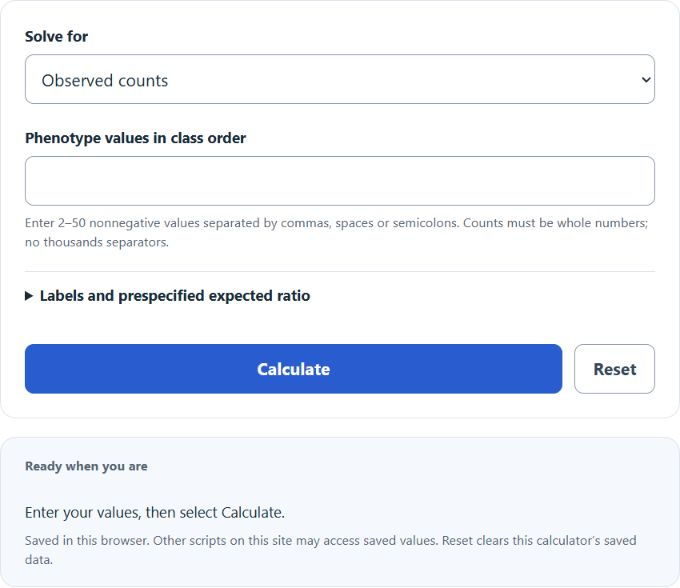
Calculate phenotypic ratios from observed phenotype counts, with percentages, the closest classic genetic ratio, and chi-square fit.
- All Biology Calculators
- Fixation Index Calculator
- Genetic Linkage Distance Calculator
- Recombination Frequency Calculator
- Hardy-Weinberg Equilibrium Calculator
Phenotypic Ratio Formula
A phenotypic ratio in genetics is normally written as a colon-separated ratio across phenotype classes (e.g., 3:1, 9:3:3:1). The calculator also supports a two-class normalization in the results, reporting the first-to-smallest ratio factor.
- Where F1, F2, …, Fn are the phenotype counts/frequencies for each phenotype class (the ratio is written as F1:F2:…:Fn and then simplified).
- FS is the smallest (least-frequent) phenotype count/frequency among the classes (used for the first-to-smallest normalization).
- R1:S is the first-to-smallest ratio factor (dimensionless), equal to F1/FS.
To report a phenotypic ratio from observed data with multiple phenotype classes, write the counts/frequencies as F1:F2:…:Fn and simplify (often by dividing by the greatest common divisor). For the two-class case, dividing F1 by FS gives the first-to-smallest factor; you can also express the ratio as F1:FS and simplify.
How to Calculate Phenotypic Ratio?
The following example problems outline how to calculate a two-class normalized phenotypic ratio (first-to-smallest normalization).
Example Problem #1:
- First, determine the frequency (or count) of the first phenotype class.
- The frequency of the first phenotype is given as 15.
- Next, determine the frequency (or count) of the least-frequent phenotype class (the smallest count).
- The frequency of the least-frequent phenotype is provided as 5.
- Finally, calculate the first-to-smallest ratio factor using the equation above.
R1:S = F1 / FS
The values given above are inserted into the equation below and the solution is calculated:
R1:S = 15 / 5 = 3, which corresponds to a simplified two-class ratio of 15:5 = 3:1.
Example Problem #2:
For this problem, the variables required are provided below:
frequency of the first phenotype = 16
frequency of the least-frequent phenotype = 6
Test your knowledge using the equation and check your answer with the calculator above. (Tip: 16:6 simplifies to 8:3, and the first-to-smallest factor is 16/6 ≈ 2.6667.)
R1:S = F1 / FS = ?