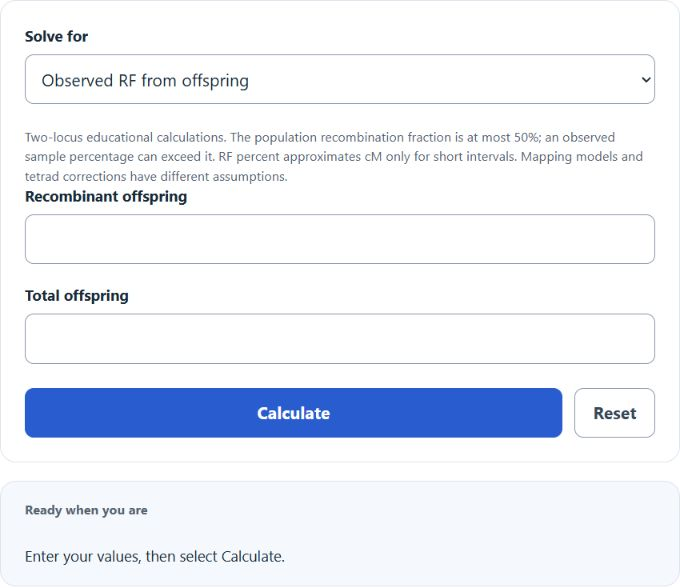
Calculate recombination frequency, map distance, and tetrad-based genetic linkage estimates from offspring counts or gene pair data.
- Genetic Linkage Distance Calculator
- Centimorgan to Percentage Calculator
- Fixation Index Calculator
- HWE Calculator
- Phenotypic Ratio Calculator
- All Biology Calculators
Recombination Frequency Formula
The following formula is used to calculate a recombination frequency.
- Where RF is the recombination frequency
- RCO is the total number of recombinants
- TO is the total offspring.
To calculate RF percent, divide recombinant offspring by total offspring and multiply by 100. Observed sample percentages can exceed 50%, while the population two-locus recombination fraction is at most 50%. RF percent approximates cM only for short intervals; Haldane and Kosambi conversions use distinct crossover assumptions and require RF below 50% for finite distance. For unordered tetrads, observed RF is 100 × (NPD + T/2)/(PD + NPD + T), whereas the Perkins map estimate is 50 × (T + 6NPD)/(PD + NPD + T) cM. These are different quantities. Perkins assumes no chromatid interference and becomes less reliable with higher-order crossovers.
Recombination Frequency Definition
Recombination frequency is the proportion of offspring or gametes recombinant for the two loci being studied, relative to the parental allele configuration.
Recombination Frequency Example
How to calculate a recombination frequency?
- First, determine the total number of recombinants.
Calculate the number of recombinants.
- Next, determine the total offspring.
Measure the total number of offspring.
- Finally, calculate the recombination frequency.
Use the formula above to calculate the recombination frequency.
FAQ
A recombination frequency is the rate or proportion of recombinant offspring that are produced in a genetic cross of two organisms.