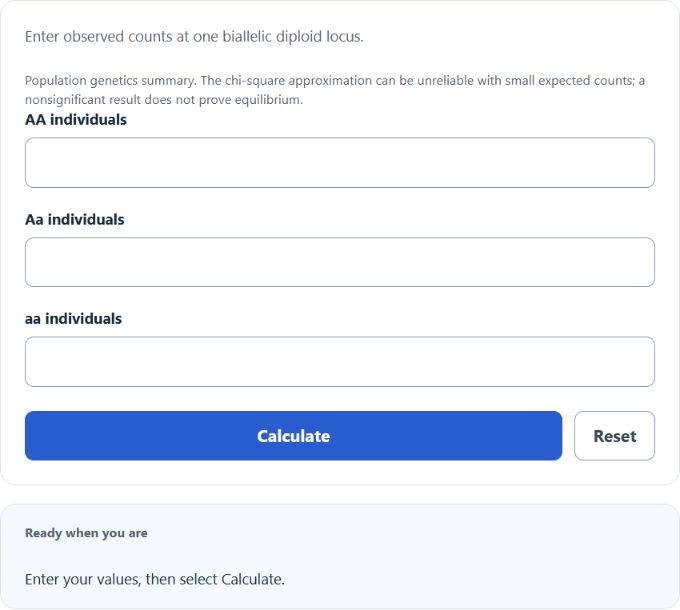
Calculate Hardy-Weinberg equilibrium from AA, Aa, and aa counts, showing allele frequencies, expected genotype counts, and chi-square.
Related Calculators
- Mutation Rate Calculator
- Phenotypic Ratio Calculator
- Coat Color Calculator
- Heritability Coefficient Calculator
- All Biology Calculators
HWE Formulas
For a single bi-allelic locus with allele frequencies p and q (where p + q = 1), Hardy–Weinberg equilibrium (HWE) predicts the following expected genotype frequencies:
Variables:
- p is the frequency of the first allele (A) in the population
- q is the frequency of the second allele (a) in the population
- p², 2pq, and q² are the expected genotype frequencies of AA, Aa, and aa, respectively
If you have a sample size of N individuals, the expected genotype counts under HWE are E(AA)=p²·N, E(Aa)=2pq·N, and E(aa)=q²·N. Pearson’s χ² = Σ(O−E)²/E uses 1 degree of freedom when the allele frequency is estimated from this sample. Its approximation can be unreliable for small expected counts; use an exact HWE test for inference in that case. A nonsignificant result does not prove equilibrium. A monomorphic sample has no informative chi-square comparison.
How to Calculate HWE Expected Genotype Frequencies?
The following steps outline how to calculate the Hardy–Weinberg expected genotype frequencies using f(AA)=p², f(Aa)=2pq, and f(aa)=q² (with p + q = 1).
- From whole-number genotype counts, calculate N = AA + Aa + aa and p = (2AA + Aa)/(2N).
- Compute the frequency of the second allele as q = 1 − p.
- Calculate the expected genotype frequencies: p² (AA), 2pq (Aa), and q² (aa).
- If you have a total sample size N, multiply each expected frequency by N to obtain expected genotype counts.
Example Problem:
For example, 36 AA, 48 Aa, and 16 aa individuals give N = 100 and the following allele frequencies:
Frequency of the first allele in the population (p) = 0.6
Frequency of the second allele in the population (q) = 0.4
Expected genotype frequencies under HWE: p² = 0.36 (AA), 2pq = 0.48 (Aa), and q² = 0.16 (aa).