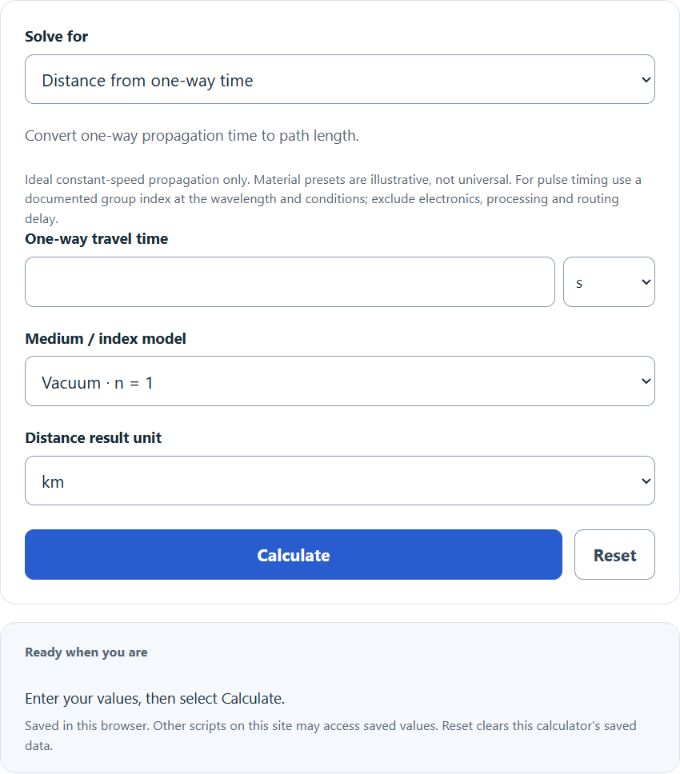
Calculate one-way distance, propagation time, or one-way range from round-trip time using vacuum light speed or an explicit medium index.
- All Physics Calculators
- All Distance Calculators
- Warp Speed Calculator
- Milliradian Distance Calculator
- Light Loss Factor Calculator
Light Speed Distance Formula
The light speed distance calculator uses the standard relationship between distance, speed, and time. For light traveling in a vacuum, the propagation speed is the physical constant known as the speed of light. If you are modeling light in air, glass, water, fiber, or another material, use the effective propagation speed for that medium rather than the vacuum value.
Where:
- D = distance traveled
- v = propagation speed
- t = travel time
- c = speed of light in vacuum
When you are calculating true light travel in a vacuum, substitute the vacuum light speed into the distance equation.
Rearranged Equations
The calculator provides distance, time and round-trip range modes. Propagation speed is derived from the selected medium index; the following equations express the underlying distance–speed–time relationship.
How to Use the Calculator
- Choose distance from one-way time, time from one-way distance, or range from round-trip time.
- Select the correct unit for each value using the unit dropdowns.
- Choose the medium and enter the visible required value. In custom mode, enter the propagation index.
- Click Calculate to compute the selected result.
Time units include seconds, milliseconds, microseconds, nanoseconds, minutes, hours, days and Julian years. Distance units include meters, kilometers, miles, astronomical units and light-years. Round-trip input supports seconds through nanoseconds.
Quick Reference Distances at the Speed of Light
| Travel Time | Distance in Meters | Distance in Kilometers | Notes |
|---|---|---|---|
| 1 nanosecond | 0.299792458 m | 0.000299792458 km | About 29.98 cm |
| 1 microsecond | 299.792458 m | 0.299792458 km | About 300 m |
| 1 millisecond | 299,792.458 m | 299.792458 km | About 300 km |
| 1 second | 299,792,458 m | 299,792.458 km | One light-second |
| 1 minute | 17,987,547,480 m | 17,987,547.48 km | One light-minute |
| 1 hour | 1,079,252,848,800 m | 1,079,252,848.8 km | One light-hour |
| 1 day | 25,902,068,371,200 m | 25,902,068,371.2 km | One light-day |
| 1 Julian year | 9,460,730,472,580,800 m | 9,460,730,472,580.8 km | Approximately one light-year |
Examples
Example 1: If light travels in a vacuum for 3 seconds, the distance is:
That is equal to 899,377.374 kilometers.
Example 2: If a signal must travel 10 kilometers in vacuum, first convert the distance to meters, then solve for time:
This is about 33.36 microseconds of one-way travel time.
Round-Trip Distance and Time-of-Flight
In radar, lidar, laser ranging, and many timing systems, the measured signal duration includes the outbound and return path. In that case, only half of the measured travel corresponds to the one-way distance.
Use this form only when the recorded time includes both directions of travel.
Light in a Medium
Light moves more slowly in materials than it does in a vacuum. If you know the refractive index of the material, the propagation speed can be estimated with the following relationship:
Material presets are illustrative approximations. Indices depend on material, wavelength and conditions. For pulse timing use a documented group index; a phase index may not predict group delay. This simple constant-speed model supports indices of at least 1 and excludes electronics, processing and routing delays.
Why Unit Choice Matters
- Very short delays are often best expressed in nanoseconds or microseconds.
- Longer astronomical distances are easier to interpret in light-seconds, light-minutes, light-hours, or light-years.
- Engineering applications often use meters, kilometers, or miles depending on the system being modeled.
- Communication and sensor systems may need one-way and round-trip calculations checked separately.
Common Uses for a Light Speed Distance Calculator
- Estimating electromagnetic signal delay over long distances
- Converting time-of-flight measurements into distance
- Checking latency limits in communications and instrumentation
- Understanding astronomical distance scales
- Comparing vacuum propagation with propagation through physical materials
Frequently Asked Questions
Is a light-year a unit of time?
A light-year is a unit of distance, not time. It represents how far light travels in one Julian year through a vacuum.
Can this calculator solve for time instead of distance?
Yes. Select Time from one-way distance, choose the medium and result unit, and enter the path distance. Speed is determined by the selected index.
Why might real-world results be slower than the vacuum calculation?
Real systems can include material delays, atmospheric effects, routing paths, electronics latency, and propagation through media that reduce the signal speed below the vacuum value.
When should I use the round-trip equation?
Use the round-trip form only when the measured time includes travel to the target and back to the source.