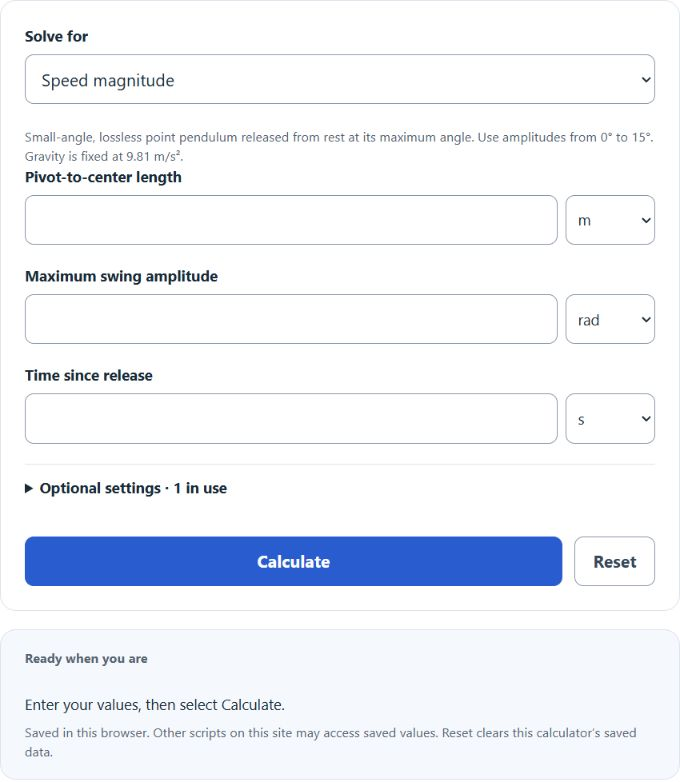
Calculate pendulum speed, angle amplitude, or time since release from pendulum length, swing angle, and velocity with unit conversions.
- All Physics Calculators
- All Velocity Calculators
- Pendulum Force Calculator
- Downward Force Calculator
Pendulum Velocity Formula
For a simple pendulum using the small-angle motion model, the instantaneous tangential speed magnitude can be estimated from the starting angle, pendulum length, and elapsed time.
This form is useful when you know the pendulum length, the initial swing angle, and the time since release. The calculator handles unit conversion automatically, but the physics relationship is based on a consistent set of length and time units.
| Symbol | Meaning | Typical Units |
|---|---|---|
| v | Instantaneous tangential speed magnitude of the bob | m/s, ft/s, in/s, cm/s |
| θ0 | Starting angle or angular amplitude | radians or degrees |
| L | Pendulum length measured from pivot to the bob’s center | m, ft, in, cm |
| t | Elapsed time from release | s, min, h |
| g | Gravitational acceleration | length/time2 |
| ω | Natural angular frequency | rad/s |
How to Calculate Pendulum Velocity
- Measure the pendulum length from the pivot point to the center of the bob.
- Enter the swing angle as the starting angle of the motion. If you use degrees, the calculator converts the value internally.
- Determine the pendulum’s angular frequency.
- Use the time value to evaluate the sine term and compute the instantaneous tangential velocity.
What the Result Tells You
- Zero velocity at the ends of the swing: the bob briefly stops before reversing direction.
- Largest speed near the bottom: the pendulum moves fastest as it passes through equilibrium.
- Larger starting angles increase speed: a wider release angle produces a larger velocity response in this model.
- Length changes timing: longer pendulums move more slowly through each cycle because their natural frequency is lower.
Maximum Pendulum Velocity
The maximum speed occurs as the bob passes through the lowest point of its path.
This relationship is especially useful for quick comparisons because it shows how peak speed depends on the starting angle and the square root of pendulum length.
Alternative Form When Angle Is Known
If you know the pendulum’s current position rather than the elapsed time, the velocity can also be written in terms of the current angle and the starting angle.
This form is helpful for energy-based analysis and for checking how speed changes at different points along the arc.
Related Motion Quantity
If you also need the time for one full oscillation, the period of a simple pendulum is:
Knowing the period can make it easier to choose a meaningful time value when estimating the bob’s velocity at a specific point in the cycle.
Practical Notes
- Use the full pendulum length, not just the visible string above the bob.
- Keep angle units straight; radians are used in the underlying equation.
- This calculator uses ideal small-angle motion and accepts amplitudes up to 15°; it fixes gravity at 9.81 m/s².
- The reported speed is a nonnegative tangential magnitude, not a signed horizontal or vertical component.
- If air resistance, friction, or a very large release angle matter, real-world motion can differ from the idealized result.