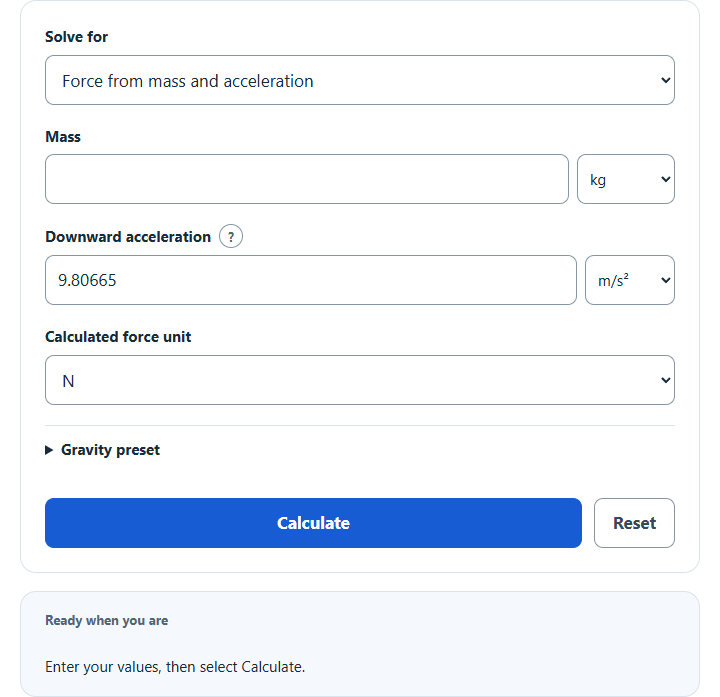
Calculate downward force from mass and gravity or another downward acceleration, or from a pressure difference and area, and solve for mass or area.
- All Physics Calculators
- All Force Calculators
- Inclined Plane Force Calculator
- Contact Force Calculator
- Horizontal + Vertical Force Calculator
- Pendulum Force Calculator
- Gyroscopic Force Calculator
- Hammer Force Calculator
- Lateral Force Calculator
- Pendulum Velocity Calculator
Downward Force Formula
The following equation is used to calculate the Downward Force.
- Where Fd is the downward force (N)
- m is the mass (kg)
- AD is the acceleration in the downward direction (m/s²)
To calculate the downward force, multiply the mass by the downward acceleration.
What is a Downward Force?
Definition:
A downward force is a force that pulls an object down. For example, the Earth’s gravity pulls things down towards it, so we can say that gravity is a downward force.
How to Calculate Downward Force?
Example Problem:
The following example outlines the steps and information needed to calculate the Downward Force.
First, determine the downward acceleration of the object. In this example, gravity pulls the object downward at an acceleration of 9.81 m/s^2.
Next, measure the mass of the object. This object is measured to have a total mass of 30 kg.
Finally, calculate the downward force using the formula above:
Fd = m * AD
Fd = 30* 9.81
Fd = 294.3 N