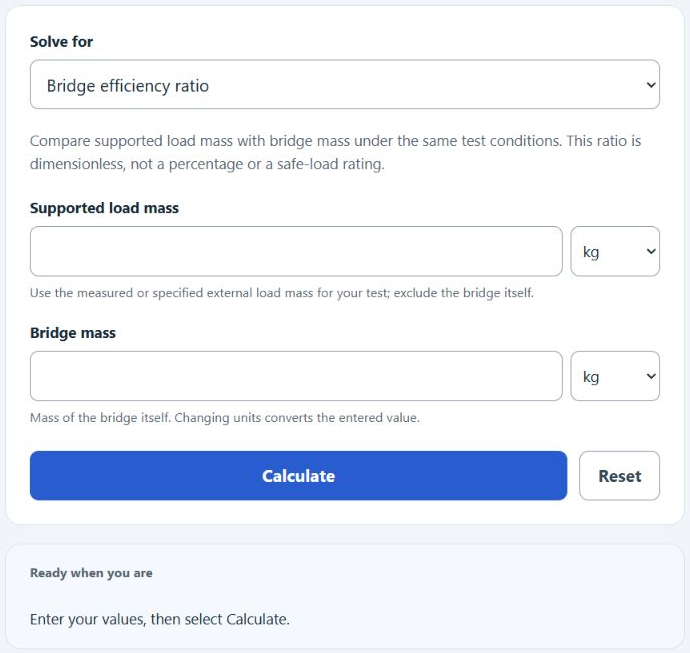
Calculate bridge efficiency ratio, mass supported, or bridge mass from any two values with unit conversions in kg, g, lb, or t easily.
- All Physics Calculators
- All Efficiency Calculators
- Dead Load Calculator
- Equivalent Dynamic Load Calculator
- Wind Pressure & Force Calculator
- Structural Efficiency Calculator
- Bridge Weight Calculator
Bridge Efficiency Formula
The bridge efficiency ratio compares how much mass a bridge can support to the mass of the bridge itself. A higher ratio means the bridge supports more load for each unit of its own mass.
- BE = bridge efficiency ratio, also written as mass supported divided by mass of bridge
- MS = mass supported by the bridge
- MB = mass of the bridge
Choose the value to solve for, enter the two displayed quantities, then select Calculate:
- Bridge efficiency ratio: divides the mass supported by the mass of the bridge.
- Mass supported by bridge: multiplies the bridge efficiency ratio by the mass of the bridge.
- Mass of bridge: divides the mass supported by the bridge efficiency ratio.
Mass values are converted to kilograms internally before calculation, so you can mix kilograms, grams, pounds, and tonnes.
Bridge Efficiency Ratio Reference
This table describes ratios, not performance grades. Compare results only for equivalent materials, spans and testing rules. This calculator does not predict failure load or establish a safe load; competition-specific caps and scoring adjustments are not applied.
| Bridge Efficiency Ratio | Meaning |
|---|---|
| Less than 10 | The supported load mass is less than 10 times the bridge mass. |
| 10 to less than 50 | The supported load mass is 10 to less than 50 times the bridge mass. |
| 50 to 100 | The supported load mass is 50 to 100 times the bridge mass. |
| More than 100 | The supported load mass is more than 100 times the bridge mass. |
Mass Unit Conversions Used
The calculator converts each mass to kilograms before applying the bridge efficiency formula.
| Unit | Equivalent in Kilograms |
|---|---|
| 1 gram | 0.001 kg |
| 1 kilogram | 1 kg |
| 1 pound | 0.45359237 kg |
| 1 tonne | 1000 kg |
Example
Example 1: Calculate bridge efficiency
A model bridge has a mass of 250 g and supports 12.5 kg. Find the bridge efficiency ratio.
Convert the bridge mass to kilograms:
Apply the formula:
The bridge efficiency ratio is 50.
Example 2: Calculate mass supported
A bridge has a mass of 0.4 kg and an efficiency ratio of 75. Find the mass supported.
The bridge supports 30 kg.
FAQ
What is a good bridge efficiency ratio?
A higher ratio means more supported mass per unit of bridge mass. There is no universal good ratio: compare only designs using the same materials, span and testing rules. The ratio is not an energy-efficiency percentage or a structural safety rating.
Does bridge efficiency have a unit?
No. Bridge efficiency is a ratio of one mass divided by another mass. Since the units cancel out, the result is dimensionless. For example, 20 kg divided by 0.5 kg gives an efficiency ratio of 40, not 40 kg.
Why do the two mass values need to use the same unit?
The formula only works correctly when both masses are in the same unit. This calculator handles that by converting mass supported and bridge mass to kilograms before doing the calculation. If you calculate by hand, convert both masses to the same unit first.