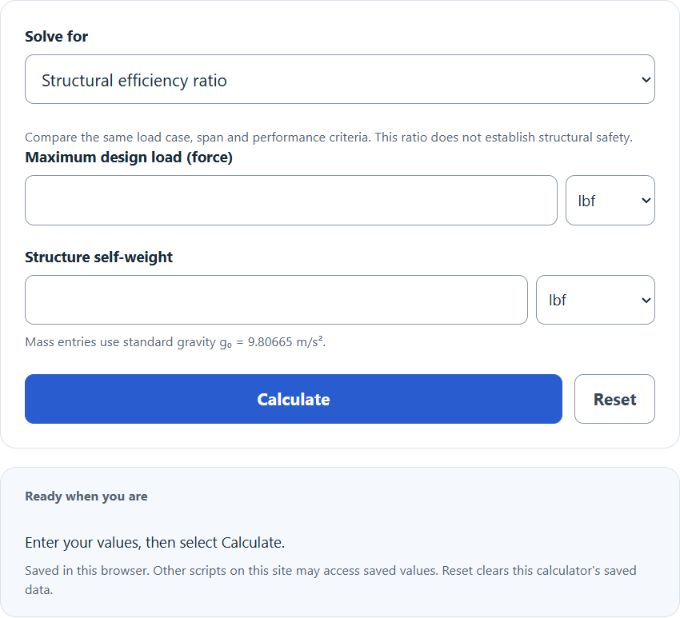
Calculate the structural efficiency ratio from maximum design load and self-weight, or solve the algebraic target for self-weight or load.
- All Construction Calculators
- All Efficiency Calculators
- Bridge Efficiency Calculator
- Live Load Calculator
- Truss Efficiency Calculator
- Bridge Efficiency Calculator
Structural Efficiency Formula
Structural efficiency measures how much maximum design load a structure can support relative to its own weight. It is a fast comparison metric for preliminary design, optimization, and evaluating alternate framing concepts when weight matters.
Where:
- Est = structural efficiency
- DL = maximum design load
- W = weight of the structure
If DL and W are entered in the same force units, the result is a dimensionless ratio. The calculator converts N, kN and lbf to a common force basis. Mass options explicitly use standard gravity g₀ = 9.80665 m/s² to obtain self-weight; lb force and lb mass are labeled separately.
Rearranged Forms
Because the calculator can solve for any missing variable, the same relationship can be rearranged as follows:
How to Calculate Structural Efficiency
- Identify the governing maximum design load for the structure or member being evaluated.
- Determine the self-weight of that same structure.
- Make sure both values use the same unit basis and the same design assumptions.
- Divide the design load by the structural weight to obtain the efficiency ratio.
Important: The ratio is only meaningful when the load case, span, support condition, and performance criteria are consistent across the options being compared.
Examples
Example 1: Finding Structural Efficiency
A structure supports a maximum design load of 500 kN and weighs 300 kN.
This means the structure carries about 1.67 units of design load for every 1 unit of structural weight.
Example 2: Finding Self-Weight at a Target Ratio
If the target efficiency is 2.4 and the required design load is 120 kN, the maximum structural weight is:
At a fixed design load of 120 kN, self-weight of 50 kN gives a ratio of 2.4. Lower self-weight gives a higher ratio only if load capacity remains unchanged; this does not establish an allowable design weight.
How to Interpret the Result
- Higher structural efficiency means more load-carrying capability per unit of self-weight.
- Lower structural efficiency means the system is heavier for the same design load.
- A high value is not automatically better if it comes with excessive deflection, vibration, instability, low redundancy, or difficult fabrication.
Structural efficiency is best used as a screening and comparison metric. It does not replace checks for strength, buckling, stiffness, fatigue, serviceability, durability, or code compliance.
What Affects Structural Efficiency?
- Material selection: materials with better strength-to-weight characteristics often improve efficiency.
- Geometry: section shape and depth strongly affect stiffness and load capacity.
- Span length: longer spans usually require more material and can reduce efficiency.
- Support conditions: boundary conditions change internal forces and member demands.
- Load path: direct, well-distributed load paths are typically more efficient.
- Connections and bracing: inefficient detailing can add weight without proportional benefit.
- Serviceability requirements: deflection and vibration limits often control lightweight structures.
Common Applications
This metric is commonly used when comparing:
- bridges and long-span trusses
- roof framing systems
- towers, masts, and lattice structures
- temporary structures and lightweight platforms
- spaceframes and composite systems
- alternate structural layouts during concept design
Common Mistakes
- Confusing mass and force: select the correct unit for each input. The calculator converts mixed force units; mass uses the stated standard-gravity assumption.
- Using the wrong load case: efficiency should be based on the governing design case, not a convenient nominal load.
- Comparing unlike systems: differences in span, supports, or performance requirements can make side-by-side comparisons misleading.
- Using total building weight instead of the target structure: only use the weight of the system being evaluated.
- Ignoring stability and stiffness: a light structure is not necessarily an adequate structure.
Structural Efficiency vs. Related Metrics
| Metric | Meaning | Primary Use |
|---|---|---|
| Structural Efficiency | Load carried relative to structural self-weight | Concept comparison and weight optimization |
| Factor of Safety | Margin between available capacity and required demand | Safety and reliability checks |
| Utilization Ratio | Portion of available capacity currently being used | Member sizing and code review |
| Strength-to-Weight | Material performance per unit weight | Material selection |
Frequently Asked Questions
Can structural efficiency be greater than 1?
Yes. A value greater than 1 means the structure supports a design load larger than its own weight, which is common for many efficient systems.
Is structural efficiency the same as factor of safety?
No. Structural efficiency compares load to self-weight, while factor of safety compares capacity to demand. They answer different design questions.
What units should I use in the calculator?
Select each quantity's actual unit. Mixed force units are converted automatically; mass entries are converted to self-weight using standard gravity.
Can this calculator solve for design load or structural weight?
Yes. If any two variables are known, the rearranged formulas can be used to calculate the third.
When is this ratio most useful?
It is most useful in early-stage design, side-by-side option studies, and any project where reducing self-weight can improve performance, transportability, or cost efficiency.