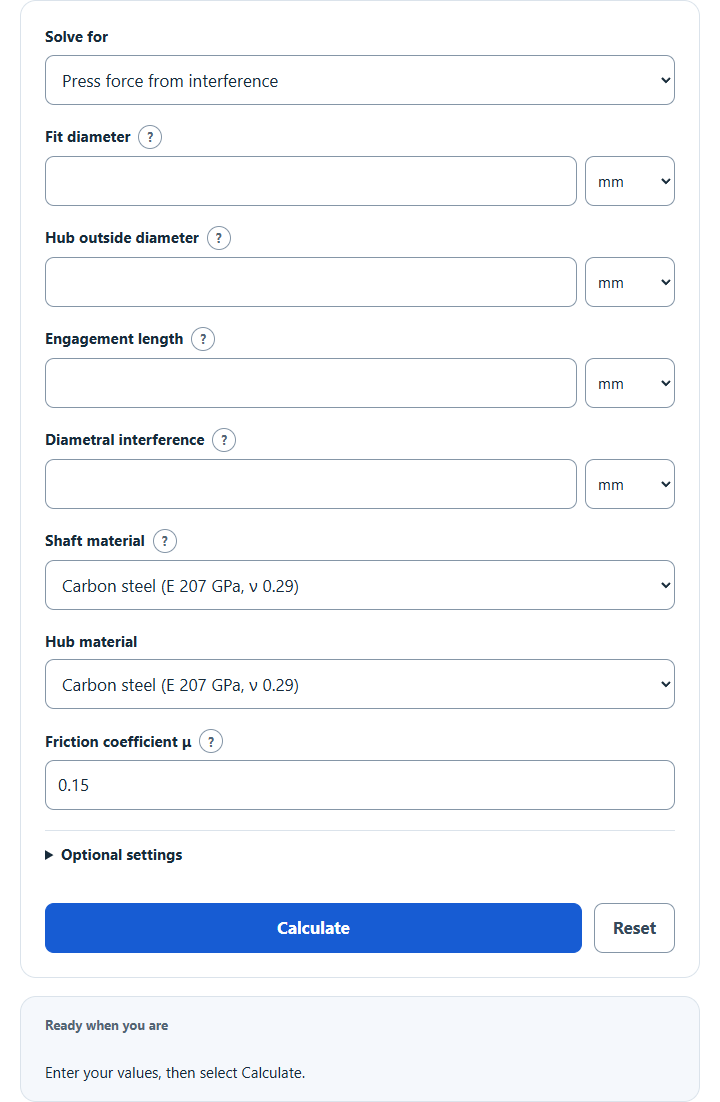
Calculate press fit force from fit diameter, hub size, length and interference using typical material presets, or find the interference for a target force.
- All Physics Calculators
- All Force Calculators
- Press Force Calculator
- Bearing Load Calculator
- Equivalent Dynamic Load Calculator
- Mass to Pressure Calculator
Press Fit Force Formula
The following equation is used to calculate the Press Fit Force.
- Where Fp is the press fit force (N)
- p is the contact surface interference pressure (N/m^2)
- The contact surface interference pressure is dependent on the size, elasticity, interference fit, and Poisson’s ratios of the housing and sleeve.
- A is the contact surface area (m^2)
- u is the coefficient of friction between the bearing and housing
To calculate a press fit force, multiply the contact interference pressure by the contact surface area, then again by the coefficient of friction.
What is a Press Fit Force?
Definition:
A press-fit force is a required force needed to press a bearing, or similar object, into a housing.
How to Calculate Press Fit Force?
Example Problem:
The following example outlines the steps and information needed to calculate the Press Fit Force.
First, determine the contact surface interference pressure. In this example, the pressure is calculated to be 500 N/m^2.
Next, determine the contact surface area. This is measured to be .125 m^2.
Next, determine the coefficient of friction. For this example, the coefficient of friction is .56.
Finally, calculate the press fit force using the formula above:
Fp = p * A * u
Fp = 500 * .125 * .56
Fp = 35 N