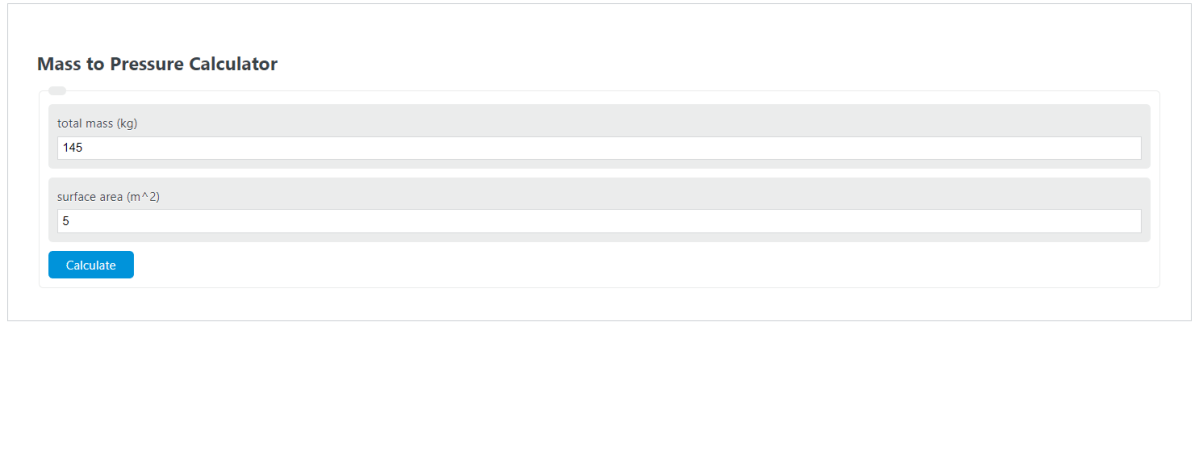
Convert mass and contact area to pressure, or solve mass or area, with unit conversions, support-count handling, local gravity, force, and per-contact load.
- All Pressure Calculators
- Density to Pressure Calculator
- Weight to Pressure Calculator
- Torque to Pressure Calculator
- All Unit Converters
Pressure From Mass Formula
The following formula is used to calculate the Pressure From Mass.
- Where Pm is the Pressure From Mass (Pa)
- TM is the total mass (kg)
- SA is the surface area (m^2)
To calculate pressure from mass, multiply the mass by the acceleration due to gravity, then divide by the area.
| Mass (kg) | Pressure (Pa) | Pressure (psi) |
|---|---|---|
| 0.1 | 0.981 | 0.000142 |
| 0.25 | 2.453 | 0.000356 |
| 0.5 | 4.905 | 0.000711 |
| 0.75 | 7.358 | 0.001067 |
| 1 | 9.810 | 0.001423 |
| 2 | 19.620 | 0.002846 |
| 3 | 29.430 | 0.004268 |
| 5 | 49.050 | 0.007114 |
| 7.5 | 73.575 | 0.010671 |
| 10 | 98.100 | 0.014228 |
| 12.5 | 122.625 | 0.017785 |
| 15 | 147.150 | 0.021342 |
| 20 | 196.200 | 0.028456 |
| 25 | 245.250 | 0.035571 |
| 30 | 294.300 | 0.042685 |
| 40 | 392.400 | 0.056913 |
| 50 | 490.500 | 0.071141 |
| 75 | 735.750 | 0.106712 |
| 100 | 981.000 | 0.142282 |
| 200 | 1962.000 | 0.284564 |
| *Assumes surface area A = 1.00 m² and g = 9.81 m/s². Formula: P = (m × g) / A. Conversion: 1 psi = 6894.76 Pa. | ||
How to Calculate Pressure From Mass?
The following two example problems outline how to calculate the Pressure From Mass.
Example Problem #1:
- First, determine the total mass (kg). In this example, the total mass (kg) is given as 52.
- Next, determine the surface area (m^2). For this problem, the surface area (m^2) is given as 50.
- Finally, calculate the Pressure From Mass using the equation above:
Pm = TM * g / SA
Inserting the values from above and solving the equation:
Pm = 52 * 9.81 / 50 = 10.202 (Pa)
Example Problem #2:
Using the same process as above, first define the variables required by the formula. In this case, these values are:
total mass (kg) = 60
surface area (m^2) = 81
Entering these values yields:
Pm = 60 * 9.81 / 81 = 7.266 (Pa)