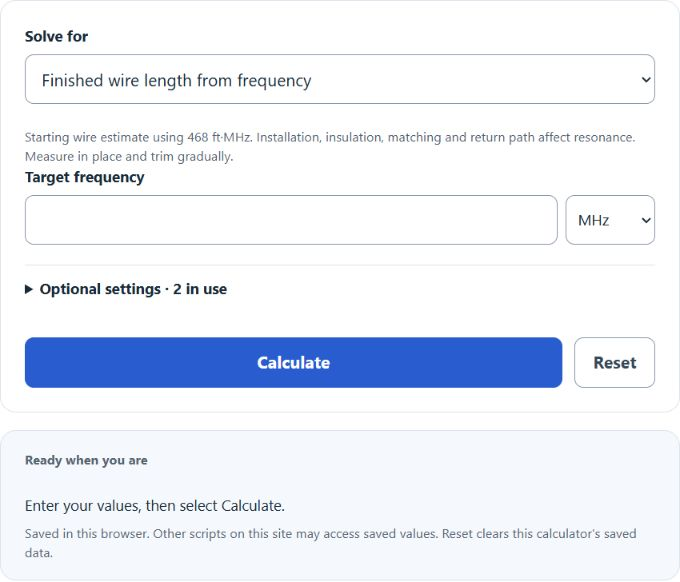
Calculate EFHW antenna wire length from frequency, or estimate frequency from finished wire length, with unit conversions, trim allowance, and harmonics.
- All Physics Calculators
- 5/8 Wave Antenna Length Calculator
- Helical Antenna Calculator
- Antenna Loop Calculator
EFHW Antenna Formula
The following empirical formula estimates a starting finished length for an End-Fed Half-Wave (EFHW) antenna. It does not guarantee resonance or a suitable impedance match.
Formula source: NASA Radio JOVE Training Module 2 (2024)
Variables:
- L is the length of the antenna (feet)
- f is the frequency (MHz)
With the default adjustment factor of 1, divide 468 by the frequency in MHz to estimate finished length in feet. A custom factor multiplies this estimate. The optional cut-and-trim allowance adds extra starting wire only; measure the installed antenna and trim gradually.
What is an EFHW Antenna?
An EFHW (End-Fed Half-Wave) Antenna is a type of radio antenna commonly used in amateur radio. It is designed to be fed at one end, hence the name, and is typically half the length of the radio wave it is intended to transmit or receive. This design allows for efficient operation and a relatively simple construction, making it popular among radio enthusiasts. The antenna can be installed in various configurations such as vertical, horizontal, sloping, or as an inverted V depending on the available space and specific needs.
How to Calculate EFHW Antenna?
The following steps outline how to calculate the length of an EFHW Antenna using the formula: L = 468 / f.
- First, determine the frequency (f) in MHz.
- Next, use the formula L = 468 / f to calculate the length of the antenna (L) in feet.
- Finally, you have estimated the finished wire length. Add any selected cut allowance, then measure and tune the installed antenna.
- After inserting the frequency value and calculating the result, check your answer with the calculator above.
Example Problem:
Use the following variables as an example problem to test your knowledge.
frequency (f) = 14 MHz