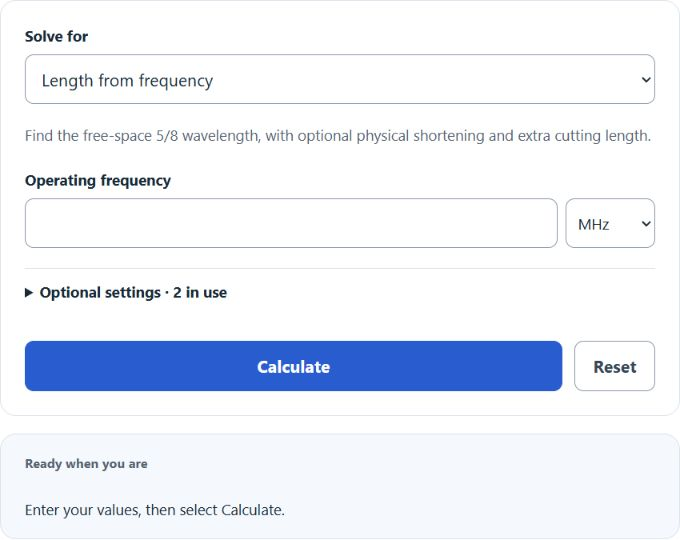
Calculate a 5/8-wave antenna length or reverse frequency with kHz-to-GHz and metric-imperial conversions, velocity factor, and trim allowance.
- All Physics Calculators
- Antenna Loop Calculator
- Half Square Antenna Calculator
- Helical Antenna Calculator
- EFHW Antenna Calculator
- Antenna Beamwidth Calculator
- Antenna Stacking Distance Calculator
5/8 Wave Antenna Length Formula
The calculator uses c = 299,792,458 m/s and the free-space 5/8 wavelength relationship. The default shortening factor is 1 and the cut-long allowance is zero. Optional settings apply a supplied construction factor and extra cutting length separately.
- L = 5/8-wave antenna length in meters
- f = frequency in MHz
- 187.37028625 = free-space constant for 5/8 wavelength when frequency is in MHz and length is in meters
If you enter frequency, the calculator finds the 5/8-wave length. If you enter length, it finds the frequency where that length is 5/8 of a wavelength. The calculator also converts between MHz, GHz, and kHz for frequency, and meters, feet, and inches for length.
Common 5/8-Wave Antenna Lengths by Frequency
These values are free-space lengths. A real antenna may need trimming or adjustment depending on conductor size, loading coils, ground plane, mounting height, and nearby objects.
| Frequency | 5/8-Wave Length | Length in Feet | Typical Band Area |
|---|---|---|---|
| 27 MHz | 6.940 m | 22.77 ft | CB radio |
| 50 MHz | 3.747 m | 12.30 ft | 6 meter band |
| 146 MHz | 1.283 m | 4.21 ft | 2 meter band |
| 440 MHz | 0.426 m | 1.40 ft | 70 cm band |
| 915 MHz | 0.205 m | 0.67 ft | ISM band |
Frequency and Length Unit Conversions
| Quantity | Conversion Used |
|---|---|
| 1 GHz | 1000 MHz |
| 1 kHz | 0.001 MHz |
| 1 ft | 0.3048 m |
| 1 in | 0.0254 m |
Examples
Example 1: Find the 5/8-wave length for 146 MHz
Use the length formula:
The result is:
So a free-space 5/8-wave antenna for 146 MHz is about 1.283 meters, or about 4.210 feet.
Example 2: Find the frequency for a 0.5 meter 5/8-wave antenna
Use the frequency formula:
The result is:
A 0.5 meter free-space 5/8-wave antenna corresponds to 374.7406 MHz.
FAQ
Is this the exact physical length I should cut?
Not always. With the default factor of 1 and no allowance, the calculated value is the free-space 5/8 wavelength. With optional settings, it is the adjusted cut-long length. A real antenna can be affected by the material, conductor diameter, insulation, end effects, matching network, loading coil, and nearby objects. In practice, you usually cut slightly long, measure SWR or resonance, then trim in small steps.
Why does the calculator use 187.37028625?
The exact vacuum speed of light gives 299.792458 × 0.625 = 187.37028625 when frequency is in MHz and length is in meters. The common 187.5 shortcut uses 300 instead of 299.792458 and is approximate. For an adjusted physical length, multiply by the supplied shortening factor; add any cut-long allowance separately.
Does a 5/8-wave vertical need a ground plane?
Usually, yes. A 5/8-wave vertical commonly needs a ground plane, radials, vehicle body, or other counterpoise system to work properly. It also typically needs matching because its feedpoint impedance is not usually a direct 50-ohm match.