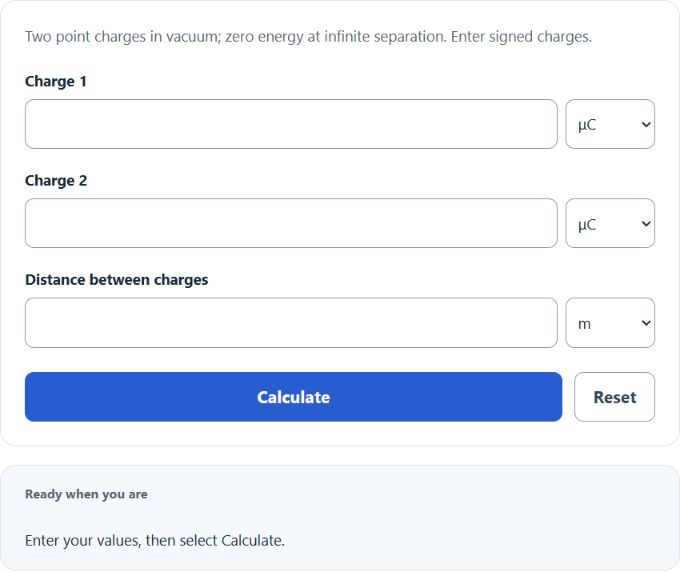
This page shows how to calculate electrostatic potential energy between two point charges. Enter the two charges and the distance between them to determine the electric potential energy stored in the system.
Electrostatic Potential Energy Formula
To calculate electrostatic potential energy between two point charges, multiply Coulomb’s constant by the product of the two charges and divide by the distance between them.
Variables:
- U is the electrostatic potential energy in joules
- k is Coulomb’s constant, approximately 8.99 × 10⁹ N·m²/C²
- q₁ is the first charge in coulombs
- q₂ is the second charge in coulombs
- r is the distance between the charges in meters
For nonzero charges, like signs give positive potential energy and opposite signs give negative potential energy, taking zero energy at infinite separation. If either charge is zero, the energy is zero. The magnitude increases as nonzero charges get larger or move closer together.
What is Electrostatic Potential Energy?
Electrostatic potential energy is the stored energy associated with the arrangement of electric charges. It represents the work required to bring one charge into position near another charge. In electrostatics, this energy plays a central role in understanding attraction, repulsion, and the stability of charged systems.
How to Calculate Electrostatic Potential Energy?
The following steps outline how to calculate electrostatic potential energy.
- First, determine the two point charges in coulombs.
- Next, determine the distance between the charges in meters.
- Then, multiply Coulomb’s constant by the product of the two charges.
- Finally, divide by the separation distance to find the electrostatic potential energy.
Example Problem:
Calculate the electrostatic potential energy between a 2 μC charge and a -3 μC charge separated by 0.5 m.
q₁ = 2 × 10⁻⁶ C
q₂ = -3 × 10⁻⁶ C
r = 0.5 m
U = (8.99 × 109) × (2 × 10-6) × (-3 × 10⁻⁶) ÷ 0.5
U ≈ -0.1079 J
Electrostatic Potential Energy Table
The table below shows example electrostatic potential energy values for several simple charge configurations.
| Charge 1 | Charge 2 | Distance | Potential Energy |
|---|---|---|---|
| 1 μC | 1 μC | 1 m | 0.0090 J |
| 2 μC | -3 μC | 0.5 m | -0.1079 J |
| 5 μC | 5 μC | 0.2 m | 1.1234 J |
| 10 nC | -20 nC | 0.1 m | -1.7975 × 10^-5 J |
| 0.5 μC | -0.5 μC | 2 m | -0.0011 J |
These examples assume point charges in a vacuum or air, where Coulomb’s constant is approximately the same. In real materials, the surrounding medium can change the effective interaction and therefore the actual potential energy.