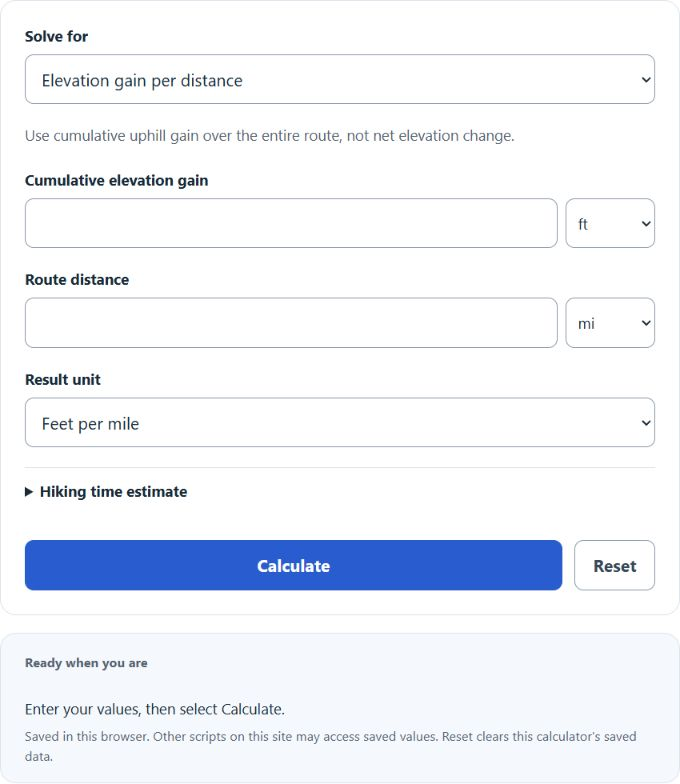
Calculate elevation gain per mile from total gain and distance, or find total gain or distance from a rate, including treadmill incline and hiking time.
Calculator Functions
| Function | What it does | What it requires |
|---|---|---|
| Elevation gain per distance | Finds the average climb per mile or per kilometer of a route | Requires the cumulative elevation gain (ft or m) and the route distance (mi or km) |
| Total elevation gain | Finds the total climb from a gain rate, or from a treadmill incline, and a distance | Requires the elevation gain rate (ft/mi, m/km, ft/km, m/mi or % incline) and the route distance (mi or km) |
| Total distance | Finds the distance over which a gain rate adds up to a total climb | Requires the cumulative elevation gain (ft or m) and the elevation gain rate, both above zero |
Each function has a result unit, and each result also shows the total gain in feet, the route distance in miles, the climb density as a percentage and a climbing band. The optional Hiking time estimate takes a flat-ground speed, a total descent and break minutes.
Elevation Gain Per Mile Formulas
| R | Elevation gain per distance (ft/mi or m/km) |
| G | Cumulative elevation gain (ft or m) |
| D | Route distance (mi or km) |
G is the sum of every uphill section along the route. It is not the net change between the start and the finish, so a loop that returns to its starting height still has a gain.
Elevation gain per distance
The main formula as written. 500 ft of gain over 10 miles is 50 ft/mi, and 2,500 ft over 5 miles is 500 ft/mi, or 94.697 m/km. One ft/mi equals 0.3048 ÷ 1.609344 = 0.1894 m/km [1]. Climb density is the same ratio as a percentage: gain divided by distance in the same unit, so 500 ft/mi is 500 ÷ 5,280 = 9.47%.
| Feet per mile | Meters per km | Climb density | Climbing band |
|---|---|---|---|
| 100 ft/mi | 18.9 m/km | 1.89% | Easy / flat |
| 200 ft/mi | 37.9 m/km | 3.79% | Easy–moderate |
| 250 ft/mi | 47.3 m/km | 4.73% | Easy–moderate |
| 400 ft/mi | 75.8 m/km | 7.58% | Moderate |
| 500 ft/mi | 94.7 m/km | 9.47% | Moderate |
| 600 ft/mi | 113.6 m/km | 11.36% | Strenuous |
| 800 ft/mi | 151.5 m/km | 15.15% | Very strenuous |
| 1,000 ft/mi | 189.4 m/km | 18.94% | Very strenuous |
The climbing bands change at 200, 400, 600 and 800 ft/mi. They are a rough guide built into the calculator and are not an official trail grade.
Total elevation gain
400 ft/mi held for 8 miles adds up to 3,200 ft. With the rate set to % incline the same formula covers a treadmill: gain = distance × incline ÷ 100, so 3 miles at a 5% incline is 0.15 miles of climb, or 792 ft.
Total distance
Climbing 3,000 ft at 600 ft/mi takes 5 miles. Both entries must be above zero, because a zero rate never reaches the gain.
Hiking time estimate
d ÷ 4,000 + B ÷ 60
T is the time in hours, D the distance, v the flat-ground speed, G the gain in feet, d the total descent in feet and B the break time in minutes. Naismith’s rule allows an hour for every three miles plus an hour for every 2,000 ft of ascent [2]. The calculator keeps the 2,000 ft per hour and replaces three miles an hour with the speed entered. Naismith’s rule has no term for descent [2], so the 4,000 ft per hour allowance is a rule of thumb added here. A 10-mile route with 2,500 ft up and 2,500 ft down at 3 mi/h with 30 minutes of breaks comes to 3.3333 + 1.25 + 0.625 + 0.5 = 5.7083 hours.
Limits of This Estimate
- Gain per mile is an average over the whole route. A short steep climb and a long steady one can give the same figure, so the elevation profile still matters.
- The time estimate is a planning rule of thumb. Measured against recorded walks, Naismith’s rule holds up for whole routes but misjudges steep or difficult sections [2], and terrain, load, weather and fitness all move the result.
- The treadmill formula treats belt distance as horizontal distance. At a 15% incline that overstates the climb by about 1%.
- These estimates are based on the best available data and estimations.
Sources
- NIST, Guide for the Use of the International System of Units (SP 811), Appendix B.8: the foot as 0.3048 m and the mile as 1,609.344 m, both exact
- Wood, Mackaness, Simpson and Armstrong (2023), Improved prediction of hiking speeds using a data driven approach, arXiv:2303.16065: Naismith’s rule of an hour per three miles plus an hour per 2,000 ft of ascent, its lack of a descent term, and its accuracy against recorded walks