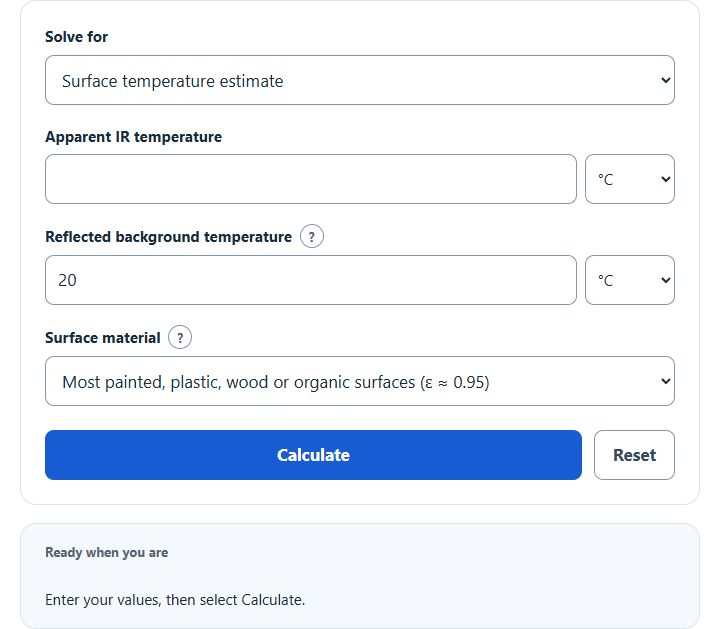
Correct an infrared temperature reading for emissivity to estimate true surface temperature, using typical material values, or solve for emissivity.
Emissivity Correction Formula
The following broadband gray-body approximation estimates surface temperature from an apparent reading referenced to emissivity 1, surface emissivity and reflected background temperature. It assumes an opaque surface and no atmospheric loss. All powers use absolute temperature in kelvins; real band-limited instruments require their own calibration.
Variables:
- TTK is the true temperature in kelvins (K)
- MTK is the apparent (measured/uncorrected) temperature in kelvins (K)
- ε is surface emissivity (dimensionless, greater than 0 and at most 1 for temperature correction); Trefl,K is reflected background temperature in kelvins
Convert apparent and reflected temperatures to kelvins, subtract (1 − ε) times the fourth power of reflected temperature from the fourth power of apparent temperature, divide by ε, then take the fourth root. Convert back to °C or °F if desired. Reflected background is included; spectral response, transmission and atmospheric absorption are not. Do not apply this directly to an already compensated instrument reading.
What is Emissivity Correction?
Emissivity correction is the process of adjusting an infrared temperature reading to account for the emissivity of the surface being measured. Emissivity is a material property defined as the ratio of thermal radiation emitted by a real surface to that emitted by an ideal blackbody at the same temperature. A blackbody has an emissivity of 1, meaning it emits the maximum thermal radiation possible at that temperature. Most real materials have emissivities less than 1, so a reading taken without proper emissivity compensation can be biased.
How to Calculate True Temperature with Emissivity Correction?
The following steps outline how to calculate the true temperature using the simplified emissivity correction relationship above.
- Determine the apparent temperature reading (MT) referenced to emissivity 1 and estimate the reflected background temperature; enter their units.
- Determine the emissivity (ε) of the material (a value typically between 0 and 1).
- Convert MT to Kelvin: MTK = MT°C + 273.15 (or convert °F to °C first).
- Use TTK = [(MTK4 − (1 − ε) Trefl,K4) / ε]1/4 for the estimated surface temperature in kelvins.
- Convert TTK back to °C or °F if needed.
Example Problem :
Use the following variables as an example problem to test your knowledge.
apparent temperature (MT) = 150°C
emissivity (ε) = 0.95
With reflected background at 20°C, the estimated surface temperature is approximately 154.2216°C using the reflected-background formula above.