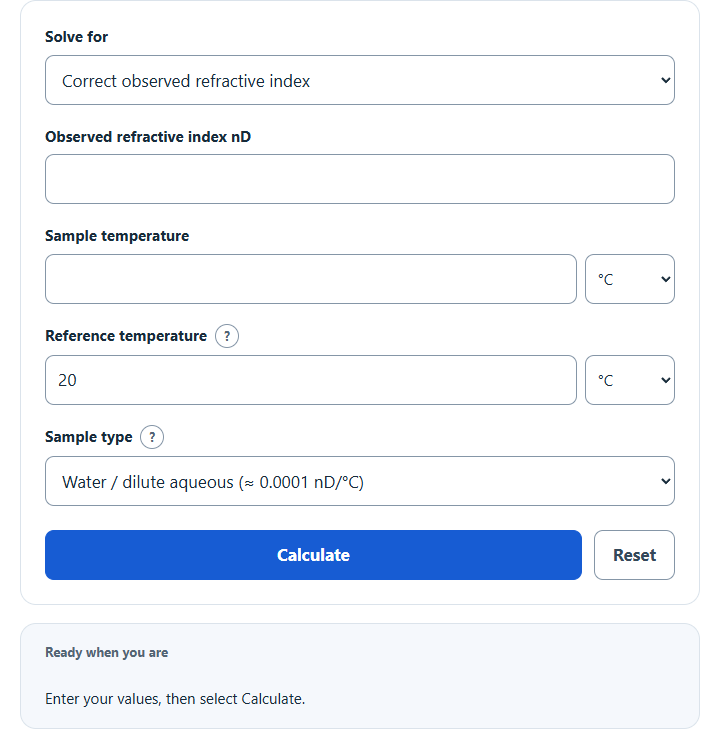
Correct a refractometer reading to 20 °C using a typical temperature coefficient for water or essential oils, or enter your sample’s own coefficient.
- All Food and Cooking Calculators
- Refractive Index Correction Calculator
- Effective Refractive Index Calculator
- Lens Index Calculator
Refractometer Temperature Correction Formula
The following formula is used to calculate the corrected refractive index:
Variables:
- nDc is the corrected refractive index
- nDo is the observed refractive index
- CF is the sample-specific correction coefficient in refractive-index change per degree Celsius, defined here as −dnD/dT; it is not a Brix correction factor
- Tsample is the sample temperature in degrees Celsius
- Treference is the reference temperature in degrees Celsius (usually 20°C)
To calculate the corrected refractive index, add CF × (sample temperature − reference temperature) to the observed refractive index, using a temperature difference in degrees Celsius. CF is the negative of the physical slope dnD/dT, so its sign matters. The METTLER TOLEDO RE40 operating instructions, section 9.2, require a sample-specific slope and treat Brix compensation separately. A constant coefficient is a local linear approximation; no universal sucrose coefficient is assumed.
What is Refractometer Temperature Correction?
Refractometer temperature correction is the process of adjusting the refractive index measurement of a sample to account for temperature differences from a standard reference temperature. Since the refractive index of a liquid changes with temperature, it is important to correct for these variations to ensure accurate readings, especially when comparing to standard values or conducting precise quality control.
How to Calculate Corrected Refractive Index?
The following steps outline how to calculate the corrected refractive index:
- First, determine the observed refractive index (nDo) of the sample.
- Next, measure the sample temperature (Tsample) in degrees Celsius.
- Determine the reference temperature (Treference) in degrees Celsius, which is typically 20°C.
- Use a coefficient for the same sample composition, wavelength and local temperature range. Do not apply this correction again to an already temperature-compensated reading.
- Apply the formula to calculate the corrected refractive index (nDc).
- After inserting the variables and calculating the result, check your answer with the calculator above.
Example Problem:
For an illustrative arithmetic example only, assume CF = 0.00045 nD/°C for the following readings. This is an entered assumption, not an identified sucrose coefficient or an instrument calibration. The corrected nD is 1.3330 + 0.00045 × (25 − 20) = 1.33525.
Observed refractive index (nDo) = 1.3330
Sample temperature (Tsample) = 25°C
Reference temperature (Treference) = 20°C