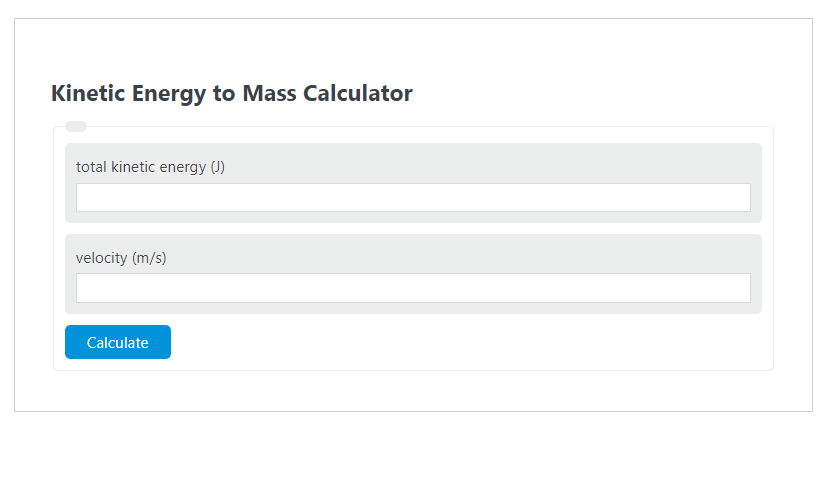
Calculate kinetic energy, mass, or velocity from the other two values with unit conversions for J, kJ, MJ, ft⋅lb, m/s, km/h, and mph.
- All Physics Calculators
- Mechanics and Physics Unit Converters
- All Mass Calculators
- Density to Molar Mass Calculator
- Energy to Mass Calculator
Kinetic Energy to Mass Formula
The calculator uses the standard kinetic energy equation. Enter any two values, and it rearranges the formula to solve for the missing value.
KE = \frac{1}{2}mv^2m = \frac{2KE}{v^2}v = \sqrt{\frac{2KE}{m}}- KE = kinetic energy, measured in joules when using SI base units
- m = mass, measured in kilograms when using SI base units
- v = velocity, measured in meters per second when using SI base units
The calculator first converts your entries into base SI units: joules, kilograms, and meters per second. It then applies the correct rearranged formula and converts the answer back into your selected unit.
- To calculate kinetic energy: enter mass and velocity.
- To calculate mass: enter kinetic energy and velocity.
- To calculate velocity: enter kinetic energy and mass.
Unit Conversions Used for Kinetic Energy, Mass, and Velocity
These are the main conversion factors used before applying the kinetic energy formula.
| Quantity | Unit | Conversion to base unit | Base unit |
|---|---|---|---|
| Energy | 1 kJ | 1,000 J | Joule |
| Energy | 1 MJ | 1,000,000 J | Joule |
| Energy | 1 ft⋅lb | 1.35582 J | Joule |
| Mass | 1 g | 0.001 kg | Kilogram |
| Mass | 1 lb | 0.453592 kg | Kilogram |
| Velocity | 1 km/h | 0.277778 m/s | m/s |
| Velocity | 1 mph | 0.44704 m/s | m/s |
Example Kinetic Energy Values
| Object | Mass | Velocity | Kinetic energy |
|---|---|---|---|
| 1 kg object | 1 kg | 10 m/s | 50 J |
| Baseball-sized object | 0.145 kg | 40 m/s | 116 J |
| Small car | 1,000 kg | 20 m/s | 200,000 J |
Example Calculations
Example 1: Calculate mass from kinetic energy and velocity
You have a kinetic energy of 500 J and a velocity of 10 m/s.
m = \frac{2KE}{v^2}m = \frac{2(500)}{10^2} = \frac{1000}{100} = 10\text{ kg}The mass is 10 kg.
Example 2: Calculate kinetic energy from mass and velocity
You have a mass of 20 kg and a velocity of 5 m/s.
KE = \frac{1}{2}mv^2KE = \frac{1}{2}(20)(5^2) = 10(25) = 250\text{ J}The kinetic energy is 250 J.
FAQ
How do you find mass from kinetic energy?
To find mass from kinetic energy, use m = 2KE / v². The kinetic energy must be in joules and the velocity must be in meters per second if you want the mass in kilograms.
Why is velocity squared in the kinetic energy formula?
Kinetic energy depends on the square of velocity because speed has a stronger effect on motion energy than mass does. If velocity doubles, kinetic energy becomes four times larger, assuming mass stays the same.
Can velocity be zero when calculating mass?
No. The mass formula divides by velocity squared. If velocity is zero, the denominator is zero, so the calculation is not valid. An object at zero velocity has zero kinetic energy in this formula.