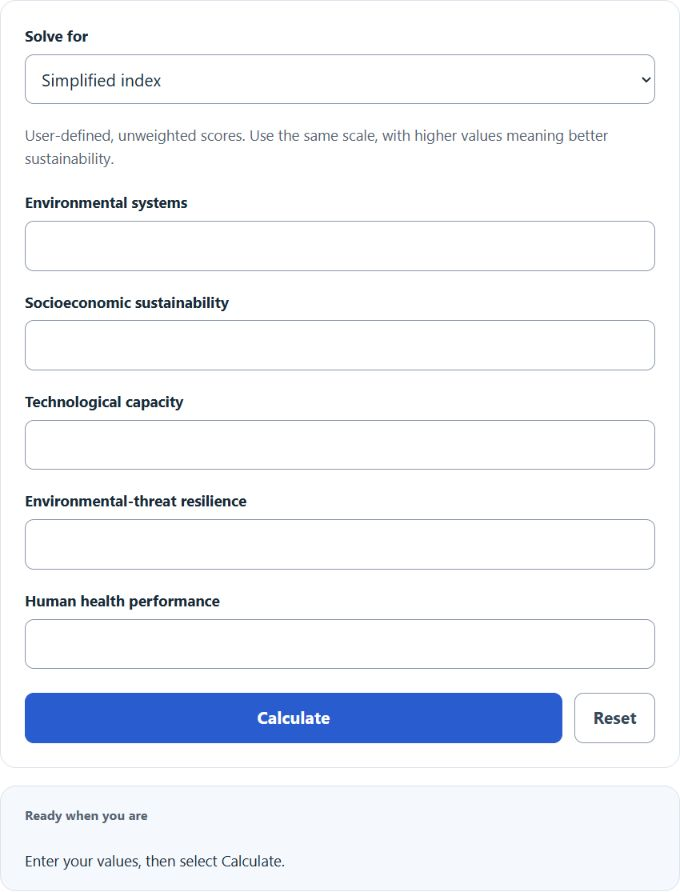
Calculate this page’s simplified, user-defined five-score average or solve for a missing sub-score. Select the quantity to solve, then enter the five required values on a common scale with higher scores meaning better sustainability.
- All Miscellaneous Calculators
- HDI Calculator
- Human Capital Index Calculator
- Population Density Calculator
- Population Growth Calculator
- GDP Growth Rate Calculator
- Biodiversity Index Calculator
Environmental Sustainability Index Formula
The following formula is used in this calculator to compute a simple, unweighted Environmental Sustainability Index (ESI) from five user-provided sub-scores.
Variables:
- ESI is the Environmental Sustainability Index
- E is the Environmental Systems score
- S is the Socioeconomic Sustainability score
- T is the Technological Capacity score
- V is the environmental-threat resilience score (higher means less vulnerability)
- H is the human health performance score (higher means less harmful impact)
For this simplified approach, add the five consistently scaled sub-scores and divide by 5. Each receives 20% weight. Reverse adverse measures before entry so higher means better for every score; the calculator does not normalize raw indicators or reproduce the official ESI or EPI.
What is an Environmental Sustainability Index?
The term “Environmental Sustainability Index (ESI)” has been used to describe composite indicators intended to summarize environmental sustainability or environmental stewardship using multiple underlying measures. A well-known example was the Environmental Sustainability Index published in the early 2000s by the Yale Center for Environmental Law & Policy in collaboration with CIESIN (Columbia University) and other partners; that project combined many indicators using a defined normalization and aggregation methodology and was later succeeded by the Environmental Performance Index (EPI). This page’s calculator does not reproduce that official methodology; it computes a simplified ESI as the unweighted average of five sub-scores that you define and score consistently (for example, on a 0–100 scale where higher scores mean better sustainability).
How to Calculate Environmental Sustainability Index?
The following steps outline how to calculate the Environmental Sustainability Index (ESI) using the given formula:
- First, determine the Environmental Systems sub-score (E) on your chosen scale.
- Next, determine the Socioeconomic Sustainability sub-score (S) on the same scale.
- Next, determine the Technological Capacity sub-score (T) on the same scale.
- Next, determine the environmental-threat resilience sub-score (V) on the same scale, oriented so higher means less vulnerability.
- Next, determine the human health performance sub-score (H) on the same scale, oriented so higher means less harmful impact.
- Finally, calculate the Environmental Sustainability Index (ESI) using the formula: ESI = (E + S + T + V + H) / 5.
- After inserting the values for each variable and calculating the result, check your answer with the calculator above.
Example Problem:
Use the following variables as an example problem to test your knowledge:
Environmental Systems score (E) = 80
Socioeconomic Sustainability score (S) = 70
Technological Capacity score (T) = 90
Environmental-threat resilience score (V) = 75
Human health performance score (H) = 85
ESI = (80 + 70 + 90 + 75 + 85) / 5 = 400 / 5 = 80